

Using the right flux for aluminum casting sharply reduces dross, raises metal recovery rates, and improves surface finish; correct selection, thorough drying, careful application, and pairing with degassing and ceramic filtration produce the best results while strict safety procedures prevent hazardous reactions.
Why flux matters in aluminum casting?
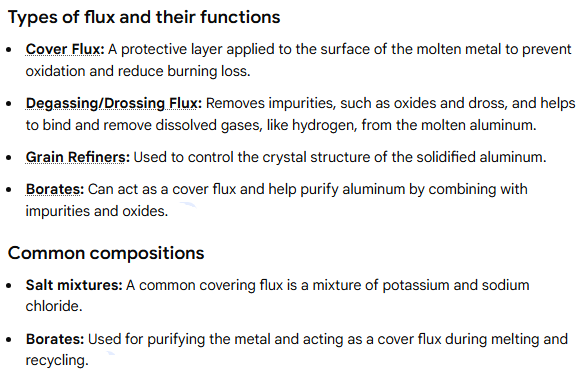
Flux products for aluminum casting perform three main roles: they gather oxides and inclusions at the melt surface for easier removal, they protect the molten metal surface during charging and pouring, and they can improve flow behavior in some operations. Fluxes do not replace proper melt-gas removal by purging with inert gas; instead, they function together with degassing and filtration to produce low-porosity, high-integrity castings.

Principal categories of aluminum flux and what each does
Industry practice groups aluminum fluxes by their primary function. Below are common categories and short notes on when to use each.
Drossing flux
Used to collect and clump oxide and non-metallic inclusions at the surface of the melt so operators can skim them off. This category is common in crucible, reverberatory, and holding furnace operations.
Cover (covering) flux
Forms a protective layer on top of the melt, reducing re-oxidation during charging and handling. Useful during extended holding periods or when adding cold feedstock that would otherwise generate oxide.
Cleaning and degassing flux
Formulated to help capture dissolved gases and entrained oxides. These are often used in conjunction with inert-gas purging. Note that in many precision foundry situations, gas purging (argon or nitrogen) is the primary degassing step.
Grain-modifying and silicon-modifying fluxes
Specific salts and chemical additives that influence grain structure or silicon morphology in certain alloys. These are niche and require strict process control.
Table: flux categories, typical composition, core function, recommended use
| Flux category | Typical major ingredients | Core function | Typical use case |
|---|---|---|---|
| Drossing flux | Halide salts (KCl, NaCl), fluorides in some blends | Agglomerates dross and enables skimming | Scrap melting, secondary aluminum furnaces. |
| Cover flux | Chloride/fluoride-based granules | Surface protection, reduce re-oxidation | Holding ladles, extended melt storage. |
| Degassing flux | Salt blends plus active reagents | Aid in removing dissolved gases and inclusions | Paired with argon purging or injection systems. |
| Grain modifier | Alkali salts, modifying agents | Alter microstructure | Alloy-specific treatments. |
How flux works in molten aluminum
Flux components are typically halide salts that either melt near the casting temperature or react to form low-density phases that float to the surface. When introduced into the melt, flux granules wet oxide fragments, combine with contaminants, and promote agglomeration. The agglomerated dross floats or settles so operators can remove it. Many modern formulations aim to minimize noxious fumes while keeping removal efficiency high.
Important technical note: flux particles containing moisture or volatile binders can cause rapid vaporization when added to molten metal, producing explosive splattering. Thorough drying and preheating of flux and baskets prevents violent reactions.
Table: safe handling checklist for aluminum flux
| Item | Requirement |
|---|---|
| Moisture control | Oven-dry flux before use; store sealed. |
| PPE | Heat-resistant gloves, face shield, P100 respirator or supplied-air if fumes present. |
| Ventilation | Local exhaust positioned near refining area. |
| Addition method | Use ladle, preheated basket, or controlled injection. Do not drop cold flux into open melt. |
| Emergency | Water contact with molten aluminum must be avoided; have fire plan and shielding. |
Selecting the right flux: five decision factors
-
Alloy type: some flux chemistries suit certain aluminum alloys; check supplier guidance.
-
Process step targeted: choose drossing flux for bulk impurity control, covering flux for protection during holds, and degassing flux for paired degassing.
-
Environmental and fumes profile: low-fume or low-fluoride blends can reduce operator exposure and emissions. Recent product development prioritizes this trait.
-
Application method: manual skimming, flux-dosing unit, or injection requires flux in different physical forms (granule, powder, paste).
-
Regulatory and workplace safety: local rules may restrict certain fluoride contents; always confirm with supplier SDS.
Table: common commercial flux brands and comparison
| Brand / supplier | Typical range | Notable strengths | Link / source |
|---|---|---|---|
| Foseco (COVERAL range) | Covering, drossing, cleaning fluxes | Broad technical support, global distribution | Foseco product pages. |
| ADtech (industrial fluxes) | Flux compositions for secondary aluminum | Product pages describe common salt blends; integrated with filtration products | ADtech site. |
| Independent foundry suppliers | Variety | Often low-cost, tailored blends for scrap casting | Industry listings and supplier pages. |
| Specialist low-fume ranges | Low fluorides, cleaner decomposition | Reduced emissions, higher cost | Newer suppliers and product announcements. |
Note: product selection should rely on supplier technical data and SDS review to confirm composition and recommended use.
Application techniques: practical steps that matter
Pre-dry and preheat
Always oven-dry flux in a controlled manner before use. Preheating prevents trapped water from flashing to steam and causing violent metal ejection. Preheated baskets or ladles reduce shock and fuming.
Manual drossing and skimming
After flux addition, allow time for agglomeration and surface stabilization. Use long-handled skimming tools to remove the dross layer. Keep operators clear and use shielding.
Flux dosing units and injection methods
Automatic flux dosing or injection can reduce operator exposure and improve repeatability. When using injection, match particle size and flux formula to injection hardware to avoid nozzle clogging.
Pairing flux with degassing and filtration
Best results occur when fluxing is combined with inert-gas purging and ceramic foam filters. Gas purging removes dissolved hydrogen while fluxing cleans surface-borne oxides and inclusions. Ceramic filters trap non-metallic particles during pouring.
Table: typical defects, likely root cause, corrective action
| Casting defect | Likely root cause | Practical corrective action |
|---|---|---|
| Surface dross and scum | Inadequate fluxing or delayed skimming | Add appropriate drossing flux; allow dwell; improve skimming technique. |
| Porosity under skin | Entrapped gas; poor degassing; flux contamination | Increase inert gas purging; check flux purity; avoid flux with trapped moisture. |
| Excessive fumes or smoke | High-fluoride flux or wet flux | Switch to low-fume product; ensure flux is dry. |
| Inclusion-related shrinkage | Inadequate filtration or flux not effective | Add ceramic filter; review flux composition and application. |
Safety and environment — hazards, controls, regulation
Molten aluminum plus water or moisture in flux can create violent splattering and steam explosions; operators must assume any flux product may emit hazardous fumes when heated. Engineering controls include preheating flux, local exhaust ventilation, fume capture, and maintaining dry storage. PPE must include face protection, heat-resistant clothing, and respirators when fume levels are uncertain.
Environmental and occupational exposure pressures are driving development of low-fume flux blends that reduce fluorides and hard-to-capture species. Check local emissions rules and the supplier SDS before committing to large-scale use.
Scientific advances and alternatives
Recent research seeks flux formulas that improve wetting of alumina, lower contact angle on oxides, and boost dross flotation while reducing harmful emissions. Designing flux chemistry with surface-active components can enhance oxide capture without raising fluoride load. Meanwhile, hydrodynamic approaches, like improved inert-gas injection and optimized ladle design, are alternate routes to better melt quality.
Case study: Iranian customer using ADtech ceramic filter plates with flux optimization
Background
A secondary aluminum recycler in Iran operated with scrap-heavy feedstock and frequent surface dross, leading to material loss and finish defects. The plant had basic fluxing practice but lacked ceramic filtration and consistent flux drying. ADtech provided ceramic foam filtration plates tailored to the ladle pouring setup and recommended an integrated approach: pre-drying of flux, controlled flux dosing, pairing with a fine ceramic filter at the runner gate, and operator training.
Intervention steps
-
ADtech ceramic filter plates were installed in the gating system to trap non-metallic inclusions during pouring.
-
Flux was switched to a grain size better matched to injection equipment, then oven-dried prior to use.
-
Operators were trained in flux dosing, dwell time, and skimming technique, plus basic degassing practice using rotary lance purging.
Outcomes and practical observations
The customer reported visibly cleaner pours, reduced surface skim volume, and fewer finishing reworks on cast parts. Ceramic filters captured suspended inclusions that fluxing alone did not remove. Operator confidence improved when they followed the new protocol for flux drying and dosing. The result highlights that filtration plus correctly applied flux produces better quality than fluxing alone.
Practical checklist for foundry operators who want consistent flux performance
-
Read supplier SDS before first use.
-
Store flux in sealed containers in a dry area.
-
Oven-dry flux before use; document batch drying time and temperature.
-
Preheat skimming baskets and ladles.
-
Pair fluxing with inert-gas purging and ceramic filtration for best results.
-
Monitor fumes and install local exhaust near refining area.
Frequently asked questions
-
What is flux for aluminum casting and why is it used?
Flux is a formulated mixture of salts and additives introduced to molten aluminum to combine with oxides and impurities, which then agglomerate for removal. Flux reduces waste and improves yield when used correctly. -
Will flux remove dissolved hydrogen to prevent porosity?
Flux helps gather surface oxides and suspended inclusions; removing dissolved hydrogen typically requires inert-gas purging. Use both techniques for best results. -
How should flux be stored and prepared?
Keep flux dry in sealed containers, oven-dry before use, and preheat handling tools. Moisture in flux can cause dangerous splattering. -
Can I use table salt or household chemicals as flux?
Commercial flux blends are engineered for specific melting behavior and safety. Household salts lack the complete chemistry needed and may increase defects or emissions. Use foundry-grade products. -
Are there low-fume flux options?
Yes. Suppliers now offer low-fluoride, low-fume formulas that cut emissions and operator exposure. Verify via SDS and supplier testing. -
How long should I wait after adding flux before skimming?
Allow time for flux to wet and agglomerate oxides; typical wait depends on melt temperature and flux type. Follow supplier recommendations and monitor the surface. -
Can fluxing replace filtration?
No. Fluxing and filtration perform different removal tasks. Ceramic filters trap inclusions during pouring; fluxing treats the melt surface and helps dross management. Use both for highest quality. -
Is flux safe for use in small shops or hobby casting?
Flux can be used safely with proper drying, PPE, ventilation, and process control. Never add wet flux to molten metal; follow basic foundry safety rules. -
How do I pick a flux for scrap-heavy melting?
Choose drossing fluxes with strong flotation action and pair with robust skimming. Consider low-fume options if emissions are a concern. Test small batches before full implementation. -
What are signs that flux caused problems in my casting?
Watch for sub-surface porosity near the skin, unusual fumes, or increased inclusions. Re-check flux dryness, composition, and dosing method if these appear.
Final operational checklist quick reference for day-to-day use
-
Read the supplier SDS every time you change flux type.
-
Dry flux before every use.
-
Use filters during pours.
-
Combine fluxing with inert-gas degassing when porosity is a concern.
-
Track scrap mix and flux performance; keep simple logs that link flux batch to pour outcomes.