

A die casting melt filter box liner is a refractory insert engineered with non-wetting surface chemistry and high thermal insulation properties, installed inside the filter box housing to protect the outer structural shell from direct molten metal contact while preventing aluminum from adhering to internal surfaces and minimizing heat loss during the filtration process. The non-wetting characteristic matters more than most buyers initially realize, because a liner that allows metal adhesion gradually builds up deposits that distort flow geometry, while poor thermal insulation causes premature metal freezing at the filter interface, a problem that shuts down production lines faster than almost any other filtration-related issue we’ve encountered. We have worked directly with die casting operations troubleshooting exactly this combination of problems, and the pattern is consistent: facilities running liners without proper non-wetting treatment and adequate insulation properties experience shorter filter box service life, more frequent cleaning downtime, and higher rejection rates from cold shut defects near the filtration point.
If your project requires the use of Die Casting Melt Filter Box Liner for Inline Filtration, you can contact us for a free quote.
What a Melt Filter Box Liner Does in Die Casting
The filter box liner sits between the molten aluminum flow and the outer structural shell of the filter box housing, acting as a sacrificial and protective barrier that takes the direct thermal and chemical punishment so the surrounding steel structure doesn’t have to. In die casting specifically, where cycle times run fast and temperature control tolerances are tight, the liner has to accomplish several jobs simultaneously that don’t always come easily in a single material.
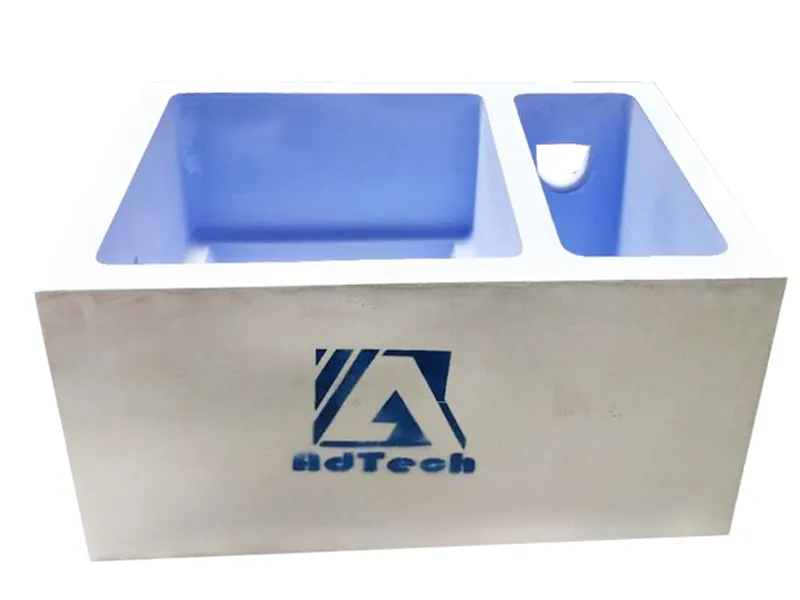
First, it protects the structural housing from erosion and chemical attack that would otherwise degrade the steel shell over repeated exposure to molten aluminum. Second, it maintains its own dimensional integrity through repeated thermal cycling, since die casting operations frequently start and stop production, subjecting the liner to heating and cooling cycles far more often than a continuous casting line would experience. Third, and this is where the non-wetting and insulation properties become critical, it needs to keep the metal flowing smoothly through the filtration zone without sticking to surfaces or losing so much heat that the metal begins solidifying prematurely before it exits the filter box toward the shot sleeve or gooseneck.
Die casting presents a distinct challenge compared to other casting methods because the metal often travels shorter distances at higher velocities and needs to arrive at the injection point at a very specific temperature window. A filter box liner that pulls too much heat from the metal, or that develops surface buildup from wetting behavior that disrupts flow, directly threatens the process window die casters depend on for consistent shot quality.
| Liner Function | Practical Importance in Die Casting |
|---|---|
| Structural shell protection | Prevents costly housing replacement, extends equipment life |
| Non-wetting surface behavior | Prevents metal buildup that distorts flow geometry |
| Thermal insulation | Maintains metal temperature through the filtration zone |
| Dimensional stability under cycling | Withstands frequent start/stop production patterns |
| Chemical resistance to aluminum alloys | Prevents accelerated erosion from alloy-specific reactivity |
Why Non-Wetting Behavior Matters So Much in This Application
Wetting behavior describes how readily a liquid spreads across and adheres to a solid surface. When molten aluminum contacts a liner material that promotes wetting, the metal tends to cling to the surface rather than flowing past it cleanly, and over repeated production cycles, this adhesion builds into a progressively thicker deposit layer.
This buildup creates several compounding problems. The deposit narrows the effective flow channel, gradually restricting throughput and forcing operators to compensate with adjusted pressure or timing settings that weren’t part of the original process specification. The deposit also changes the internal geometry unevenly, since buildup rarely occurs perfectly symmetrically, which introduces the kind of flow distribution problems we discussed regarding caster tips and casting nozzles in continuous casting, except here the consequence shows up as inconsistent shot quality or intermittent cold shut defects in die castings.
Non-wetting materials work by presenting a surface chemistry that molten aluminum doesn’t readily bond with, allowing the metal to flow across the surface and depart cleanly rather than leaving residue behind. Boron nitride based coatings and composites have become the standard reference point for non-wetting performance in aluminum contact applications, largely because the material’s surface energy characteristics genuinely discourage aluminum oxide film adhesion that drives most of the buildup problem in less suitable materials.
| Wetting Behavior | Consequence Over Production Cycles |
|---|---|
| High wetting tendency | Progressive metal buildup, flow channel narrowing |
| Moderate wetting tendency | Gradual, slower buildup requiring periodic cleaning |
| Low/non-wetting behavior | Minimal residue, sustained flow consistency |
We tracked buildup accumulation at one die casting facility comparing a standard alumina-based liner against a boron nitride composite liner installed in equivalent filter box positions on parallel production lines running the same alloy and cycle parameters. The alumina liner showed measurable deposit thickness requiring cleaning intervention within a production week that the boron nitride liner didn’t require for several additional weeks under otherwise identical conditions.
Understanding Thermal Insulation Requirements for Die Casting Liners
Heat management inside a filter box liner involves a more delicate balance than people expect. The liner needs to insulate the outer structural shell from excessive heat exposure, protecting the steel housing and reducing overall energy loss from the system, while simultaneously not pulling so much heat from the passing metal that localized cooling creates premature solidification at the filter interface.
Die casting alloys typically have relatively narrow processing temperature windows, and even a modest temperature drop as metal passes through the filtration zone can push the alloy toward its solidus temperature before it reaches the shot chamber, creating the cold shut and incomplete fill defects that plague die casting operations more severely than slower-cooling casting processes where a temporary temperature dip has more time and thermal mass to recover before solidification becomes a concern.
Insulation performance in liner materials typically comes from controlled porosity within the ceramic structure, since trapped air pockets within the material significantly reduce thermal conductivity compared to dense, non-porous refractory. However, this porosity needs careful balancing against mechanical strength requirements, since overly porous materials can suffer erosion and structural degradation faster under the mechanical stress of continuous metal flow contact.
| Insulation Property | Practical Effect |
|---|---|
| Low thermal conductivity | Reduces heat loss from metal, protects outer shell |
| Controlled porosity | Achieves insulation without excessive structural weakness |
| Thermal gradient management | Prevents localized cold spots at filter interface |
| Heat retention consistency | Maintains stable process temperature window |
We advise die casting operations running temperature-sensitive alloys, particularly certain magnesium-aluminum combinations with narrower processing windows, to specifically request thermal conductivity data from liner suppliers rather than assuming general insulation claims translate to adequate performance for their specific alloy and cycle time combination.
Materials Used in Non-Wetting, Insulating Filter Box Liners
Several material categories serve this dual-purpose application, each bringing different tradeoffs between non-wetting performance, insulation capability, mechanical durability, and cost.
Boron nitride composite liners represent the premium option, combining excellent non-wetting characteristics with reasonably good insulation properties and strong thermal shock resistance. These materials handle the repeated thermal cycling common in die casting particularly well, since boron nitride’s crystal structure tolerates rapid temperature change better than many alternative ceramics.
Ceramic fiber board liners offer strong thermal insulation performance, often exceeding what denser refractory materials provide, though they typically need supplementary non-wetting surface treatment or coating since the base fiber material alone doesn’t inherently resist aluminum wetting as effectively as boron nitride formulations.
Calcium silicate based insulating refractories provide good thermal insulation at generally lower cost than boron nitride composites, making them attractive for operations where budget constraints outweigh the benefits of premium non-wetting performance, though these materials generally require more frequent cleaning intervention to manage buildup.
Composite multi-layer liners combine an insulating backing material with a thin non-wetting surface layer or coating, attempting to capture the benefits of both properties without the full cost of a solid boron nitride composite throughout the entire liner thickness.
| Material Category | Non-Wetting Performance | Insulation Performance | Relative Cost |
|---|---|---|---|
| Solid boron nitride composite | Excellent | Good | High |
| Ceramic fiber board with coating | Good (with treatment) | Excellent | Moderate to high |
| Calcium silicate insulating refractory | Fair to moderate | Good | Low to moderate |
| Multi-layer composite liner | Good to excellent | Good to excellent | Moderate to high |
| Standard alumina refractory | Poor | Moderate | Low |
How Liner Design Differs From Standard Filter Box Refractory
General filter box refractory linings, the kind we covered when discussing standard industrial filter box construction, prioritize structural protection and reasonable service life at moderate cost, suitable for applications where wetting behavior and precise thermal management aren’t the dominant concerns.
Die casting specific liners diverge from this general approach because die casting’s fast cycle times, frequent thermal cycling from start-stop production, and narrow alloy temperature windows create demands that generic refractory linings weren’t necessarily designed to address. A liner performing adequately in a continuous DC casting application, where flow is steady and thermal conditions remain relatively stable for extended periods, might underperform significantly in die casting’s more dynamic thermal environment.
The distinction matters practically for buyers because sourcing a generic filter box liner without specifying die casting application context can result in receiving a product optimized for the wrong operating conditions entirely, leading to premature buildup, inadequate insulation performance, or thermal shock failure from cycling the material wasn’t designed to withstand.
| Design Consideration | Standard Filter Box Liner | Die Casting Specific Liner |
|---|---|---|
| Thermal cycling tolerance | Moderate, assumes steadier operation | High, designed for frequent start/stop |
| Non-wetting priority | Secondary consideration | Primary design requirement |
| Insulation precision | General adequacy | Tuned to narrow alloy temperature windows |
| Service life expectation under cycling | Shorter under frequent cycling | Extended despite cycling stress |
Liner Performance Comparison by Material Type
Bringing the material comparison into direct performance metrics helps buyers translate abstract material properties into practical decision-making criteria.
| Performance Metric | Boron Nitride Composite | Ceramic Fiber with Coating | Calcium Silicate Refractory | Standard Alumina |
|---|---|---|---|---|
| Metal buildup resistance | Excellent | Good | Fair | Poor |
| Heat retention for metal flow | Good | Excellent | Good | Moderate |
| Thermal shock tolerance | Excellent | Good | Fair | Moderate |
| Typical service life in die casting | Extended | Moderate to extended | Moderate | Short |
| Cleaning frequency required | Low | Low to moderate | Moderate | High |
| Initial cost | Highest | High | Moderate | Lowest |
| Total cost over equivalent production volume | Often lowest despite high initial cost | Competitive | Moderate | Often highest due to frequent replacement |
We consistently steer die casting clients running high-cycle-time production toward boron nitride composite or high-quality coated ceramic fiber options, since the total cost calculation almost always favors these materials once cleaning labor, downtime, and rejection rate improvements factor into the comparison against the lower initial price of standard alumina alternatives.
Installation and Fitting Considerations
Proper liner installation affects both immediate performance and long-term service life, and several considerations specific to non-wetting, insulating liners deserve attention beyond standard refractory installation practice.
Fitting tolerance between the liner and the outer filter box shell needs careful attention, since gaps can create air pockets that actually undermine insulation performance by allowing convective heat loss pathways the solid liner material was meant to prevent. Conversely, overly tight fitting can create mechanical stress during thermal expansion that risks cracking, particularly relevant for materials like boron nitride composites that, despite good thermal shock tolerance, still have expansion characteristics that need accommodation in the fitting design.
Preheating protocols for these liners often require more careful attention than standard refractory, since some non-wetting surface treatments or coatings can be sensitive to improper heating rates that might damage the treated surface layer even if the base ceramic material itself would tolerate faster heating without issue.
Surface preparation before installation, ensuring the liner surface is clean and free from manufacturing residue that could interfere with the intended non-wetting surface chemistry, matters more for these specialized liners than for general-purpose refractory where surface condition has less functional consequence.
| Installation Factor | Consideration for Non-Wetting/Insulating Liners |
|---|---|
| Fitting tolerance | Avoid gaps causing convective heat loss, avoid excessive tightness |
| Preheating rate | Follow manufacturer guidance to protect surface treatment |
| Surface cleanliness before installation | Prevents interference with non-wetting surface chemistry |
| Thermal expansion accommodation | Design fitting to allow appropriate expansion movement |
Benefits of Proper Liner Selection for Die Casting Operations
Selecting the right liner material and design for a specific die casting application produces measurable operational benefits that extend well beyond the immediate filtration function.
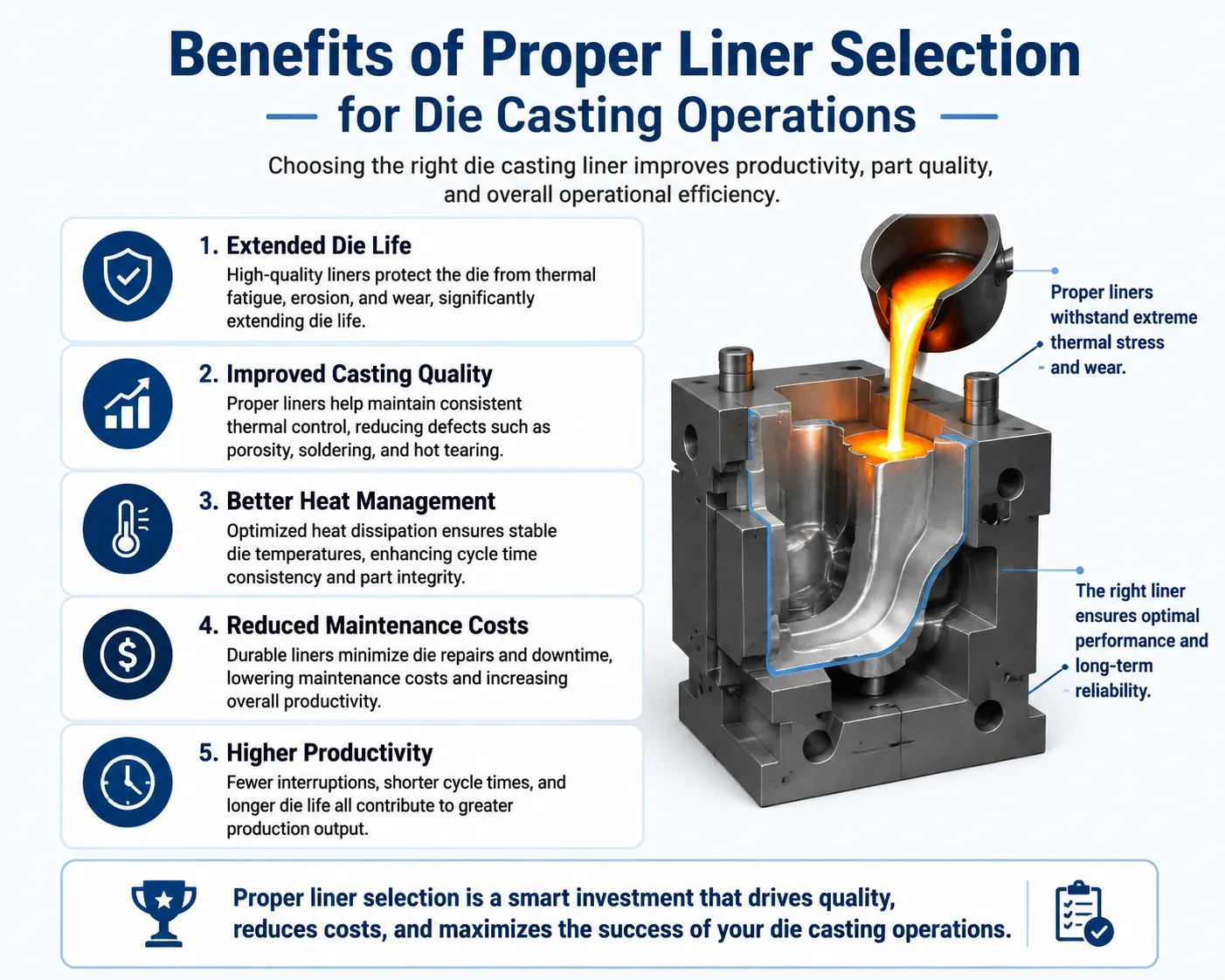
Extended production runs between cleaning cycles: Non-wetting surfaces that resist metal buildup allow longer continuous operation before requiring shutdown for cleaning, directly improving overall equipment utilization.
Reduced cold shut and incomplete fill defects: Proper thermal insulation maintains metal temperature through the filtration zone, reducing the localized cooling that contributes to these common die casting defects.
Lower filter box maintenance labor: Reduced buildup and improved thermal cycling tolerance decrease the frequency and intensity of maintenance intervention required to keep the system performing correctly.
Extended filter box service life overall: A properly performing liner protects the outer structural shell more effectively over time, delaying the need for full filter box replacement.
More consistent shot-to-shot quality: Stable thermal conditions and consistent flow geometry, free from progressive buildup distortion, support the process consistency die casting operations depend on for repeatable part quality.
| Benefit Area | Typical Improvement Reported |
|---|---|
| Cleaning cycle frequency reduction | 30% to 60% extension between cleaning interventions |
| Cold shut defect reduction | Measurable decrease, varies by alloy and baseline conditions |
| Filter box service life extension | 20% to 40% longer before major refurbishment needed |
| Shot quality consistency | Reduced variance in fill completeness and surface quality |
Signs of Liner Degradation and Failure
Recognizing early indicators of liner wear or failure prevents the more serious downstream consequences of continuing to run a compromised liner.
Visible metal adhesion or buildup on liner surfaces during scheduled inspection indicates the non-wetting surface treatment or material property is degrading, since fresh, properly functioning liner surfaces should show minimal residual metal after normal cleaning procedures.
Gradual increase in observed cold shut or incomplete fill defect rates, without corresponding changes in other process parameters like injection pressure or shot timing, often points toward declining insulation performance as the liner ages or develops thermal pathways it wasn’t originally designed to have.
Surface cracking or spalling visible on the liner material signals structural degradation that will likely accelerate if left unaddressed, since cracks tend to propagate further under continued thermal cycling stress and can eventually compromise the liner’s protective function for the underlying structural shell.
Increasing cleaning frequency required to maintain acceptable flow performance suggests the non-wetting characteristic has degraded to the point where buildup accumulates faster than it did when the liner was newly installed.
| Degradation Sign | Indicates | Recommended Response |
|---|---|---|
| Visible metal residue buildup | Non-wetting surface degradation | Plan replacement, assess remaining service life |
| Rising cold shut defect rate | Declining insulation performance | Investigate liner condition alongside other process factors |
| Surface cracking or spalling | Structural degradation | Replace before further thermal cycling causes failure |
| Increasing cleaning frequency needed | Reduced non-wetting effectiveness | Compare against expected service life benchmarks |
Common Problems Linked to Poor Liner Performance
Certain die casting quality and operational problems trace back to filter box liner issues more frequently than operators initially suspect, since the symptoms often manifest downstream from the actual root cause location.
Intermittent cold shut defects that don’t correlate clearly with obvious process parameter changes often point toward gradually declining liner insulation performance, particularly if the defect pattern has developed progressively over weeks or months of production rather than appearing suddenly from an identifiable process change.
Unexplained flow rate inconsistency during shot filling, sometimes attributed to shot sleeve or plunger wear, can actually originate from progressive metal buildup within the filter box narrowing the effective flow channel and altering the timing of metal delivery to the injection point.
Increased scrap rates specifically clustered around the start of production shifts, when the system is transitioning from cold startup toward stable operating temperature, often relate to liner insulation performance not adequately managing the thermal transition period compared to steady-state operation later in the shift.
| Downstream Symptom | Liner-Related Root Cause to Investigate |
|---|---|
| Intermittent cold shut defects | Declining insulation performance, gradual liner degradation |
| Unexplained shot fill timing inconsistency | Metal buildup narrowing flow channel |
| Elevated scrap during shift startup | Inadequate thermal transition management |
| Progressive quality drift over production campaign | Cumulative buildup or structural degradation |
Maintenance and Service Life Extension Practices
Establishing systematic maintenance practices around filter box liners extends their functional service life and helps catch degradation before it causes significant production problems.
Scheduled visual inspection during routine filter changes should specifically examine liner surface condition for buildup, cracking, or discoloration that might indicate developing problems, documented consistently so gradual trends become visible over time rather than only noticing dramatic changes.
Gentle cleaning procedures appropriate to the specific liner material help maintain non-wetting performance without damaging surface treatments, since aggressive mechanical cleaning methods suited to standard refractory can actually damage more delicate boron nitride coatings or composite surface layers.
Temperature cycling management, avoiding unnecessarily rapid heating or cooling beyond what production scheduling actually requires, reduces cumulative thermal stress on the liner material and extends its practical service life even for materials rated for good thermal shock tolerance.
| Maintenance Practice | Purpose | Frequency Recommendation |
|---|---|---|
| Visual surface inspection | Catch early degradation signs | Every scheduled filter change |
| Appropriate gentle cleaning | Maintain non-wetting performance | As needed, using material-appropriate method |
| Thermal cycling management | Reduce cumulative thermal stress | Ongoing production scheduling consideration |
| Service life documentation | Track degradation trends over time | Continuous logging practice |
Cost Analysis and Total Ownership Considerations
Evaluating liner investment requires looking beyond initial purchase price toward the full operational cost picture across the material’s service life.
| Cost Factor | Standard Alumina Liner | Boron Nitride Composite Liner |
|---|---|---|
| Initial purchase cost | Lower | Higher |
| Typical service life in die casting application | Shorter | Extended, often multiple times longer |
| Cleaning labor frequency | Higher | Lower |
| Associated defect/scrap cost from buildup issues | Higher | Lower |
| Downtime for liner replacement | More frequent | Less frequent |
| Total cost per unit of production volume | Often higher despite lower unit price | Often lower despite higher unit price |
We walk clients through this total cost comparison whenever a die casting operation questions why they should invest in premium boron nitride composite liners over cheaper alternatives. Once cleaning labor time, scrap cost from buildup-related defects, and replacement frequency all factor into the calculation, the premium material frequently produces lower total cost per unit of production despite its higher sticker price, particularly for high-volume operations running extended production campaigns.
Procurement Guidance for Buyers
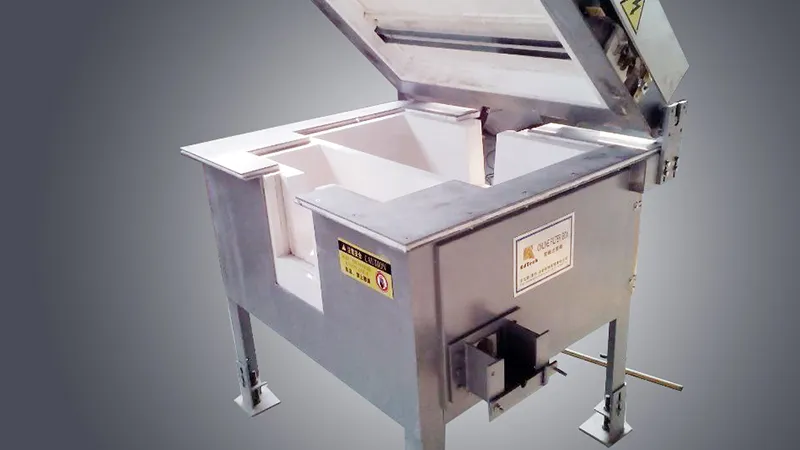
Sourcing die casting filter box liners requires specifying application-specific requirements rather than accepting generic refractory liner specifications that may not address the non-wetting and insulation demands unique to this use case.
Request documented non-wetting performance data, ideally including contact angle measurements or comparable testing results with molten aluminum, rather than accepting marketing claims without supporting technical evidence.
Ask for thermal conductivity specifications relevant to your specific alloy’s processing temperature range, since general insulation claims don’t always translate directly to adequate performance for narrower temperature window alloys common in certain die casting applications.
Verify thermal cycling tolerance data specific to the frequency and magnitude of temperature change your production schedule actually creates, since die casting’s characteristic start-stop pattern demands different tolerance than steadier continuous casting operations.
| Procurement Item to Request | Purpose |
|---|---|
| Non-wetting performance documentation | Confirms actual buildup resistance capability |
| Thermal conductivity specification | Ensures adequate insulation for your alloy’s temperature window |
| Thermal cycling tolerance data | Matches material capability to your production pattern |
| Dimensional fitting specifications | Ensures proper installation within existing filter box housing |
| Expected service life under comparable conditions | Supports accurate total cost calculation |
Frequently Asked Questions
What makes a filter box liner “non-wetting” specifically for aluminum?
Non-wetting liners use materials, most commonly boron nitride based compositions, whose surface energy characteristics discourage molten aluminum and its oxide film from adhering to the surface, allowing metal to flow across and depart cleanly rather than building up residue over repeated production cycles.
How does thermal insulation in a liner affect die casting shot quality?
Adequate insulation maintains metal temperature as it passes through the filtration zone, preventing the localized cooling that can push the alloy toward premature solidification, which directly reduces cold shut and incomplete fill defects in the finished casting.
Is boron nitride always necessary, or can standard refractory liners work adequately?
Standard refractory liners can work in lower-volume or less temperature-sensitive die casting applications, but operations running high cycle volumes or alloys with narrow processing temperature windows generally see better total cost outcomes with boron nitride composite or comparable non-wetting, insulating materials.
How often should a die casting filter box liner be replaced?
Replacement frequency depends heavily on material quality, production volume, and alloy composition, but premium non-wetting insulating liners often last significantly longer than standard refractory, sometimes multiple times longer under equivalent production conditions.
Can a degraded liner be cleaned and restored rather than replaced?
Some buildup can be gently removed using material-appropriate cleaning methods, but liners showing structural cracking, spalling, or significant surface treatment degradation generally need replacement rather than restoration, since cleaning cannot reverse actual material degradation.
Does liner material choice affect energy consumption in die casting?
Yes, liners with better thermal insulation reduce heat loss from the metal and the surrounding system, which can contribute to modest energy efficiency improvements alongside the quality benefits from maintaining more stable process temperatures.
What causes cold shut defects related to filter box liner problems?
Cold shut defects related to liner issues typically stem from inadequate thermal insulation allowing excessive heat loss as metal passes through the filtration zone, causing the metal to arrive at the injection point at a lower temperature than the process requires for complete fill.
How do I know if my current liner material is appropriate for my alloy?
Reviewing your alloy’s specific processing temperature window against the liner’s documented thermal conductivity and non-wetting performance data, combined with tracking actual defect rates and buildup accumulation in production, reveals whether your current material matches your application’s demands.
Are non-wetting liners more difficult to install than standard refractory?
Installation complexity is generally similar, though these specialized liners often require more careful attention to preheating rate and surface preparation to protect non-wetting surface treatments that standard refractory installation practices don’t need to consider.
Does liner performance vary between different aluminum alloys?
Yes, alloys with different silicon, magnesium, or copper content can interact differently with liner surface chemistry, and operations switching between multiple alloy systems should verify liner compatibility across their specific alloy range rather than assuming uniform performance.
Closing Thoughts From Our Die Casting Experience
Filter box liners occupy a small physical footprint within a die casting line but carry outsized influence over both production consistency and long-term equipment costs. Based on what we’ve observed troubleshooting die casting quality issues across multiple facilities, the combination of non-wetting surface behavior and precise thermal insulation performance separates liners that quietly do their job for extended periods from those that generate recurring cleaning labor, unexplained defect patterns, and premature replacement costs.
If your die casting operation struggles with intermittent cold shut defects or notices declining shot consistency that doesn’t trace clearly to shot sleeve, plunger, or die temperature issues, we would suggest examining filter box liner condition and material specification before looking elsewhere. The liner sitting quietly inside your filter box housing might be exactly where your persistent quality problem originates, and the fix often costs considerably less than the scrap and downtime that comes from continuing to run a liner that’s no longer performing the job it was designed to do.