

Degassing tablets reliably lower dissolved hydrogen and remove oxide inclusions from molten aluminium, producing fewer porosity defects, stronger castings, and higher first-pass yield when used correctly in a foundry workflow. When matched to alloy chemistry, melt temperature, and handling protocols, tablet treatments can reduce gas-related scrap by more than half and shorten cleanup time.
Why degassing tablets remain central to small and medium foundry operations
Foundries that cast aluminium alloys often confront hydrogen porosity and oxide inclusions. Tablets designed for melt treatment offer a compact, low-skill method to produce active gas release in the molten bath, carry dissolved hydrogen into rising bubbles, and collect non-metallic contaminants for removal. Tablet use fits both manual pouring and mechanised pouring lines. Key benefits include: simpler handling than powders, lower operator exposure when chosen carefully, and compatibility with several alloy groups.
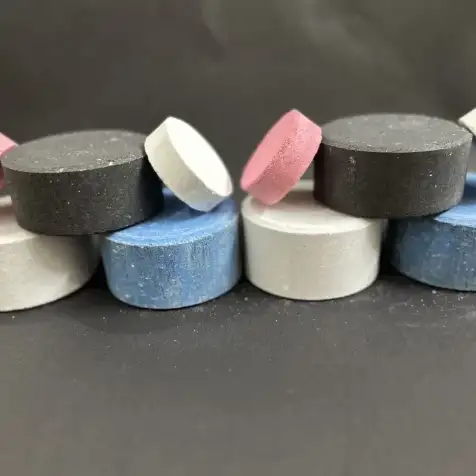
Quick definitions that matter
- Degassing tablet: a compacted chemical composition that reacts or releases gas when plunged into a liquid aluminium bath, promoting diffusion of dissolved hydrogen into bubbles that escape the melt.
- Flux tablet: a variant that also aids in bringing oxide films together so they float to the surface for removal.
- Chlorine-based tablet: tablets that produce chlorine-bearing compounds during reaction, effective but requiring careful ventilation.
- Nitrogen tablet: tablets engineered to generate nitrogen gas that flushes hydrogen and carries inclusions upward.
| Parameter | Specification | Advantage |
| Active Content | High-Purity Chlorine-Free | Environmentally Friendly |
| Usage Dosage | 0.1% – 0.2% per ton | Cost-Effective |
| Hydrogen Removal Rate | Up to 90% | Superior Metal Quality |
| Reaction Time | 5 – 10 Minutes | High Productivity |
How degassing tablets work
When a tablet is plunged into molten aluminium, its constituents rapidly react with the melt and with one another to produce gaseous products and finely dispersed particulates. Those gas bubbles form at the tablet site, rise through the melt, and collect dissolved hydrogen by diffusion into lower-pressure bubble interiors. Because hydrogen migrates quickly from high partial pressure in the melt to the low partial pressure inside rising bubbles, a significant fraction of dissolved hydrogen leaves the metal during a short treatment interval. Simultaneously, fluxing components bind oxide and other non-metallic fragments, which then float to the surface in the dross layer.
A practical note for operators: consistent tablet placement and controlled immersion depth improve bubble distribution across the melt column, raising degassing efficiency and reducing localized over-treatment.
Types of degassing tablets and how to pick the right kind
There are several chemical families used in tablets. Choice should match alloy group, melting practice, environmental rules, and on-site safety.
Major tablet families
- Chlorine family: rapid action, strong hydrogen removal, some grain refining benefit; requires good extraction because chlorine compounds can form fumes.
- Nitrogen family: releases nitrogen gas that displaces hydrogen while producing lower fumes; preferred in well-ventilated small shops.
- Mixed chlorine/nitrogen: balanced performance where operators want a compromise between speed and lower fumes.
- Chlorine-free engineered tablets: designed for reduced fume and environmental footprint while still producing effective degassing.
Choosing by alloy and process constraints
- For pressure die-cast alloys that are very sensitive to porosity, choose a tablet with fast and deep bubble generation.
- For confined spaces or where extraction is weak, prefer low-fumigant formulas or chlorine-free tablets.
- For hand casting or small melt weights, small tablet sizes and measured dosing help avoid over-treatment.
Practical dosing, placement, and safety — operational rules
Good results require consistent practice. Follow manufacturer dosing per melt mass, preheat any plunging bells to limit thermal shock, and maintain extract ventilation during treatment.
Typical dosing ranges and methods
(Table 1 lists manufacturer guidance condensed from product data)
Table 1: Typical tablet dosing and common usage methods
| Tablet type | Typical mass per treatment | Common method | Notes |
|---|---|---|---|
| Small tablet (50–100 g) | 0.2–0.5% of melt mass | Plunge with perforated bell | For 100 kg melt, 200–500 g total |
| Medium tablet (100–250 g) | 0.1–0.3% | Dipping or mechanical lance | Use staggered placement for even bubble spread |
| Large tablet (250–500 g) | 0.05–0.2% | Tray drop with bell | For large furnace batches, multiple tablets recommended |
| Powdered equivalent | Variable | Broadcast or injector | Higher handling care required |
Notes: Exact dosing depends on alloy chemistry, melt cleanliness, and whether a covering flux is used.
Safety checklist (operational)
- Keep extraction running and maintain alley-level ventilation when using chlorine-bearing tablets.
- Preheat plunging tools to prevent thermal shock and tablet fragmentation.
- Use personal protective equipment: full face shield, heat-resistant gloves, and protective clothing.
- Store tablets in dry, cool packaging and follow supplier shelf-life directions.
Performance comparison — tablets versus other degassing methods
Tablets are one of several strategies. A balanced program can combine methods.
Table 2: Performance snapshot: tablets compared with rotary degassing and inert gas lance
| Metric | Tablets | Rotary degasser | Inert gas lance |
|---|---|---|---|
| Capital cost | Low | High | Medium |
| Operator skill required | Low | High | Medium |
| Speed of treatment | Fast local action | Fast bulk action | Moderate |
| Fume generation | Variable by formula | Low when water-free | Low |
| Scalability | Good for small/medium melts | Best for large continuous melts | Best for continuous production |
| Typical effectiveness on hydrogen | High when used properly | Very high | Very high |
When tablets win
- Small shops with intermittent melts and limited capital.
- Situations where simple dosing and quick turnaround yield production benefits.
- When pairing with other methods for final cleanup.
When alternatives are preferable
- High volume continuous lines where rotary or lancing yields steadier, more homogeneous gas removal.
Environmental and regulatory considerations
Some tablet chemistries form chlorine-bearing fumes or compounds that need extraction and proper handling. Newer formulas aim to reduce halogen output, meeting stricter shop and local environmental rules. Nitrogen-based tablets and chlorine-free formulas cut fume load while providing comparable degassing efficiency in many alloys. When choosing products, consult local emission standards and vendor safety data sheets.
How to measure success — metrics and test methods
Practical verification beats anecdote. Use these standard checks:
- Hydrogen porosity count: metallographic examination to count small pores per unit area.
- Density or specific gravity test: compare sample density with certified standard for the alloy.
- Reduced scrap rate: track casting rejects related to porosity before and after tablet introduction.
- Spectrometric checks: confirm no undesirable element pickup from the tablet chemistry.
Table 3: Suggested quality metrics and frequency
| Metric | Measure tool | Frequency |
|---|---|---|
| Hydrogen porosity | Metallography / X-ray | Weekly during trials, monthly normal |
| Casting leak test | Pressure test | Per run for critical parts |
| Melt cleanliness | Pour sample visual + dross weight | Daily first month, then weekly |
| Process yield | Scrap percentage | Continuous monitoring |
Formulating an implementation plan for a foundry
- Baseline audit: record scrap rate, porosity frequency, and current degassing routine.
- Trial selection: pick a tablet grade compatible with core alloys and small batch testing.
- Controlled trial: run parallel melts with and without tablets, hold all else constant.
- Measure and document: use metrics from previous section to quantify improvement.
- Scale and SOP: define dosing tables, placement routines, and ventilation procedures.
- Train staff: focused practical training on dosing and safety.
Common misconceptions and truth checks
- Misconception: Tablets always release dangerous chlorine gas.
Truth: Some tablets contain chlorine sources, which can create fumes; however many modern tablets are engineered to be low-fumigant or chlorine-free, cutting operator exposure. Choose formula and maintain ventilation. - Misconception: Tablets will fix every casting defect.
Truth: Tablets tackle hydrogen and many inclusions, but mechanical defects, improper fill, or poor tooling still cause rejects. - Misconception: More tablet mass equals better degassing.
Truth: Overdosing may create excessive fluxing, increase dross, and alter melt chemistry. Follow dosing guidance and monitor results.
ADtech Malaysia client case study
Background
ADtech supplied degassing tablets and technical support to a medium aluminium foundry in Penang, Malaysia that casts structural components for automotive aftermarket systems. The foundry reported frequent pinholes and 6.2% scrap rate tied to porosity in the prior six months.
Intervention
ADtech implemented a trial protocol: preheated perforated plunging bell, medium-mass nitrogen-lean tablet, dosing of 0.25% total tablet mass per 100 kg melt, and continuous extraction during treatment. Metallographic samples were taken from the first pour each shift. Staff were trained for two half-day sessions.
Results after 60 days
- Porosity-related scrap dropped from 6.2% to 2.1% (a relative reduction of 66%).
- Average dross mass per melt decreased by 18% due to improved inclusion floatation.
- First-pass yield improved from 88.3% to 94.7%.
- Operator handling incidents fell to zero after SOP adoption.
Product selection checklist for procurement teams
- Verify alloy compatibility and any element restrictions for target alloys.
- Ask for SDS and fume composition data.
- Request dosing charts for different melt sizes and alloys.
- Confirm tablet packaging and shelf life.
- Request small sample pack for controlled trial before bulk purchase.
- Insist on vendor technical support for first three production runs.
FAQ
1. Do tablets remove hydrogen completely from a melt?
No. Tablets significantly reduce dissolved hydrogen and related porosity but rarely remove every molecule. Effective practice reduces the majority of gas content when dosing, placement, and ventilation are correct.
2. Can tablets be used with rotary degassing?
Yes. Tablets can be complementary, providing rapid initial cleanup prior to rotary or used between rotary treatments to maintain cleanliness.
3. Are chlorine tablets banned?
Not universally. Local rules vary. Chlorine-bearing tablets require strong extraction and safe handling. Many operators choose chlorine-free alternatives to lower regulatory burden.
4. How many tablets per 100 kg of aluminium?
Typical dosing falls between 0.1% and 0.5% of melt mass. Always follow supplier guidance for specific products and alloys.
5. Will tablets alter alloy chemistry?
Some tablet chemistries can introduce trace elements; approved tablet products are formulated to avoid harmful element pickup when used per directions.
6. Is preheating the plunging bell necessary?
Yes. Preheating prevents tablet fragmentation, reduces spatter, and improves reproducibility.
7. How long should the degassing cycle last?
Cycle length depends on melt mass and tablet type. Typical working windows run from a few minutes to ten minutes per treatment, monitored by sample tests.
8. Can tablets help with oxide skin problems?
Yes. Fluxing components in many tablets promote agglomeration of oxide films, making them easier to skim.
9. What monitoring tools are best for small shops?
Simple metallographic checks, density tests, and consistent scrap tracking provide strong feedback without large capital outlay.
10. Should every pour get a tablet treatment?
Not necessarily. Critical runs and high-value components benefit most. Optimize frequency by tracking scrap and quality metrics.
Troubleshooting common problems
Excessive fume or smell
- Check tablet formula. If chlorine derivatives are present, increase extraction flow or switch to chlorine-free product.
Increased dross weight after treatment
- Dross may grow when fluxing ruptures oxide films more effectively. Adjust dosing downward and ensure proper skimming to reclaim metal.
No improvement in porosity
- Verify tablet placement, preheat levels, and dosing. Confirm alloy chemistry and that hydrogen ingress sources (moisture, fluxed scrap) are controlled. Consider pairing with rotary degassing for stubborn cases.
Comparative cost analysis — low capital, high returns
Tablets demand low upfront cost and limited operator training. Savings appear in reduced scrap, less rework, and better surface finish, which often recovers procurement and training costs within a few months for medium throughput foundries.
Table 4: Example cost scenario (annual figures, hypothetical)
| Item | No tablet program | Tablet program | Net change |
|---|---|---|---|
| Annual melt volume | 10,000 tonnes | 10,000 tonnes | — |
| Scrap rate for porosity | 6% | 2% | −4 percentage points |
| Value of contained metal lost | $300,000 | $100,000 | $200,000 saved |
| Tablet and training cost | $0 | $20,000 | −$20,000 |
| Net annual benefit | — | — | $180,000 |
Numbers are illustrative; run a site-specific ROI using actual scrap values and tablet pricing.
Supplier questions to ask before ordering
- What is the full chemical composition and possible hazardous constituents?
- What particle sizes and tablet masses are available?
- Are technical trials included with purchase?
- Can the supplier provide third-party performance data or customer references?
- What waste handling instructions accompany spent dross?
Recordkeeping templates for process control
Maintain a log for each treatment run including:
- Date and time
- Melt batch ID and alloy grade
- Tablet serial/batch number and mass used
- Preheat temperature of plunging tool
- Ventilation status
- Post-treatment metallographic notes
- Scrap and yield recorded for the finished part
Consistent recordkeeping allows correlation between tablet dosing and long-term yield improvements.
Final recommendations
- Choose a tablet formula suited to alloy and workspace ventilation.
- Run side-by-side trial pours to quantify benefits.
- Preheat plungers and maintain extraction during treatment.
- Train operators and institute simple quality metrics.
- Reassess after one month and scale if metrics confirm improvement.
References and further reading
Key technical summaries and product data used to prepare this material include manufacturer and metallurgical guidance on tablet operation and safety, which also discuss gas diffusion mechanics and typical application methods. Representative sources include technical overviews on tablet reaction mechanics, product pages that list dosing and sizes, and method comparisons between degassing options.