

Ultrasonic vibration applied to molten aluminum is a highly effective method to remove dissolved hydrogen and reduce entrained oxides, producing denser castings and fewer porosity defects; when installed correctly and tuned for alloy, melt volume and pouring cadence, ultrasonic melt treatment can shorten processing time, lower reliance on chemical fluxes and complement conventional degassing techniques, delivering reproducible metallurgical benefits for aluminum foundries.
Historical perspective and Meek’s contribution
Ultrasonic degassing for aluminum alloys emerged from laboratory and applied research in the late 20th and early 21st centuries. One of the pivotal works was by T. T. Meek and colleagues, who evaluated ultrasonic vibration applied directly to molten A356 and related alloys and quantified degassing performance under controlled conditions. Meek’s experiments and the subsequent paper established that power ultrasound can accelerate hydrogen removal and alter bubble behavior in the melt, forming a basis for later pilot-scale and commercial systems.
Meek’s work is frequently cited as a proof point in industry literature because it was among the first to present systematic data on ultrasonic parameters, melt volumes and post-treatment hydrogen levels. Later studies built on those foundations and explored how frequency, amplitude and combined vacuum or purging strategies affect outcome.
Why hydrogen and inclusions matter in aluminum castings
Hydrogen is unusually soluble in molten aluminum and its solubility declines sharply during solidification. The dissolved gas nucleates into bubbles that remain trapped as porosity in cast parts. These pores reduce fatigue life, lower ductility and can lead to reject rates in precision components. Non-metallic inclusions such as oxides and dross pieces act as crack initiators and surface blemish sources and also accelerate erosion of filtration and degassing hardware. Controlling hydrogen and particulate load before mold filling is therefore central to producing sound castings and lowering total production cost.
Key quality metrics foundries monitor include hydrogen content in ppm, Reduced Pressure Test (RPT) indices, X-ray porosity maps and inclusion counts from metallography. A degassing strategy that reliably reduces hydrogen ppm and lowers inclusion counts translates into fewer repairs, shorter machining cycles and improved customer accept rates.

Physical mechanisms behind ultrasonic degassing
Ultrasound affects liquid metals through three principal physical phenomena: cavitation, acoustic streaming and mechanical agitation of the melt. Understanding these is essential to design and tune equipment.
Cavitation and gas bubble behavior
When an ultrasonic horn or probe (usually operating around 20 kHz for industrial systems) emits high-intensity sound into molten aluminum, alternating pressure cycles create microscopic vapor and gas cavities. Cavitation bubbles form, grow and then violently collapse. This transient cavitation generates localized high-pressure and high-temperature microenvironments, drives coalescence of dissolved gas, and encourages small hydrogen molecules to diffuse into growing bubbles that subsequently rise to the bath surface. The net effect is accelerated removal of dissolved hydrogen and of fine entrained gases.
Acoustic streaming and mass transport
Ultrasonic fields generate steady flows known as acoustic streaming. These flows transport bubbles and inclusions toward the free surface or toward regions where flotation and skimming can occur. Acoustic streaming improves the effective exchange surface area between gas nuclei and the bulk melt and also helps detach microscopic oxides from the melt volume so they can be removed.
Interaction with inclusions and wetting films
Oscillatory stress and microjetting from collapsing cavities help break oxide films and promote coalescence of inclusions. Where inclusions are wetted by metal, cavitation may dislodge them and make them available for flotation or filtration. This is one reason ultrasound tends to improve not only hydrogen metrics but also inclusion counts and casting surface quality.
Equipment types and industrial configurations
Ultrasonic degassing equipment generally falls into several categories based on how ultrasound is introduced, the scale of the melt treated and whether the unit is used standalone or combined with other degassing techniques.
Direct immersion probe systems
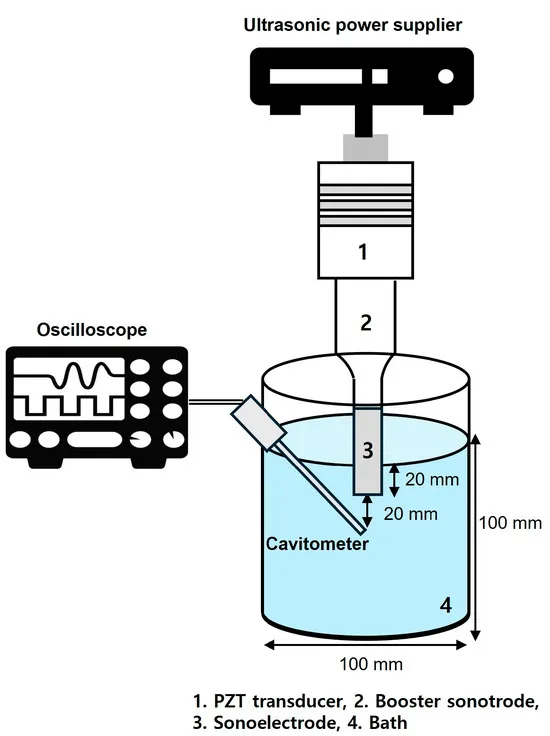
A titanium or sonotrode probe is immersed into the melt and driven by a generator through a booster and transducer. Direct contact systems are common for static melt volumes and pilot-scale installations. Probes are typically 20 kHz for aluminum to balance cavitation intensity and mechanical robustness. Industrial probe designs use high-grade titanium or coated graphite to resist corrosion and erosion.
Indirect or vessel-mounted systems
Ultrasound is coupled into the vessel wall or through a turbulator. These systems avoid inserting a probe directly into the metal but can be less efficient because energy dissipates through vessel materials. They are sometimes used for retrofit cases where immersion is impractical.
Combined systems with vacuum or argon assist
Many practical implementations pair ultrasonic probes with vacuum chambers or argon purging to exploit synergistic effects. Vacuum lowers ambient pressure and enlarges cavitation bubbles; argon purging introduces controlled bubble populations that ultrasound then breaks into smaller bubbles with high surface area to absorb hydrogen. Studies show combined techniques often achieve the fastest degassing and the lowest residual hydrogen.
Table 1: Common industrial ultrasonic degassing setups
| System type | Typical application | Strengths | Considerations |
|---|---|---|---|
| Immersion probe (20 kHz) | Lab to pilot, static ladles | High local intensity, fast degassing | Probe wear, need for handling and preheat |
| Vessel-coupled transducers | Retrofit or integrated furnaces | No immersion, lower contamination risk | Energy transmission losses, less efficient |
| Ultrasonic + vacuum | Aerospace or critical parts | Lowest hydrogen possible, fast | Higher CAPEX, vacuum hardware needed |
| Ultrasonic + argon purge | Production lines needing speed | Fast, can be inline | Requires gas supply and optimized flow |
Sources: experimental and industry reports.
Key process variables and their effects
To obtain consistent results the plant engineer must manage several controllable variables.
Frequency
Most aluminum ultrasonic systems use frequencies in the 18 to 25 kHz window because that range produces strong cavitation in dense metallic melts while allowing durable probe construction. Higher frequencies produce finer cavitation but with shallower penetration. Lower frequencies give stronger mechanical agitation and larger cavitation events. Recent studies examine the effect of frequency on bubble dynamics and show frequency influences the balance between stable and transient cavitation.
Power and intensity
Power density applied at the probe tip determines cavitation intensity and treatment depth. Laboratories report intensities from hundreds of watts to multiple kilowatts depending on melt volume. Too low power yields weak cavitation and slow degassing. Excessive power risks probe erosion, probe overheating and unwanted alloy reactions. Well-designed systems provide adjustable power and feedback loops to maintain optimal intensity.
Immersion depth and probe geometry
Probe immersion depth and the shape of the sonotrode tip affect the distribution of acoustic energy. Conical or stepped tips are used to tailor bubble field geometry. Immersion too shallow produces surface cavitation and splashing; too deep may cause excessive wear on the probe body. Manufacturers publish recommended immersion profiles and tip geometries for given melt volumes.
Treatment time and melt turnover
Ultrasonic degassing is typically rapid relative to rotary purging. Many trials show effective hydrogen reduction in minutes for small volumes, while larger ladles may require longer exposure or staged treatment. The effective melt turnover that experiences intense cavitation determines global hydrogen reduction; for large volumes, combine ultrasound with melt stirring, argon injection or a multi-probe array to treat the entire volume.
Table 2: Representative parameter ranges and expected outcomes
| Parameter | Typical industrial range | Effect on degassing |
|---|---|---|
| Frequency | 18–25 kHz | Balance of cavitation intensity and probe longevity |
| Power density at tip | 100 W/cm² to 2000 W/cm² | Higher speeds coalescence but increases wear |
| Immersion depth | 0.1 to 0.6 of melt depth | Affects acoustic field distribution |
| Argon flow rate (if used) | 5–25 L/min (small ladles) | Provides bubble population to augment removal |
| Vacuum level (if used) | 50–300 mbar absolute | Enhances bubble growth and escape |
Sources: experimental studies and vendor guidance.
Combining ultrasound with argon purging or vacuum
The synergy of ultrasound with other degassing methods is widely reported.
Ultrasonic plus argon purging
Argon purging injects inert bubbles into the melt which serve as nucleation sites for hydrogen. Ultrasound fragments these bubbles into much smaller bubbles, increasing total interfacial area and speeding hydrogen diffusion into the gas phase. Many trials report ultrasonically assisted argon degassing as the fastest method to reduce hydrogen in small-to-medium batches. Operationally, argon flow must be dry and oil-free and the gas injection system must be coordinated with the ultrasonic pulse to avoid turbulence.
Ultrasonic plus vacuum
Lowering ambient pressure enhances cavitation and increases bubble growth. Ultrasonic energy under vacuum conditions can remove gas more thoroughly and produce very low hydrogen residues suitable for aerospace and safety-critical parts. The trade-offs are higher equipment costs and the need for vacuum-tight chambers and pumping systems.
Table 3: Relative performance of hybrid strategies
| Strategy | Speed | Final hydrogen | Typical application |
|---|---|---|---|
| Ultrasound alone | Fast for small volumes | Moderate to low | Pilot, lab, small batch |
| Ultrasound + argon | Fastest in trials | Low | Production lines seeking speed |
| Ultrasound + vacuum | Fast and deepest degassing | Lowest residue | Aerospace, critical castings |
Caveats: results depend on alloy, melt cleanliness and equipment tuning.
Effect on microstructure and mechanical properties
Ultrasonic melt treatment influences not only gas content but also grain structure and inclusion morphology.
-
Grain refinement. Acoustic cavitation and streaming promote nucleation and can reduce dendrite arm spacing in some alloys, leading to improved secondary dendrite arm spacing and more uniform microstructures. This often improves strength and toughness after casting.
-
Inclusion fragmentation and removal. Oscillatory stresses break oxide films into smaller fragments that float and are skimmed, or that are better captured by downstream filtration. This reduces surface blemishes and internal inclusions that compromise mechanical integrity.
-
Porosity reduction. Lower hydrogen leads to fewer shrinkage pores and gas porosity, improving density and fatigue resistance. Many studies report measurable improvements in tensile properties and elongation for A356 and similar casting alloys after ultrasonic treatment.
Ultrasonic Degassing of Molten Aluminum: 3D Guide to Hydrogen Removal & Alloy Quality Improvement
Practical installation and melt-train integration
For plants integrating ultrasonic systems some pragmatic rules apply.
Where to place the ultrasonic step
Best practice places the ultrasonic probe upstream of final filtration and immediately after skimming and degassing stations when possible. If combined with argon purge, coordinate gas delivery ports to avoid large jets directly on filter faces. For continuous or semi-continuous lines design probe arrays or inline housings that treat flow in transit.
Preheating and probe handling
Ultrasonic probes must be preheated to near-melt temperatures and handled to avoid thermal shock. Many probes have ceramic or titanium faces and robust welds; nevertheless they are wear items. Build maintenance access and spares planning into the installation.
Automation and recipe control
Implement recipes in PLC with parameters such as power output, immersion depth and treatment time stored per alloy and ladle mass. Use simple interlocks to ensure the probe is at the correct position before activating ultrasound and to protect operators. Data logging supports traceability for quality audits.
Safety, environmental and operator practice
Ultrasonic systems introduce no novel chemical hazards but require robust thermal safety and handling discipline.
-
Electric safety. High-power generators and water-cooled transducers require appropriate electrical protection, grounding and preventive maintenance.
-
Thermal and handling. Probes are hot and must be handled by trained staff with mechanical hoists or articulated arms. Preheat and cooldown procedures reduce thermal shock.
-
Fume control. Cavitation and skimming in treated baths can release fumes; use local exhaust and filtration. When argon is used monitor oxygen as argon displaces breathable air.
-
Noise. High-power ultrasonic generators produce mechanical noise; ensure acoustic isolation and hearing protection for nearby staff.
Maintenance and consumables
Ultrasonic probes and sonotrodes are subject to mechanical erosion, corrosion and coating degradation. Key points:
-
Inspect probe tips and horn bodies regularly for pitting and cracks. Replace or re-machine tips according to supplier intervals.
-
Keep spare probe assemblies and gaskets on site. Typical heavy-use probes may need replacement after a set number of operating hours or tonne throughput.
-
Maintain generator cooling systems and electrical connections to prevent premature failure.
-
Use oil-free compressors and dry gas supplies if argon or other gases are in use; gas contamination causes probe fouling and reduces effectiveness.
Monitoring and quality assurance methods
To quantify performance, combine multiple measurement techniques.
Table 4: Recommended QA tests and frequency
| Test | Purpose | Typical frequency |
|---|---|---|
| Hydrogen titration (gas analysis) | Direct ppm measurement | Weekly or per campaign |
| Reduced Pressure Test (RPT) | Comparative porosity index | Before and after trials |
| Metallography / inclusion count | Particle size and distribution | Periodic sampling |
| X-ray or CT scanning | Internal porosity mapping | For high-value parts |
| Head loss and pour rate logs | Indirect evidence of filter protection | Continuous logging |
Establish acceptance criteria for each casting family and maintain control charts to detect drift.
Comparative performance: ultrasonic versus rotary and vacuum methods
Each degassing technology has pros and cons.
Table 5: Comparative summary
| Metric | Rotary inert gas purging | Vacuum degassing | Ultrasonic degassing |
|---|---|---|---|
| Typical capital cost | Low to moderate | High | Moderate |
| Throughput scalability | Excellent for large volumes | Moderate | Best for small to medium batches; scalable with arrays |
| Hydrogen removal speed | Steady, proven | Very effective | Fast for targeted volumes |
| Consumables | Gas and rotor wear | Vacuum pumps, seals | Probe wear, electricity |
| Effect on inclusions | Limited flotation | Moderate | Breaks oxides, aids flotation |
| Environmental impact | Gas use, dross | Vacuum pumps | Low; no flux needed usually |
Studies suggest ultrasonic techniques can be substantially faster than impeller-driven rotor degassing for small melts, and that combining ultrasound with vacuum or argon typically provides superior results to single methods alone. Choice depends on required residual hydrogen, throughput and capital constraints.
Case studies and representative trial outcomes
A number of published experimental investigations and pilot deployments show consistent benefits.
-
Lab and pilot trials on A356. Multiple studies including Meek’s work and later experiments found that ultrasound at about 20 kHz reduced hydrogen ppm and improved density and tensile properties in A356. Some trials reported degassing times roughly three times faster than rotor purging for similar endpoints.
-
Hybrid vacuum-ultrasonic. Oak Ridge and other labs tested ultrasound under reduced pressure with promising results: synergy produced faster hydrogen evacuation and lower final hydrogen content compared with vacuum alone.
-
Industrial pilot reports. Vendor case literature and pilot reports indicate that ultrasonics combined with inline argon purging can be implemented into small to medium foundries to reduce scrap and improve finish quality, often with payback horizons under two years when retrofit replaces flux-heavy practices.
Cost drivers and return on investment
Main cost elements to model:
-
Capital: generator, transducer(s), probe handling fixtures and any vacuum or gas hardware.
-
Operating: electricity for generator, probe replacements, cooling water or air and any gas costs for hybrid systems.
-
Benefits: lower scrap, less machining and rework, lower flux consumption, improved first-pass yield.
Table 6: Example ROI calculation
| Item | Example input | Comment |
|---|---|---|
| Annual melt throughput | 3,000 t | typical mid-size foundry |
| Scrap reduction | 0.8% absolute | after process tuning |
| Metal saved | 24 t | saved per year |
| Metal value | $1,800 / t | market dependent |
| Annual metal saving | $43,200 | excludes labor/machining savings |
| Annual consumables | $8,000 | probes, electricity, gas |
| Net benefit | $35,200 | crude estimate |
| CAPEX | $40,000–150,000 | depends on scale and hybridization |
| Payback | < 24 months | illustrative only, site-specific |
Run a small pilot with measured pre/post metrics to create a defensible business case.
Troubleshooting matrix and corrective actions
Table 7 Common symptoms and fixes
| Symptom | Likely cause | Fix |
|---|---|---|
| Little or no hydrogen reduction | Insufficient power or incorrect immersion | Increase power, reposition probe, validate immersion depth |
| Probe tip erosion | High abrasive load, high power or poor material grade | Replace tip with SiC-coated or higher grade titanium; reduce power |
| Excess turbulence and splashing | Probe too shallow or argon flow too high | Lower probe, reduce gas flow or reposition gas ports |
| Equipment overheating | Generator or transducer cooling failure | Repair cooling, add interlocks |
| Poor repeatability | No stored recipes or operator variation | Implement PLC recipes and operator training |
Document interventions and adjust control limits once a pattern emerges.
Standards, testing protocols and supplier documentation to request
When evaluating vendors and planning trials request:
-
Generator and transducer performance data and recommended operating windows.
-
Probe materials and wear life under defined alloy and throughput assumptions.
-
Trial data for your alloy or a closely similar alloy, including RPT and hydrogen titration before/after.
-
Safety datasheets, electrical wiring diagrams and recommended maintenance schedules.
-
References to independent lab tests or published papers supporting claimed performance.
Implementation checklist: pilot to scale
-
Gather baseline metrics: hydrogen ppm, RPT, scrap and inclusion counts for a target casting family.
-
Choose pilot ladle size and probe configuration recommended by vendor.
-
Instrument test: hydrogen titration, RPT and metallography pre/post.
-
Develop recipes and lock into PLC with operator procedures and safety interlocks.
-
Iterate tuning: power, time, immersion depth and any hybrid gas or vacuum settings.
-
Record operational cost and consumable replacement cadence.
-
Scale by adding additional probes or inline housings once performance is reproducible.
FAQs
1. How fast does ultrasonic degassing work compared to rotor purging?
2. What frequency is best for aluminum melt treatment?
3. Can ultrasound remove dissolved hydrogen completely?
4. Will ultrasound harm alloy chemistry or introduce contamination?
5. How is probe wear managed?
6. Can ultrasound be added to an existing line easily?
7. Does ultrasound reduce the need for fluxes?
8. What monitoring should be used to validate effectiveness?
9. Are there scale limits for ultrasonic degassing?
10. What initial data should I ask vendors for?
Closing remarks
Ultrasonic vibration for degassing aluminum alloys is now a mature technology with a robust scientific foundation and a growing industrial track record. Meek’s early experimental work provided a launching point that subsequent researchers have refined into repeatable methods that, when combined with vacuum or argon, produce very low hydrogen levels and cleaner melts. For foundries considering adoption the recommended path is a focused pilot with good instrumentation, conservative ramping of power settings, and supplier-backed maintenance plans. When implemented correctly ultrasound often reduces scrap, shortens processing time and improves finished-part performance.