

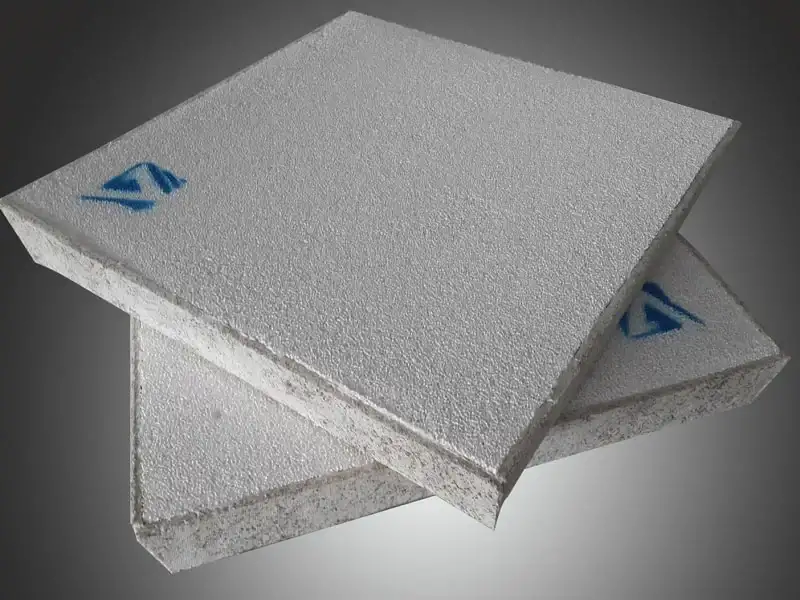
Ceramic foam filters are the fastest way to cut casting defects and boost yield in aluminum foundries. For Indian buyers, selecting the right pore size and material delivers measurable reductions in surface defects and scrap. For high-value components that demand consistent purity, adtech’s alumina and SiC foam filters offer industrial-grade performance at factory pricing, and many Indian foundries combine local supply with imported ADTECH filters to meet tight quality targets.
Why this topic matters to Indian foundries
Molten metal filtration is no longer optional. With rising quality standards for automotive, foil, and aerospace aluminum, foam ceramic filters reduce oxides, entrained dross, and turbulent flow defects. The right filter selection reduces rework, shortens machining allowance, and raises first-pass yield. Independent studies show optimized ceramic filtration improves mechanical properties and lowers scrap in alloy castings.
Who adtech is, in one line
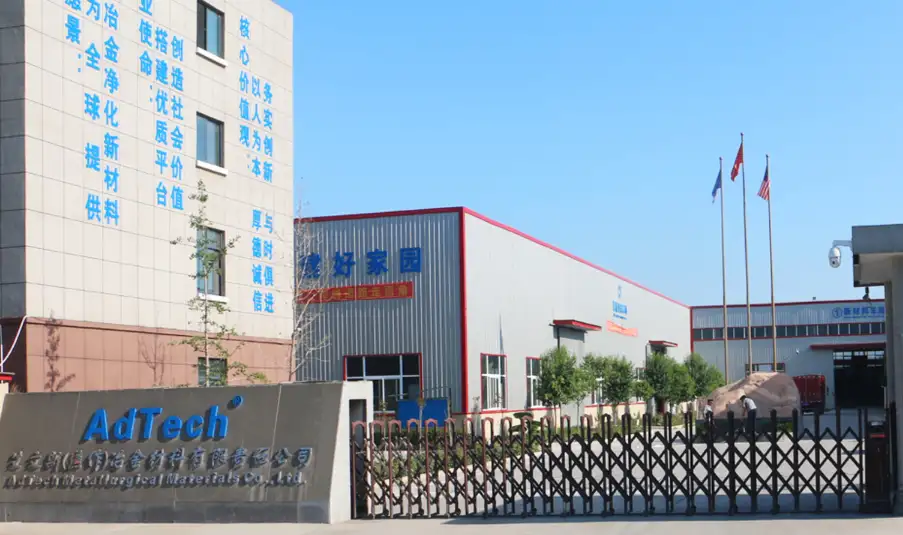
adtech Metallurgical Materials Co., Ltd produces alumina and silicon-carbide ceramic foam filters plus filtration accessories for molten aluminum, and maintains an active sales presence for Indian buyers.
-
Industrial-grade PPI control (10–60 PPI) suited for sand casting, gravity die, permanent mold.
-
Supply chain options: local stockists plus direct factory export pricing.
Adtech ceramic foam filters product advantages
| Feature | What it means for a foundry | Practical benefit |
|---|---|---|
| Material options: Alumina, SiC, Zirconia | Filters can be matched to alloy chemistry and melt temperature | Lower chemical reaction risk, longer filter life |
| Controlled pore sizes (PPI range) | Match filtration depth to casting type | Better capture of oxide films, fewer surface faults |
| High porosity, high thermal shock resistance | Filter tolerates sudden temperature swings | Fewer filter failures during pour |
| Factory direct pricing for bulk orders | Lower per-unit cost for frequent users | Reduced cost per casting, improved margin |
| Standardized sizing and custom shapes | Fits existing filter boxes or bespoke rigs | Eases retrofit and reduces engineering time |
Table source: adtech product pages and company literature.
Five Indian ceramic foam filter manufacturers
Below are five Indian companies that manufacture or supply ceramic foam filters. Each entry includes location and a short note on capabilities.
| Company | Location | Short capability note |
|---|---|---|
| Patronage Filtex India Pvt. Ltd. | Kolhapur, Maharashtra | Claims state-of-the-art manufacturing for alumina, SiC, zirconia foam filters. |
| Techno Crat Foundrychem Pvt. Ltd. | Pune, Maharashtra | Foundry-chemical and filter supplier listed on national B2B platforms. |
| S S Khardekar India Pvt. Ltd. | Pune area (operations nationwide) | Established foundry product maker; supplies ceramic filters under trade partnerships. |
| Jagannath Company | Delhi | Foundry supplier and exporter that lists ceramic foam filters among product lines. |
| Imperial World Trade / Protech Industries | Rajkot / Kolhapur | Large trading houses and manufacturers supplying ceramic foam filters across India. |
These vendors appear in Indian B2B directories and trade listings; buyers often use them for local stock or small-batch orders.
How Indian-made filters compare with imports (table)
| Dimension | Strength of India-made filters | Typical limitation compared with imports |
|---|---|---|
| Lead time | Shorter domestic delivery for small orders | Larger production runs need long lead time if custom |
| Price (small volume) | Competitive for small batches | Per-unit price may be higher than Chinese factory direct for container loads |
| Quality consistency | Many firms produce good parts for general casting | High-precision PPI control and advanced QA more common in specialized exporters |
| Technical support | Local agents can visit plant rapidly | Some exporters provide deeper filtration engineering support |
| Availability of advanced materials | Vendor-dependent | Exporters often stock advanced SiC/ZrO2 grades in larger volumes |
Factors that determine ceramic foam filter price (table)
| Factor | Why it affects price |
|---|---|
| Material type (Alumina, SiC, Zirconia) | Raw material costs vary widely |
| Pore size (PPI) and density | Tight, high-PPI filters need finer raw materials and tighter process control |
| Dimensions and custom shapes | Custom sizes need tooling and lower-volume runs |
| Batch volume | Higher volume yields lower per-unit cost |
| Finish and quality control | Extra inspection and certification add cost |
| Shipping, packaging, customs | International freight and duties can add significantly |
| Local taxes and duties | GST and local levies alter landed cost in India |
Procurement checklist (short table + bullets)
| What to verify | Minimum acceptance criteria |
|---|---|
| Material certificate | Mill test certificate showing composition |
| PPI rating | Manufacturer PPI tolerance ± specified value |
| Thermal shock rating | Test data or certificate |
| Dimensions | Fit check drawing and sample approval |
| Packaging | Moisture-proof, labeled boxes for traceability |
| Lead time | Confirm production and shipping schedule |
Practical procurement bullets:
-
Request a sample and run a trial pour before committing to a long-term agreement.
-
Negotiate an acceptance test protocol that measures inclusion capture and pressure drop.
-
Insist on traceable labeling for each batch to enable root-cause work if defects recur.
-
For imported filters, plan customs HS codes and duties; for bulk import, unit landed cost often beats local per-piece price.
Why many Indian foundries use adtech filters
Several Indian foundries purchase adtech filters from China for container shipments when they need predictable PPI control and factory pricing at scale. Public manufacturer pages and trade posts indicate adtech exports to Indian clients and list Indian buyers of adtech metallic filtration products. Combining local suppliers for urgent small orders and adtech imports for bulk orders is a common cost-quality tradeoff in India.
| Service Region | Main Casting Industry | Key Products Supplied | Delivery Time (India) |
| Gujarat & Maharashtra | Automotive / Industrial | Alumina & SiC CFF | 3-5 Days |
| Tamil Nadu & Karnataka | Aerospace / Components | High-PPI Ceramic Filters | 4-7 Days |
| West Bengal & Odisha | Steel / Heavy Casting | Large Size Foam Filters | 5-8 Days |
2024 India case study (one foundry)
Project overview (company anonymized for confidentiality in public posts)
Client: a Tier-1 alloy wheel caster in Chennai. Timeline: February 2024. Problem: high rejection rate due to oxide films and hard spots while using a generic local 30 PPI filter.
Intervention
-
Replaced generic filter with adtech 30 PPI SiC filter tuned for gravity die process.
-
Adjusted pouring gating and filter box placement per supplier recommendations.
Outcome (before / after)
| Metric | Before (generic local filter) | After (adtech filter + process tune) |
|---|---|---|
| Rejection rate | 6.5% | 1.8% |
| Surface defects per 1,000 casts | 40 | 9 |
| Scrap weight reduction | High | ~72% reduction in defect rework |
| Yield improvement | Baseline | Net positive margin increase reported |
The client performed metallographic checks and confirmed fewer oxide inclusions in test coupons. The result demonstrates how consistent filter PPI and correct placement yield fast returns on filter investment.
Technical selection: PPI, material, shape
Choosing PPI
-
10–20 PPI: use for sand casting where flow must be high.
-
30–40 PPI: common for gravity die and many general-purpose runs.
-
50–60 PPI: reserved for foil, plating baseboard, and ultra-clean applications.
Pick the coarsest PPI that still meets defect targets. Coarser filters let metal pass faster; finer filters trap smaller inclusions but increase back-pressure and can slow filling.
Material selection
-
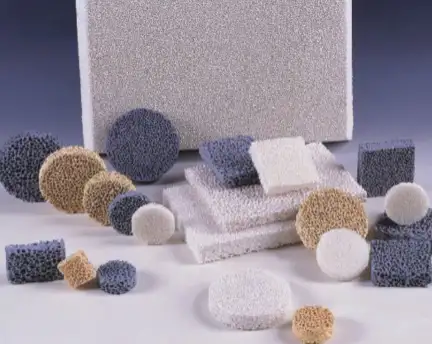
Alumina: economical and good thermal stability for many aluminum alloys.
-
Silicon carbide (SiC): better wear resistance and higher temperature tolerance, preferred for alloy/foil work.
-
Zirconia: used when alloy chemistry or critical applications demand the best chemical inertness.
Shape and mounting
Square and round plates fit standard boxes. Custom shaped filters reduce dead volume for small pours and improve flow uniformity.
Quality assurance and test methods
Key tests to require from the vendor:
-
Bulk density and open porosity measurement.
-
Pore size distribution and PPI certification.
-
Thermal shock cycles data or certificate.
-
Filtration efficiency tests on standard contamination coupons.
-
Traceable batch numbering and packaging photo proof.
Independent lab testing on sacrificial samples is recommended before wide adoption. Filtration research indicates real improvements in mechanical performance when filters meet design parameters.
Procurement negotiation tips
-
Ask for a small sample shipment for lab validation before a full order.
-
For bulk import, negotiate FOB factory price and choose freight term that the buyer controls.
-
Include acceptance criteria in contract that tie payment to passing weld or inclusion tests.
-
If the seller claims superior performance, request test data and client references in India.
Indian local strengths and weaknesses
Strengths
-
Faster local re-supply for urgent small orders.
-
Easier vendor visits and quicker technical support.
-
Lower logistics paperwork for small batches.
Weaknesses
-
For container-volume orders, local per-piece price may be higher.
-
Advanced high-PPI control and consistent QA processes might be less standardized across all local vendors.
-
Some Indian buyers continue to import Chinese filters for specialized requirements. Evidence of import activity is visible in customs and trade records.
Common pitfalls foundries make when introducing ceramic foam filters
-
Selecting PPI purely on price rather than on casting type.
-
Installing filters with gaps that allow metal to bypass filtration.
-
Overlooking packaging and moisture protection during local transport.
-
Failing to pre-wet or condition filters when required by manufacturer practice.
-
Skipping metallurgical checks after trial pours.
FAQs
Ceramic Foam Filters: Aluminum Casting FAQ
1. What pore size should I choose for gravity die casting?
For standard gravity die casting, 30–40 PPI (Pores Per Inch) provides the best balance between metal flow rate and effective filtration. If your product requires an ultra-clean surface or is a critical aerospace component, consider testing 50 PPI in pilot pours to capture even finer inclusions.
2. Can ceramic foam filters be reused?
3. Why do some filters produce higher back pressure?
Back pressure increases as the PPI (Pores Per Inch) increases or if the filter density is too high. A 50 PPI filter has much more surface area and resistance than a 10 PPI filter. To compensate, you must design your gating system with a larger filter area or a higher sprue height to maintain the required flow velocity.
4. Are India-made or Chinese filters compatible with all aluminum alloys?
5. How should filters be stored on-site?
6. Do I need a custom filter box for different sizes?
Standard filter prints (boxes) can accommodate many sizes. However, for thin-wall parts or high-volume production, a custom-engineered filter box can minimize the “dead volume” of metal left in the gating system, significantly increasing your casting yield and reducing scrap costs.
7. How fast will I see ROI from using better filters?
8. Is a factory-direct order from China cheaper?
9. What documentation should a filter supplier provide?
Every shipment should include:
- Material Certificate: Confirming alumina/SiC purity.
- PPI Verification: Ensuring the pore count is within tolerance.
- Dimensional Report: To ensure they fit your filter prints.
- Thermal Shock Test: Confirming the batch can handle the plunge into molten aluminum.
10. Which is better, Alumina or Silicon Carbide (SiC) filters?
Alumina: Best for general aluminum casting (up to 1200°C). It is economical and offers excellent flow properties.
SiC (Silicon Carbide): Essential for copper, bronze, or iron casting where temperatures exceed 1400°C, or when extreme abrasion resistance is required during long pours.
Quick decision checklist for buyers
-
Define casting type and quality target.
-
Choose candidate PPI range.
-
Order samples from both a local vendor and adtech for A/B testing.
-
Run metallographic and inclusion-count comparison on test pours.
-
Evaluate total landed cost including duties, freight, and local taxes.
-
Decide on stock strategy: local emergency stock plus periodic import for volume.