

Ceramic fiber square rope rated to 2300°F / 1260°C provides a reliable, low-thermal-conductivity gasket and packing solution for molten-aluminum handling, furnace doors, expansion joints, and degassing seals when selected with the correct composition, braid density, and optional reinforcement; when installed and maintained following best practices it extends equipment life, reduces heat loss, and delivers predictable service life under cyclic thermal loading.
If your project requires the use of ceramic fiber square rope, you can contact us for a free quote.
What this product is and why square braid matters
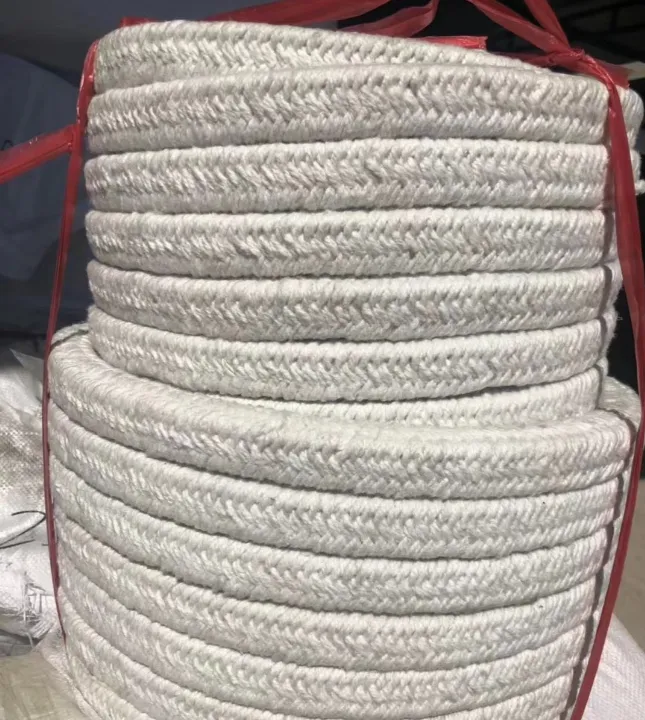
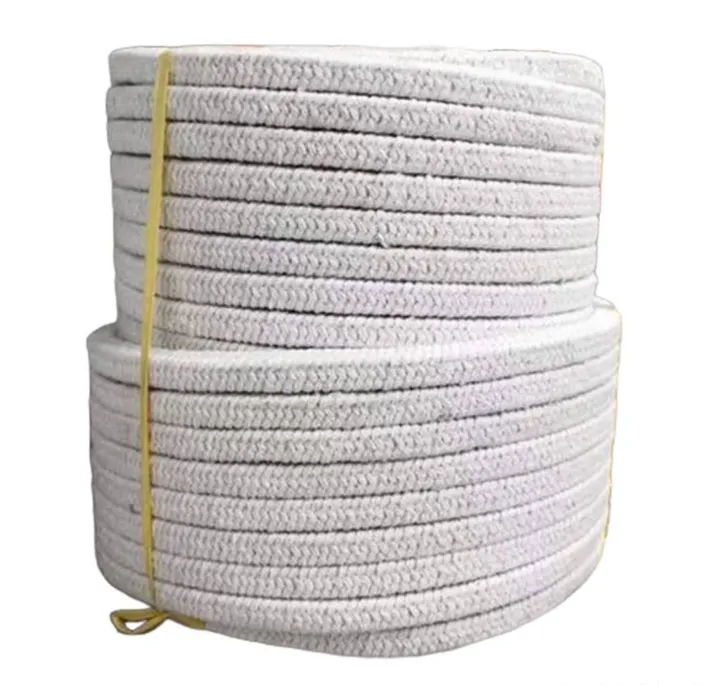
Ceramic fiber square rope is a textile-formed sealing product made from high-temperature alumino-silicate fiber yarns woven around a core and finished into a square-section braid. Compared with round braids and twisted ropes, square braid geometry yields a flatter contact surface, improved compressive sealing with lower creep-in, and a mechanically stable profile that resists rotation inside gasket channels. That makes it especially useful where a uniform seat and consistent sealing pressure are required, such as furnace door gaskets, molten metal contact seals and vacuum degassing interfaces.
Materials, compositions and why they matter
Primary material families
Ceramic fiber ropes for 2300°F service are typically formed from alumino-silicate (A-S) fibers. Two common families are:
-
Low-to-medium alumina A-S fibers: Typical Al2O3:SiO2 ratios are in the range of about 40:60 up to 55:45 by weight. These are widely used and economical while providing good insulating performance to 2300°F.
-
High-alumina fibers and specialty ceramic yarns: These include engineered ceramic fibers and oxide ceramic yarns (for example Nextel-type fibers) with higher Al2O3 content (up to 85 wt% in specialized yarns). They retain tensile strength better at elevated temperatures but are more costly.
Typical chemical composition (representative)
| Component | Typical range (wt%) | Role |
|---|---|---|
| Al2O3 (alumina) | 20 to 55 | Improves high-temperature stability and strength |
| SiO2 (silica) | 40 to 75 | Forms the glassy matrix that binds fibers, provides thermal stability |
| Trace oxides (Fe2O3, Na2O, K2O) | <1 | Impurities; affect viscosity and shrinkage. |
| Organic carrier / binder (burns out) | up to 5 | Assists processing; removed in service. |
Note: suppliers quote specific Al2O3/SiO2 balances and loss-on-ignition (LOI). For application in contact with molten aluminum, verify alloy compatibility and absence of contamination sources.
Also read: Ceramic Fiber Rope Price: 2026 Wholesale Bulk Cost Guide
Manufacturing and braid constructions
Core and over-braid architecture
Square braided rope is produced by over-braiding fine ceramic yarns over a uniaxial core. The core may be dense ceramic fiber, or a bundle of yarns laid axially to increase compressive resistance. Over-braiding produces the square cross-section and helps control unraveling when cut. Some constructions add a thin fiberglass carrier yarn that aids braiding and dimensional stability during handling.
Why square braid vs round braid or twisted rope
-
Square braid gives a larger contact area and a flatter seal bulb that compresses predictably in a gland.
-
Round braid is better where ropes must be pushed into round grooves or where rotational freedom is acceptable.
-
Twisted ropes are generally more compressible and used where fill and bulk are required.
Choose geometry to match groove cross-section, compressibility required and abrasion conditions.
Optional metallic reinforcement
For applications where mechanical abrasion, extrusion, or EMI grounding is a concern, manufacturers can include an Inconel wire or stainless-steel wire insert woven into the braid. This improves physical robustness and can increase compressive spring-back at temperature while adding corrosion considerations depending on the environment.
Temperature ratings, classification and test methods
Rated temperatures
-
Short-term peak resistance: Many ceramic fiber ropes are rated to 2300°F (1260°C) short-term.
-
Continuous service: Typical continuous working temperatures are specified near 2000°F to 2300°F depending on density and manufacturer guidance; verify long-term service tables for the exact product.
Why two numbers matter
Short-term peak rating indicates a material will withstand brief excursions without catastrophic failure. Continuous rating reflects stability, creep, and chemical changes during sustained exposure. Design sealing systems using continuous rating as the baseline and validate against expected thermal cycles.
Standard test methods commonly referenced
-
ASTM D4268: tensile testing methods for fiber ropes where applicable.
-
Manufacturer test protocols for shrinkage, LOI, and continuous-use stability are often listed on technical data sheets. Request TDS and certification from vendors.
Mechanical and thermal properties (overview table)
| Property | Typical value or range | Relevance to gasket engineering |
|---|---|---|
| Thermal conductivity (room to high T) | Low compared to metal seals; specific values depend on density | Low heat storage, better insulation |
| Bulk density | 2.0 to 48.0 kg/m3 typical across fiber products; rope densities 32–36 PCF common | Affects compressibility and thermal conductivity |
| Tensile strength | Varies with yarn and braiding; manufacturers provide datasheet numbers | Determines handling robustness and tear-resistance |
| Compression set | Moderate; testing under cyclic load required | Predicts long-term sealing performance |
| Chemical resistance (pH) | Generally tolerant pH 2 to 12; avoid hydrofluoric and concentrated phosphoric acids | Important for furnaces that off-gas corrosives |
| Weight loss / LOI | 10 to 25% depending on binder content | Higher LOI may increase early shrinkage during first bake |
| Abrasion resistance | Improved with denser braids and metallic inserts | Needed where rope rubs against metal edges |
Typical datasheet table: example spec set (representative)
This table is a synthesis of manufacturer TDS ranges. Always obtain vendor-specific TDS for procurement and validation.
| Characteristic | Typical value | Units |
|---|---|---|
| Product form | Square braided rope | — |
| Rated temperature (short-term) | 2300 | °F |
| Rated temperature (continuous) | 2000–2300 | °F |
| Composition | Alumino-silicate fiber yarn; optional Inconel insert | — |
| Cross-section sizes | 3 mm to 25 mm (examples) | mm |
| Tolerance (diameter/width) | ±0.5 mm typical | mm |
| Density (rope) | 33–36 | PCF (pounds per cubic foot) |
| LOI (loss on ignition) | 12–22 | % |
| pH resistance | 2–12 (general) | pH |
| Typical applications | Furnace gaskets, degassing seals, door seals, hot-top seals | — |
Applications in aluminum casting and molten-metal processing
Where square braided ceramic rope shines
-
Gaskets for degassing chambers and vacuum lids: square braid provides the flat seal needed when lids are clamped.
-
Furnace and kiln door gaskets: compresses to seal doors while resisting spalling.
-
Hot-top seals and pour spout packing: resists direct heat and occasional splash exposure when used behind protective lip or metal sleeve.
-
Expansion joint packing: compensates thermal expansion while maintaining seal integrity.
Special considerations for molten aluminum contact
-
Direct, prolonged contact with molten aluminum can attack fibers and cause contamination. Use rope as a sealing member behind a protective metal lip or refractory transition where possible. Avoid loose fibers entering molten metal streams; use properly anchored gasketing geometry to reduce fiber ingress.
Selection criteria for engineers and procurement specialists
-
Temperature profile: Use continuous service rating for design. For cyclical loads, request fatigue/creep test data.
-
Contact chemistry: If potential for corrosive gases exists, verify fiber composition and chemical resistance.
-
Braid geometry: Select square braid to match rectangular or flat groove; round braid for round grooves.
-
Reinforcement: Where abrasion, extrusion, or spring-back is needed, specify metallic insert (Inconel recommended for high-temp).
-
Density and compressibility: Lower density for insulation; higher density for mechanical stability.
-
Sizing and tolerance: Work with supplier to match groove width, crown height and desired compression percentage (typically 15–30% target compression at clamp load).
-
Certs and traceability: Request TDS, SDS, batch chemical analysis and any ISO or customer-specific testing records.
Installation, sealing geometry and common failure modes
Recommended installation practices
-
Groove design: Provide a gland depth equal to 1.2 to 1.5 times the rope cross-height so that at clamping the rope compresses to the target percentage without bottoming out.
-
Compression control: Use flat bearing plates or a continuous clamping bar to prevent local extrusion.
-
Anchoring: Secure rope ends with high-temperature cement or mechanical retainers; over-lapping joints should be staggered to avoid a continuous leak path.
-
Bake-in: After initial installation, a controlled heat cycle burns out carrier organics and stabilizes geometry.
Typical failure modes and mitigation
-
Creep extrusion: Occurs when compression is excessive or rope density is too low. Mitigate with higher density or metallic insert.
-
Abrasion at groove edges: Add chamfers and smooth surfaces; consider an Inconel guard wire in braid.
-
Fiber ingress into molten metal: Prevent by using protective metal lip or ceramic window; maintain rope behind a barrier.
-
Chemical attack: Choose higher-alumina fibers for corrosive atmospheres.
Also read: Ceramic Fiber Square Braided Rope: 1260°C High-Temp Furnace Sealing
Handling, storage, health and safety
Handling and PPE
Ceramic fiber products are manufactured mineral fibers and can release respirable dust during cutting and machining. Use engineering controls and PPE:
-
NIOSH-certified respirator if dust cannot be controlled.
-
Gloves, long sleeves and eye protection.
-
Wet-cut or use vacuum extraction to reduce airborne fiber.
Storage
Keep dry, covered and away from water and chemicals that could alter composition. Store in sealed packages and rotate stock to avoid long-term exposure to humidity which can affect binders.
Disposal and regulatory notes
Follow local regulations for non-hazardous mineral fiber waste; many ceramic fibers are asbestos-free but still regulated as respirable dust. Vendors supply SDS with handling and disposal guidance.
Comparative table: ceramic fiber square braid vs alternatives
| Material | Max temp (typical) | Key benefit | Key limitation |
|---|---|---|---|
| Ceramic fiber square braid | 2300°F / 1260°C | Flat seal, low thermal conductivity, flexible | Abrasion and mechanical weakness unless reinforced |
| Graphite rope | ~1200–1600°F depending on grade | Excellent compressibility and sealing in static flanges | Oxidizes at high T unless inerted; not suitable in oxidizing atmospheres |
| Mineral wool twisted rope | ~1200–1400°F | Low cost for lower temp ranges | Not suitable for 2300°F |
| Ceramic high-alumina yarn braid | up to 3000°F in specialty forms | Superior strength at temperature | Costly; may be stiff and harder to compress |
Sizing, compression calculation and a quick selection worksheet
Basic sizing rules
-
Select rope cross-section slightly larger than groove width to attain 20% compression under clamp load.
-
For flat groove: rope width = groove width + target compression allowance.
-
For round groove: choose round braid diameter to allow 15 to 25% compression.
Selection worksheet (example)
| Input | Example value |
|---|---|
| Groove width | 12 mm |
| Desired compression | 20% |
| Target installed rope width | 12 mm / (1 – 0.20) = 15 mm |
| Choose rope nominal section | 15 mm square braid |
Notes
This simple calculation assumes linear compression behavior. For critical seals, request a manufacturer compression vs load curve and perform a gasket stress analysis.
Procurement, customization and cost considerations
-
MOQ and lead time: Square braided rope may have MOQs depending on diameter and metallic inserts. For standard diameters suppliers hold stock; custom cross-sections add lead time.
-
Data and sample validation: Request TDS, sample pieces, and perform a bake and compression test before committing to full-scale purchase.
-
Cost drivers: fiber chemistry (high Al2O3 increases cost), braid complexity, metal insert, and finishing (coatings, impregnation) are primary cost drivers. Bulk buys and long-term agreements reduce unit price.
Maintenance, inspection and expected service life
-
Inspection intervals: Visual checks every scheduled shutdown; look for extrusion, fraying, and loss of cross-section.
-
Predictable life: Service life depends on temperature cycles, mechanical compression and environment. In mild cyclic use, ropes can last multiple years; in aggressive molten-metal splash environments, life may be measured in weeks or months. Track seal compression set to plan replacement.
-
Refurbishment: In some assemblies, re-packing with fresh rope is straightforward; in others complex removal requires planned downtime.
Certifications, datasheets and testing you must request
When buying, demand:
-
Technical data sheet with continuous/peak temperature and composition.
-
SDS (safety data sheet) that describes fiber class and handling.
-
Compression-set and tensile test reports if available.
-
Traceable batch chemical analysis for critical molten-metal contact applications.
Practical selection checklist (engineer / buyer)
-
Confirm continuous operating temperature and maximum excursions.
-
Define groove geometry and target compression.
-
Decide on braid geometry: square braid for flat grooves.
-
Specify reinforcement (Inconel/stainless) if abrasion expected.
-
Request TDS, SDS, compression test results and a sample.
-
Verify vendor quality system and lead time.
Frequently Asked Questions
Ceramic Braided Rope: 10/10 Technical FAQ
1. What does 2300°F rating mean in practice?
In practice, a 2300°F (1260°C) rating refers to the “classification temperature”—the point at which the material can tolerate brief exposure without catastrophic failure. For continuous service, you should always use the vendor’s continuous-use rating, which is typically lower. Design your system based on the continuous number and validate it against expected thermal cycles to prevent premature hardening.
2. Can square braided ceramic rope touch molten aluminum?
Use extreme caution. Direct, extended contact with molten aluminum risks chemical attack on the fibers and potential melt contamination. It is best practice to locate the rope behind a metal lip or refractory barrier. Always validate the specific rope grade with supplier testing under simulated splash conditions.
3. Does a metallic insert improve service life?
Yes. Adding an Inconel or stainless steel wire insert significantly increases abrasion resistance, “spring-back” (elasticity), and overall mechanical robustness. However, it increases stiffness and cost. Choose the insert grade based on the chemical environment—for example, use Inconel for superior oxidation resistance at the highest temperatures.
4. How do I cut and join rope in the field?
5. Which certifications should I insist on?
For industrial traceability, always insist on:
- TDS & SDS: Technical and Safety Data Sheets.
- Batch Chemical Analysis: To ensure purity and low shot content.
- ISO 9001 Certification: From the vendor.
- Compression/Tensile Records: For critical structural sealing applications.
6. What are the safety concerns during installation?
PPE REQUIRED
The primary concern is fiber inhalation. Avoid dry cutting without dust control. Always wear appropriate respirators (N95 or higher), gloves, and long sleeves to prevent skin irritation. Follow the SDS for specific exposure limits and local environmental regulations.
7. How to size rope for a rectangular gland?
Calculate the nominal (uncompressed) cross-section based on your target installed compression (usually 15-25%). As a rule of thumb, design the gland depth to be 1.2 to 1.5 times the cross-height to allow for proper seating and to prevent the rope from “bottoming out” before a seal is achieved.
8. What alternatives exist for oxidizing atmospheres?
9. How is service life estimated?
Service life is a function of:
- Temperature Cycles: Rapid heating/cooling accelerates fiber embrittlement.
- Mechanical Compression: Loss of resilience over time.
- Abrasion & Chemical Exposure: Physical wear and chemical erosion.
Use vendor test data and small-scale in-plant trials to establish a realistic preventative replacement interval.
10. How do I prevent fiber ingress into molten metal?
Use a physical barrier: a metal lip, ceramic sleeve, or secondary containment layer. By keeping the rope tucked behind protective geometry, you prevent direct exposure to the melt, thereby eliminating the risk of fibers breaking off and entering the metal stream.
Closing recommendations
-
Treat square braided ceramic rope as a system component: rope chemistry, braid geometry, groove design and clamp mechanics together determine seal success.
-
For mission-critical molten-aluminum systems, obtain samples and run a short in-line trial under real process conditions.
-
Always request full datasheets and test data from your supplier before acceptance. Manufacturer product lines such as FiberFrax, CeraTex and MaxRope present typical families and testing protocols you can use as references.