

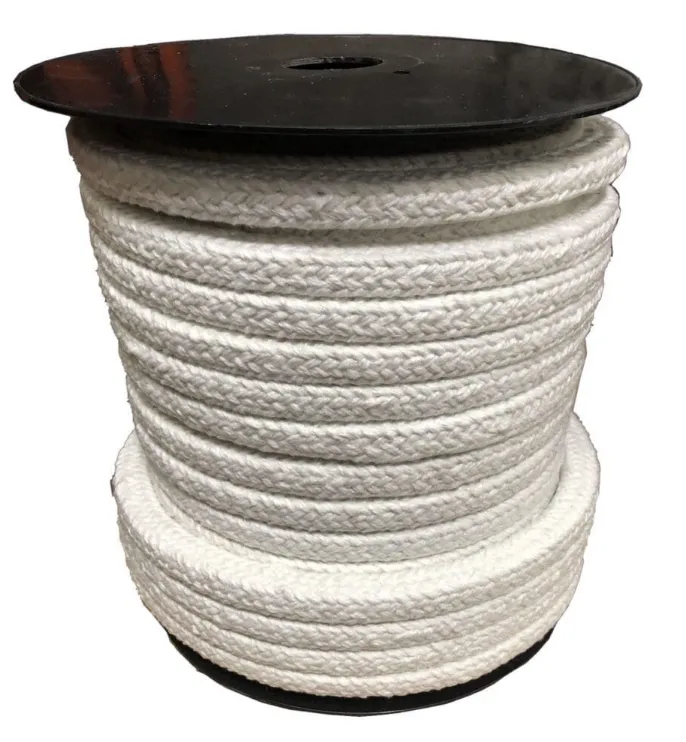
Ceramic fiber square braided rope rated to 1260°C is a compact, high-performance sealing and packing product engineered to provide long service life in furnace, kiln, and high temperature process equipment. When selected and installed correctly it delivers superior sealing under point loads, excellent compressibility recovery, and stable thermal insulation in alumina-silicate environments. For heavy duty furnace doors and irregular contact faces, square braid offers better contact distribution and abrasion resistance than round or twisted ropes, while reinforced variants add tensile strength or mechanical support where needed. Proper material grade, braid density, and installation technique determine long-term performance more than price.
Overview and purpose
Ceramic fiber braided ropes are manufactured from long ceramic fibers spun from alumina and silica feedstock. The square braided version is woven into a near-rectangular cross section that concentrates more fiber mass across the contact face. This geometry yields higher contact sealing efficiency and greater abrasion resistance where the seal sees point or edge loading. Typical applications include furnace door seals, furnace car seals, expansion joint packing, sliding gate seals and service openings in aluminum, steel, glass and ceramics plants.
Material chemistry and temperature performance
Alumina-silica chemistry and working limits
Most commercial 1260°C ceramic fiber ropes are derived from alumina-silica (Al2O3–SiO2) ceramic fibers. The nominal working temperature refers to continuous use and depends on product density and reinforcement. Typical long term working temperature is around 1000°C with short-term excursions and sealing applications rated to 1260°C. These fibers retain low thermal conductivity while resisting thermal shock better than bulk refractories in many sealing applications.
Reinforcements and coatings
Manufacturers add glass filament or stainless steel wire reinforcement when higher tensile strength, improved mechanical stability, or better anchoring is required. Stainless reinforcement is common for packing subject to movement and tension. Glass reinforcement can aid handling and improve braid integrity while still allowing the rope to conform under compression. Some ropes use a thin inorganic sizing to reduce fiber fuzz and dust during handling.
Construction formats and what they mean in practice
Square braid construction
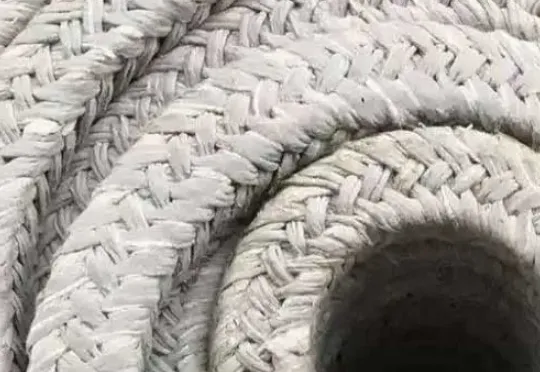
Square braid uses an over-braided weave that creates a flattened or rectangular cross section. That shape provides these practical benefits:
-
Wider contact footprint which reduces local penetration under clamp pressure.
-
Better abrasion resistance on flat faces where repeated door closures create wear.
-
Higher packing density per cross-sectional area relative to round braid.
Square braid is particularly effective where seal faces have uneven pressure distribution and where the seal must fill irregular gaps.
Round braid and twisted rope summary
Round braid (circular cross section) and twisted rope (multi-ply twist) remain widely used because they are easier to compress and conform to circular openings. Twisted rope is often preferred where compressibility and resilience are critical, for example around pipe flanges. Round braid distributes load evenly in radial applications. Compared to square braid, these forms trade sealing contact area for greater flexibility.
Selecting a format by application
-
Furnace door seals with planar mating faces: square braid preferred.
-
Circular ports or flanges: round braid or twisted rope preferred.
-
Moving seals that need tensile reinforcement: reinforced variants with SS wire recommended.
Key technical parameters (table)
| Parameter | Typical value or range | Why it matters |
|---|---|---|
| Continuous temperature rating | 1000°C typical | Indicates sustained service capability |
| Short-term max temperature | 1260°C rating | Limit for sealing/exposure events |
| Density options | 200 to 700 kg/m³ common; 650 kg/m³ typical for heavy seal | Higher density improves sealing and abrasion resistance but reduces compressibility |
| Cross section sizes | 6 × 6 mm up to 40 × 40 mm common | Match to gap size and clamping force |
| Reinforcements | Glass filament, stainless steel wire | Adds tensile strength, reduces elongation |
| Composition | Alumina-silica fibers (Al2O3–SiO2) | Controls temperature and chemical resistance |
| Thermal conductivity | Low compared to castable refractories | Reduces heat loss through seal gaps |
| Typical compressibility recovery | Good to excellent (grade dependent) | Important for maintaining seal after cycles |
(Sources for parameter norms: manufacturing datasheets and technical literature.)
How square braid compares to round and twisted constructions
Comparison table
| Property | Square braid | Round braid | Twisted rope |
|---|---|---|---|
| Contact footprint | High | Medium | Low |
| Abrasion resistance | High | Medium | Low |
| Compressibility | Medium | High | Very high |
| Ease of packing into irregular gaps | Medium | High | Very high |
| Best for planar seals | Yes | Maybe | Rarely |
| Tendency to rotate under load | Low | Medium | High |
| Reinforcement compatibility | Excellent | Good | Good |
This comparison helps engineers choose the right product based on whether sealing efficiency, conformability, or resilience is the priority.
Choosing the correct density and size: load capacity and sealing pressure
Why density matters
Rope density is the primary parameter that influences compressive load capacity and wear resistance. A higher density braid packs more fiber per unit volume which increases contact stiffness and wear life. Lower density products compress easier and better accommodate uneven gaps.
Typical selection strategy
-
Narrow gaps under light clamp force: low to medium density, round braid acceptable.
-
Wider gaps and edge-loaded contact faces: medium to high density square braid recommended.
-
Moving or tensioned seals: consider stainless reinforcement.
Density versus compressive load table (illustrative)
| Density (kg/m³) | Relative compressive stiffness | Typical application |
|---|---|---|
| 200 | Low | Light stove doors, small access hatches |
| 350 | Medium-low | Low-pressure furnace seals |
| 500 | Medium | Standard industrial furnace doors |
| 650 | High | Heavy duty furnace doors, sliding gates |
| 700+ | Very high | Abrasive contact points under high pressure |
Note this table is a practical guide. Always confirm with supplier datasheets for exact mechanical numbers.
Mechanical properties and tensile reinforcement
Square braided ceramic ropes are primarily insulation and sealing products rather than load-bearing cables. Tensile strength is modest compared to metal packings. For applications where ropes might be pulled tight or held under mechanical tension, choose reinforced variants that include SS wire or ceramic core. Reinforcement also helps prevent braid collapse when the product is compressed repeatedly.
Key mechanical considerations:
-
Tensile strength with SS reinforcement can be multiple times that of unreinforced rope.
-
Reinforced rope can be harder to compress and may require higher clamp force to seal.
-
Glass filament reinforcement balances improved handling with minimal compromise in compressibility.
Installation best practices (practical engineer checklist)
Pre-installation inspection
-
Inspect length for uniform braid and absence of broken filaments.
-
Verify material grade and density against the application requirements.
-
Confirm reinforcement type if tensile load is expected.
Preparing the joint
-
Clean mating surfaces to remove scale, slag or loose refractory.
-
Remove sharp edges or projections that could cut the braid.
-
Pre-form lengths slightly longer than the gap to allow compression.
Packing technique
-
For planar seals: place square braid with the broad face parallel to the contact surface for maximum area.
-
For round ports: compress to fit and ensure no twisting.
-
Overlap joints by one braid width where continuous sealing is needed.
-
When using SS reinforced braid, avoid bending to tight radii which could fatigue the wire.
Fastening and compression
-
Apply uniform clamp force. Uneven pressure reduces service life.
-
Avoid over-compression which can crush the braid leading to fiber shedding and premature gap opening.
Maintenance and inspection schedule
-
Inspect seals after initial heat cycles and then at scheduled shutdowns.
-
Replace when visible wear reduces contact area or when fibers become friable and loose.
-
If dusting increases or sealing performance declines, remove and replace.
How to identify high-quality ceramic fiber square braided rope
Visual and tactile checks
-
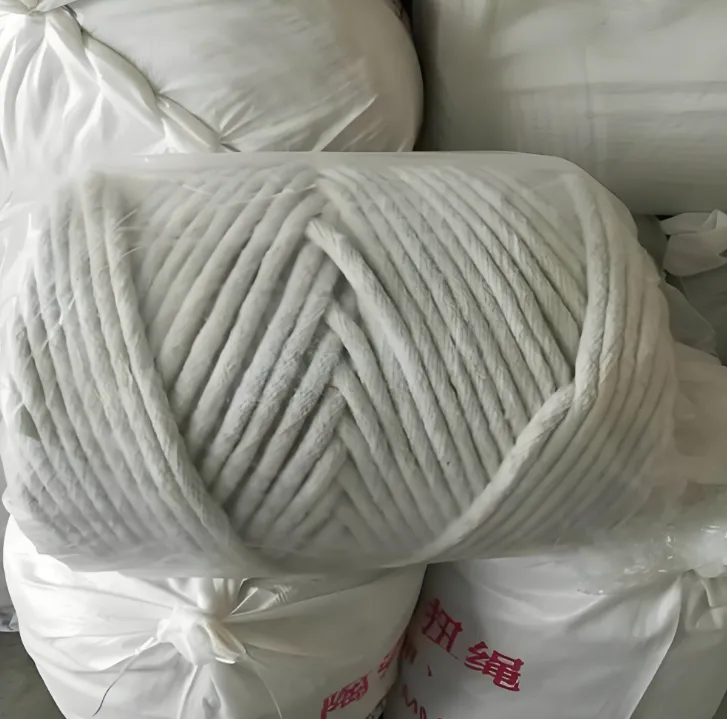
Uniform color and braid pattern along the full length.
-
Very few broken filaments or fuzz on the surface.
-
Tight, consistent braiding with no gaps or loose strands.
-
Edges cut cleanly without excessive fraying.
Lab or document checks
-
Request manufacturer Certificate of Analysis showing chemical composition (Al2O3, SiO2 percentages) and processing grade.
-
Confirm density and working temperature on the datasheet.
-
Ask for third-party test results if mechanical strength or thermal conductivity is critical.
Danger signs of poor quality
-
Dark discoloration or uneven coloring which could indicate contamination.
-
Excessive airborne dust during handling which increases maintenance and health concerns.
-
Inconsistent braid geometry that will reduce sealing performance.
Health, safety and handling
Dust control and PPE
Ceramic fiber products generate loose elongated respirable fibers when handled roughly. Use local extraction, wear respirators rated for fibrous dust, and wear protective clothing and gloves. After installation, fiber shedding falls dramatically once the system reaches operating temperatures, but proper handling during installation and removal is essential.
Disposal notes
Collected dust and waste should be handled per local regulations for mineral fiber waste. Avoid burning, and never use power tools that generate dust without containment.
Regulatory considerations
Suppliers often provide Material Safety Data Sheets with handling recommendations and fiber hazard classifications. Follow the supplier guidance and local occupational safety rules.
Chemical resistance and environment compatibility
Ceramic fiber ropes resist neutral and acidic atmospheres well. In strongly alkaline environments or in presence of molten alkaline fluxes, the fiber may degrade more rapidly. For exposure to reducing atmospheres or liquid metals, select materials and reinforcement carefully and consult with the manufacturer for compatibility.
Comparative materials table: ceramic fiber versus alternative sealing materials
| Material | Max continuous temp | Typical strengths | Best use cases | Cost level |
|---|---|---|---|---|
| Ceramic fiber rope (1260°C) | ~1000°C continuous; short-term 1260°C | Low tensile, high sealability | Furnace doors, expansion joints | Medium |
| Graphite packing | ~450°C to 600°C depending on binder | Good compressive recovery | High temperature with lubricity needs | Medium-low |
| Mineral wool packing | 600°C to 800°C | Lower sealing density | Low-cost insulation | Low |
| Metal braided packing | >600°C for some alloys | High tensile | Mechanical shafts with rotation | High |
| Ceramic gasket sheets | Up to 1400°C with refractories | Rigid sealing | Static flat flanges | Medium-high |
This table helps procurement and engineering teams weigh trade-offs.
Performance testing and acceptance criteria
Recommended tests before acceptance
-
Verify dimensional conformity and braid density.
-
Compression set test using a mock-up of the seal interface.
-
Visual inspection under magnification for consistent fiber orientation and absence of contaminants.
-
If available, request thermal conductivity and shrinkage test data from the supplier.
Field acceptance
-
Confirm that the seal holds pressure after several heat-up and cool-down cycles.
-
Check for excessive dusting or fiber emission at initial runs.
-
Monitor for leakage or hot spots near the seam.
Typical failure modes and mitigation
-
Abrasion and wear at contact edges. Mitigation: choose higher density square braid or protect edges with metal wear strips.
-
Crushing from over-compression. Mitigation: follow recommended compression ratios and use softer backing material to spread load.
-
Chemical attack in alkaline atmospheres. Mitigation: avoid exposure or select chemically resistant grades.
-
Fatigue in SS wire reinforcement from repeated bending. Mitigation: minimize tight bending radius and select rope with flexible wire lay.
Procurement checklist for engineers and buyers
-
Confirm continuous and short-term temperature ratings.
-
Specify cross section, density, and reinforcement type.
-
Request datasheet with composition and physical properties.
-
Ask for certificates and date-coded batch traceability.
-
Request handling and safety documentation.
-
Order sample lengths and perform on-site mock installation.
-
Clarify warranty and replacement policies.
Sample specification template (concise)
-
Product: Ceramic fiber square braided rope
-
Composition: Alumina-silica fiber, 1260°C rating
-
Density: 650 kg/m³ ± 5%
-
Cross section: 20 × 20 mm
-
Reinforcement: Stainless steel wire core optional (specify gauge)
-
Tolerance: ±0.5 mm cross section
-
Packing: Coil length 2 m per piece, wrapped and labeled
-
Documentation: Datasheet, MSDS, CoA included
FAQs
Ceramic Fiber Ropes: 10/10 Technical & Maintenance FAQ
1. What is the difference between the 1260°C rating and long-term working temperature?
1260°C is a short-term exposure rating (Classification Temperature) used for sealing and packing. Continuous service temperature is significantly lower, commonly around 1000°C depending on density and mechanical load. Exceeding continuous limits leads to fiber devitrification and excessive shrinkage.
2. Can square braided rope be used in moving seals?
It can, but square braid is stiffer than twisted rope. For moving applications or those requiring higher flexibility, choose a reinforced round braid or a twist rope designed for flex. Square braids are better suited for static high-compression grooves.
3. How do I cut and finish braid ends to avoid fraying?
4. Is stainless steel reinforcement necessary?
5. How often should furnace door seals be inspected?
6. Can ceramic fiber rope handle chemical exposure?
It resists neutral and acidic gases well. However, strong alkalis and some molten fluxes (like those used in aluminum melting) can attack and degrade the silica-alumina fibers. Consult the supplier for specific chemical environments.
7. What density should I choose for heavy-duty doors?
8. How to reduce dust during installation?
Work in a ventilated area and use local extraction. Pre-wetting the rope slightly or using pre-formed gaskets can minimize airborne particles. Once the rope has been heated through its first cycle, dust production drops significantly.
9. Are there industry standards for ceramic fiber ropes?
10. Can I splice or join lengths on-site?
Yes. Use overlap joints or inorganic refractory adhesives for a secure bond. Ensure the joint area is properly compressed within the seal groove to prevent the creation of a “heat leak path” during thermal expansion.
Final recommendations for engineers and purchasers
-
Prioritize specification clarity. Define temperature duty, gap geometry, compressive force, and expected abrasion.
-
Request samples and run a mock-up under real operating cycles before committing to long runs.
-
Where safety or production continuity is critical, choose reputable suppliers that provide certificates and measurable test data.
-
For heavy planar seals, specify square braid with appropriate density. For circular or highly irregular gaps choose round braid or twisted rope.
-
Include handling, installation and disposal guidance in purchase orders to reduce risk.
Closing note
Ceramic fiber square braided rope rated to 1260°C remains a practical and economical solution when furnace sealing requires a wide contact area and abrasion resistance. The correct choice of density, cross section, and reinforcement coupled with proper installation and inspection yields the best service life. For critical installations consult technical datasheets and request performance tests from the supplier before large scale procurement.