

In the rigorous landscape of US heavy industry—from Gulf Coast refineries to Great Lakes steel mills—effective thermal sealing is a critical factor in both operational safety and energy conservation. AdTech stands out among ceramic fiber rope suppliers in the USA by delivering advanced refractory solutions engineered for service temperatures up to 2300°F (1260°C). Our ropes are manufactured using high-purity alumina-silica fibers, providing superior chemical stability and exceptional resistance to thermal shock in the most demanding reactor and furnace environments.
If your project requires the use of Ceramic Fiber Rope, you can contact us for a free quote.
As a strategic partner to the US power generation and aerospace sectors, AdTech maintains an extensive inventory of twisted, round, and square braided ropes. Whether you require standard fiberglass reinforcement for static seals or Inconel wire reinforcement for high-vibration environments, our products ensure long-term durability and compliance with strict industrial safety standards.
US-Specific Product Portfolio:
-
Twisted Ceramic Fiber Rope: Highly flexible and compressible; the primary choice for boiler door insulation and pipe lagging in US power plants.
-
Round Braided Rope: High-density construction for maximum resistance to mechanical abuse; ideal for high-temperature gaskets and sealings in metal casting.
-
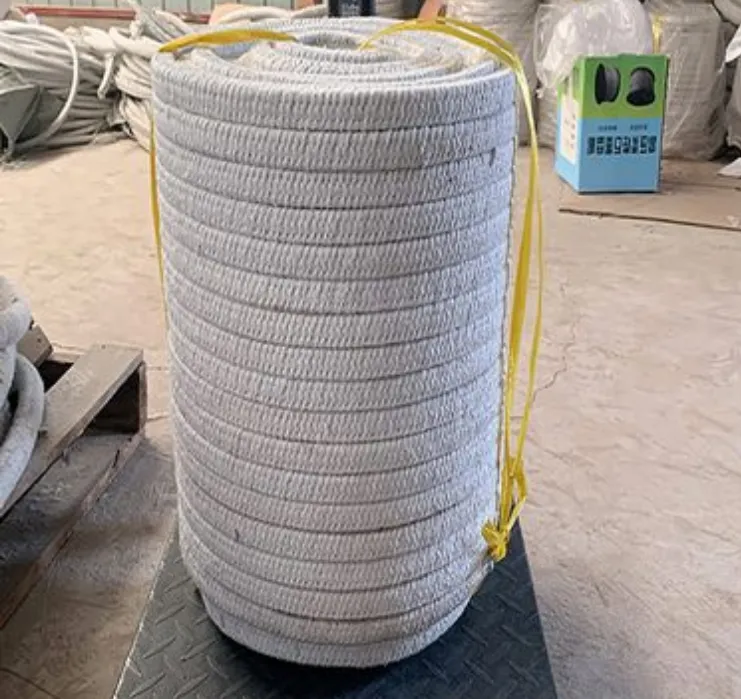
Square Braided Rope: Provides a flat, stable contact surface; specifically designed for furnace door seals and expansion joints in large-scale industrial kilns.
What Defines High-Temperature Ceramic Fiber Rope at 2300°F?
Understanding the thermodynamic baseline of refractory textiles is crucial before contacting any distributor. High-temperature ceramic fiber ropes consist of spun or blown alumino-silicate fibers woven into dense matrixes. These textiles inherently resist thermal shock, chemical attacks, and oxidative degradation.
When evaluating USA stock, buyers must verify the chemical composition. Premium grade ropes typically contain approximately forty-seven percent alumina and fifty-two percent silica. This specific ratio stabilizes the molecular structure, allowing the material to withstand continuous operating environments up to 2300 degrees Fahrenheit (1260 degrees Celsius) and brief peak exposures exceeding 2400 degrees Fahrenheit.
The Role of Inconel Wire Reinforcement in Mechanical Integrity
Standard refractory textiles lose tensile strength when subjected to intense mechanical stress or severe vibration. To counteract this physical limitation, manufacturers integrate Inconel wire into the yarn prior to the braiding process. Inconel, a nickel-chromium-based superalloy, retains exceptional yield strength at elevated temperatures where standard carbon steel or stainless steel would undergo rapid creep deformation.
The inclusion of this superalloy prevents the braided packing from unravelling during dynamic thermal cycling. Facilities operating heavy industrial furnaces rely on this specific reinforcement to maintain structural integrity under continuous compression and decompression cycles.
Table 1: Technical Specifications of 2300°F Inconel-Reinforced Rope
| Technical Parameter | Specification Value | Testing Methodology |
|---|---|---|
| Continuous Operating Limit | 2300°F (1260°C) | ASTM C892 |
| Melting Point | > 3200°F (1760°C) | Thermogravimetric Analysis |
| Alumina Content (Al2O3) | 47% – 49% | X-Ray Fluorescence (XRF) |
| Silica Content (SiO2) | 50% – 52% | X-Ray Fluorescence (XRF) |
| Reinforcement Material | Inconel 600 / 601 Wire | Metallurgical Certification |
| Thermal Conductivity (at 1000°F) | 0.85 BTU-in/hr-ft2-°F | ASTM C201 |
| Chemical Resistance | Excellent (pH 2 to 12) | Acid/Base Submersion |
How Do USA Suppliers Guarantee Quality in Inconel-Reinforced Braids?
Procurement managers face immense pressure to source defect-free materials. We observe that top-tier USA suppliers differentiate themselves through rigorous quality assurance protocols and transparent testing documentation. Domestic manufacturers operate under strict ISO 9001 quality management systems, ensuring every spool meets exact dimensional tolerances and density specifications.
Domestic Manufacturing Standards and Testing Protocols
Reliable American distributors do not merely import and resell; they conduct batch testing on raw incoming fibers and finished braided products. Tensile strength tests ensure the Inconel wire provides adequate support without snapping during tight radius installations. Furthermore, suppliers perform thermal shrinkage tests. High-quality 2300-degree ropes should exhibit less than three percent linear shrinkage when exposed to maximum operational heat. Excessive shrinkage leads to gasket failure and dangerous heat leaks.
Supply Chain Logistics and Stock Availability Dynamics
Minimizing downtime requires access to immediate inventory. Leading USA suppliers maintain vast warehouses stocked with multiple diameters and braiding configurations. By leveraging domestic stock, industrial plants bypass unpredictable ocean freight schedules and customs bottlenecks. Many distributors offer just-in-time delivery programs, allowing maintenance teams to schedule shipments precisely when outage turnarounds begin. We recommend partnering with vendors who provide real-time inventory tracking and guaranteed lead times.
Also read: Ceramic Fiber Rope Suppliers in India: Stock, Manufacturers for Sale.
Which Industries Require Continuous 2300°F Thermal Insulation Ropes?
The application spectrum concerning extreme temperature packing spans across multiple heavy industrial sectors. Engineers specify these specialized textiles wherever standard elastomers or fiberglass seals fail prematurely.
Foundry and Steel Mill Door Gasket Solutions
Metal smelting operations represent the most punishing environments regarding thermal insulation. Coke ovens, blast furnaces, and ladle covers emit intense radiant heat and corrosive gases. Inconel-reinforced square braids serve excellently to seal heavy furnace doors. The metallic reinforcement prevents the rope from tearing when the massive steel doors repeatedly slam shut, maintaining a gas-tight seal that protects personnel and conserves fuel.
Aerospace and Petrochemical Exhaust Wrapping
Petrochemical refineries utilize high-temp textiles to wrap complex exhaust manifolds and piping systems. The flexibility of round braided ceramic ropes allows maintenance personnel to insulate intricate pipe geometries. In aerospace testing facilities, engineers use these ropes to seal jet engine test cells, containing both extreme thrust temperatures and acoustic energy.
Table 2: Primary Industry Applications and Configurations
| Industry Sector | Primary Application | Recommended Configuration | Key Benefit |
|---|---|---|---|
| Primary Metallurgy | Furnace Door Gaskets | High-Density Square Braid | Impact resistance against heavy doors |
| Power Generation | Boiler Expansion Joints | Soft Twisted Rope | Accommodates thermal expansion |
| Petrochemical | Flange Sealing | Dense Round Braid | Prevents volatile gas leaks |
| Ceramic Manufacturing | Kiln Car Seals | Square Braid with Graphite | Low friction sliding action |
| Aerospace | Exhaust Heat Shields | Small Diameter Round Braid | Lightweight thermal protection |
Round Braid, Square Braid, or Twisted: Which Configuration Fits Your Thermal Joint?
Selecting the correct cross-sectional geometry dictates the success of the thermal seal. Manufacturers fabricate ceramic fiber textiles using three primary techniques, each tailored toward specific mechanical requirements.
Analyzing Density and Compression Metrics
Twisted Ropes: Formed by twisting multiple strands of ceramic yarn together. This creates a soft, highly compressible product. Engineers deploy twisted varieties to fill irregular gaps or temporary voids where low compression force exists. However, twisted structures lack the durability required regarding high-friction environments.
Round Braids: Constructed by interweaving yarns around a central core. This technique yields a denser, more uniform product compared to twisted versions. Round braids resist unravelling when cut and provide excellent sealing capabilities inside static pipe flanges or circular exhaust ports.
Square Braids: The most robust configuration available. Yarns are braided into a solid square cross-section, resulting in maximum density and structural integrity. Square braids are the definitive choice concerning heavy duty door seals, kiln cars, and environments requiring significant compression resistance. The square shape fits perfectly into U-shaped channels, preventing twisting or rolling during mechanical movement.
How Does Inconel Wire Compare to Fiberglass Reinforcement in Refractory Ropes?
When browsing supplier catalogs, buyers often encounter both fiberglass-reinforced and wire-reinforced options. Understanding the metallurgical differences prevents catastrophic application failures.
Standard refractory ropes often utilize fiberglass filaments to aid the weaving process. While cost-effective, fiberglass begins to melt and degrade around 1200 degrees Fahrenheit. If the application temperature exceeds this threshold, the fiberglass burns away entirely, leaving only the ceramic fiber. Without reinforcement, the remaining ceramic structure becomes brittle and susceptible to vibrational destruction.
Conversely, Inconel wire maintains its structural matrix well beyond 2000 degrees Fahrenheit. When the organic carrying agents burn off, the superalloy lattice continues holding the alumino-silicate fibers tightly together. We stress that any application involving physical movement, high vibration, or continuous friction at temperatures above 1200 degrees Fahrenheit mandates the use of Inconel reinforcement.
Table 3: Reinforcement Material Performance Comparison
| Feature | Fiberglass Reinforcement | Inconel Wire Reinforcement |
|---|---|---|
| Maximum Temperature Limit | 1200°F (650°C) | > 2000°F (1093°C) |
| Tensile Strength Retention | Poor at high temperatures | Excellent at peak temperatures |
| Vibration Resistance | Low | Extremely High |
| Cost Efficiency | Very Economical | Premium Investment |
| Flexibility | High | Moderate (Wire adds stiffness) |
| Best Application Environment | Static, low-temperature zones | Dynamic, extreme-temperature zones. |
What Are the Installation Protocols Regarding High-Temp Ceramic Packing?
Even the highest quality textile will fail if installed incorrectly. Maintenance teams must adhere to strict protocols to maximize the lifespan of the thermal seal.
Managing Shrinkage and Outgassing of Organic Binders
During the manufacturing process, suppliers add a small percentage of organic carriers (usually around two to three percent) to lubricate the fibers and facilitate weaving. When the newly installed rope experiences temperatures exceeding 400 degrees Fahrenheit the very first time, these organic binders will combust. This process produces a small amount of smoke and a distinct odor.
Facilities must anticipate this initial outgassing. Engineers should ensure proper ventilation during the initial heat-up cycle. Once the organics burn away, the rope becomes pure ceramic and metal, entirely non-combustible. Furthermore, technicians must account regarding thermal shrinkage. We advise cutting the rope slightly longer than the groove dimension and compressing it tightly into place, ensuring the ends overlap cleanly without leaving thermal gaps.
How to Evaluate Procurement Contracts with Refractory Material Distributors?
Purchasing departments must analyze multiple metrics beyond the baseline price per foot. Securing a reliable supply chain involves evaluating distributor capabilities, minimum order requirements, and custom fabrication offerings.
Minimum Order Quantities and Custom Fabrication Options
Many industrial applications require non-standard lengths or unique cross-sectional dimensions. Premier USA suppliers possess the capability to manufacture custom runs tailored strictly toward client specifications. Buyers should inquire about the Minimum Order Quantity (MOQ) concerning custom sizes.
Additionally, evaluate the packaging options. Distributors typically offer material on standard spools weighing anywhere from ten to fifty pounds. Large facilities should negotiate bulk pricing agreements based on annual tonnage requirements, ensuring locked-in rates despite fluctuating raw material costs. Consider partnering with vendors who offer value-added services, including pre-cutting the material into precise gasket lengths, reducing installation labor inside your plant.
Are There Health and Safety Compliances Concerning Refractory Ceramic Fibers (RCF)?
Industrial safety commands absolute priority. Refractory Ceramic Fibers (RCF) require specific handling protocols due to their microscopic structure. We strictly advise all personnel to consult local occupational safety regulations before handling these textiles.
OSHA Regulations and Handling Precautions
The Occupational Safety and Health Administration (OSHA) monitors airborne fiber concentrations. Cutting or forcefully compressing dry ceramic ropes can release respirable dust particles into the atmosphere. Prolonged inhalation of these microscopic fibers poses respiratory health risks.
To mitigate these hazards, facilities must enforce stringent Personal Protective Equipment (PPE) mandates. Technicians must wear high-efficiency particulate air (HEPA) respirators, long-sleeved clothing, gloves, and protective eyewear during installation and removal procedures. To suppress dust generation, lightly dampening the material prior to cutting proves highly effective. Always dispose of used refractory materials inside sealed heavy-duty plastic bags, adhering strictly toward local hazardous waste disposal guidelines.
To address health concerns, some suppliers now offer Alkaline Earth Silicate (AES) wool alternatives, commonly known utilizing the term biosoluble fibers. These materials dissolve naturally within human lung fluids if inhaled. However, buyers must note that AES fibers generally exhibit lower continuous temperature limits compared to traditional RCF products, typically maxing out around 1800 degrees Fahrenheit.
10 Frequently Asked Questions About 2300°F Ceramic Fiber Ropes
Technical FAQ: Inconel-Reinforced Ceramic Rope
High-Temperature Sealing, Durability & Installation Guide
1. Can I cut Inconel-reinforced ceramic rope using standard utility knives?
Cutting wire-reinforced textiles requires heavy-duty shears or specialized mechanical cutting tools. Standard utility blades will dull instantly against the superalloy wire and will struggle to sever the dense braided structure cleanly. We recommend taping the section prior to cutting to prevent the ends from fraying.
2. Will this material conduct electricity?
Yes. Because the product contains continuous metallic wire reinforcement throughout its structure, it acts electrically conductive. Never use Inconel-reinforced ropes in areas requiring electrical isolation or near exposed high-voltage terminals.
3. How much compression should I apply during installation?
Optimal compression depends entirely upon the braiding style. Square braids typically require 20% to 30% volume compression to achieve a gas-tight seal. Soft twisted ropes can compress up to 50%. Over-compressing the material risks crushing the ceramic matrix, severely reducing its insulating properties.
4. Is the rope completely waterproof?
No. Uncoated alumino-silicate fibers act highly porous and will absorb water rapidly. While water will not chemically destroy the fibers, a wet rope loses its thermal insulation capabilities entirely until the moisture fully evaporates. Store all inventory inside dry, climate-controlled environments.
5. Does the material contain any asbestos?
Absolutely zero. Modern refractory USA manufacturers entirely eliminated asbestos decades ago. These textiles utilize purely synthetic spun alumino-silicate fibers, making them a safe, modern alternative to hazardous legacy insulation materials.
6. What causes the rope to turn stiff and brittle over time?
Continuous exposure to peak temperatures causes the ceramic fibers to undergo a process called devitrification, where the amorphous glass-like structure slowly crystallizes. This natural degradation makes the material brittle. Routine maintenance schedules must include periodic replacement before catastrophic crumbling occurs.
7. Can I apply liquid refractory cement directly onto the braid?
Yes. Applying high-temperature rigidizer or refractory mortar onto the exterior hardens the surface, preventing mechanical abrasion and increasing resistance against high-velocity gas erosion. Ensure the cement shares a similar thermal expansion coefficient to prevent cracking.
8. Why does my newly installed seal emit smoke when the furnace turns on?
This represents a normal phenomenon. Manufacturers use small amounts of organic lubricants to assist the high-speed braiding machines. These organics vaporize between 400 and 600 degrees Fahrenheit. The smoking ceases entirely once the burn-off phase completes.
9. What is the difference between Inconel 600 and Inconel 601 wire?
Both superalloys perform exceptionally well. Inconel 601 contains an addition of aluminum, giving it slightly superior resistance against high-temperature oxidation. Most standard refractory ropes utilize Inconel 600, which remains perfectly adequate regarding 2300-degree Fahrenheit applications.
10. How do I determine the exact linear footage on a bulk spool?
Because the material is highly compressible, measuring purely by length proves difficult. USA suppliers sell industrial stock based on weight (pounds). Distributors provide yield charts that calculate the approximate linear feet per pound based on the specific diameter and density of the chosen configuration.
We at AdTech trust this exhaustive technical breakdown empowers your team to source optimal refractory solutions. Securing high-temperature textiles from verified domestic suppliers ensures operational longevity, protects vital industrial infrastructure, and maintains uninterrupted production schedules. Focus heavily upon precise material specifications and rigorous safety standards to achieve ultimate thermal sealing success.