

China is the world’s largest producer of ceramic fiber rope, accounting for approximately 60–65% of global production volume. Chinese manufacturers — including AdTech — offer factory-direct pricing that is typically 25–45% below equivalent Western-manufactured products while meeting the same international technical standards (ASTM C-892, ISO 10635). The combination of vertically integrated raw material supply, large-scale production capacity, and accumulated manufacturing expertise makes China the most cost-effective sourcing destination for ceramic fiber rope without compromising on performance.
If your project requires the use of Ceramic Fiber Rope, you can contact us for a free quote.
Why Source Ceramic Fiber Rope from a China Manufacturer?
The decision to source ceramic fiber rope from China is not simply a cost decision — it is a quality, supply chain, and strategic sourcing decision that deserves careful evaluation. We have been manufacturing and exporting ceramic fiber products from China for over two decades, and the question we hear most consistently from international procurement managers is not “is China quality good enough?” but rather “how do I identify which Chinese manufacturer can consistently deliver what their datasheet says?”
That question reflects the maturity of the global sourcing market: buyers understand that China’s ceramic fiber industry includes manufacturers ranging from internationally certified, vertically integrated operations with ISO 9001 and rigorous QC systems to small workshops with no meaningful quality control. The sourcing challenge is supplier identification and verification, not geography.
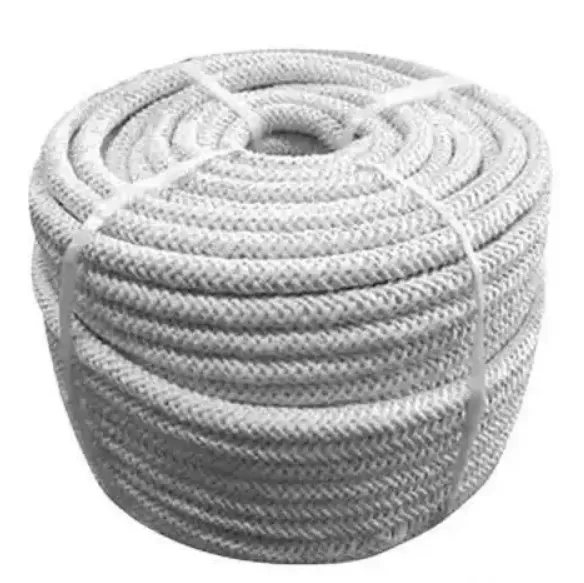
China’s Position in Global Ceramic Fiber Rope Production
China’s dominance in ceramic fiber rope manufacturing is built on structural advantages that took decades to develop:
Raw material integration: China’s alumina-silica mineral resources and the country’s large alumina refining industry provide domestic access to the primary raw materials for ceramic fiber production. Major ceramic fiber manufacturers in Shandong, Henan, and Jiangsu provinces have direct supply relationships with alumina producers, eliminating import costs that manufacturers in the USA or Europe must absorb.
Production scale: Chinese ceramic fiber plants typically operate at monthly production capacities of 200–2,000 metric tons of finished product. This scale allows fixed cost amortization across high volumes, directly reducing per-unit manufacturing cost.
Manufacturing knowledge accumulation: China’s ceramic fiber industry dates to the 1980s, with significant technology transfer from US and European manufacturers during the 1990s and subsequent domestic R&D investment. By 2010, leading Chinese manufacturers had developed proprietary fiber production technology with performance characteristics matching or exceeding Western equivalents.
Competitive pricing reality: A 30 ppi ceramic fiber rope of equivalent specification (1260°C rated, 128 kg/m³ density, 25 mm diameter, braided construction) manufactured in China typically prices at factory gate between USD 3.50–6.50 per meter depending on quantity and specification. Equivalent products from US or European manufacturers price at USD 7.00–14.00 per meter at similar quantities. The price difference reflects manufacturing cost structure, not quality difference in technically verified products.
The AdTech Manufacturer Positioning
AdTech operates manufacturing facilities in China producing ceramic fiber rope, blankets, boards, and related refractory products. Our customer base spans aluminum smelters in the Middle East, steel mills in Southeast Asia, petrochemical plants in Europe, and OEM furnace manufacturers in North America. This geographic diversity means our products must meet and consistently pass the quality verification requirements of buyers operating under ISO 9001, IATF 16949, AS9100, and other quality management systems.
We export directly from our factory, which means buyers receive manufacturer pricing rather than trading company markup. The distinction between a manufacturer and a trading company sourcing from manufacturers is one of the most important evaluation criteria when qualifying Chinese ceramic fiber rope suppliers.
What Types of Ceramic Fiber Rope Does AdTech Manufacture?
Our ceramic fiber rope product range covers the full spectrum of construction types, temperature grades, and diameter sizes used in industrial applications globally.
Construction Types Available
Round braid ceramic fiber rope: The most widely used construction. Eight or sixteen ceramic fiber yarn strands are interlocked in a diagonal crossing pattern around a central core. The braided structure provides good dimensional stability, resistance to unraveling at cut ends, and moderate compressibility. Available in diameters from 6 mm to 100 mm.
Square braid ceramic fiber rope: Four or eight strand braided pattern producing a nearly square cross-section (face dimensions typically within 5–10% of each other). The flat faces of square braid maximize contact area with mating metal surfaces in door seal applications, generating more uniform sealing pressure than round rope. Available in sizes from 10 mm to 75 mm square equivalent.
Twisted ceramic fiber rope: Multiple twisted strands plied together without interlocking. Produces a more open, more flexible structure than braided construction. Higher compressibility but lower tensile strength. Preferred for pipe wrapping and applications requiring tight bends. Available from 6 mm to 50 mm diameter.
Wire-reinforced ceramic fiber rope: Standard round or square braid construction with stainless steel (SS 304, SS 310, or Inconel 601) wire wound or woven into the structure. Provides tensile strength of 800–2,000 N depending on wire gauge. Standard for furnace door sealing applications above 500°C. Available from 15 mm to 150 mm diameter.
Hollow braid ceramic fiber rope: The braid surrounds an empty center or loose fiber fill. Maximum compressibility — 50–60% compression ratio achievable. Lowest tensile strength. Used where joint closure force is limited and maximum compression is required.
Impregnated ceramic fiber rope: Standard rope construction saturated with graphite, vermiculite, or colloidal silica to enhance gas sealing, radiation resistance, or surface hardness. Available in all construction types on request.
Temperature Grade Range
| Grade | Fiber Composition | Max Continuous Temp | Max Peak Temp | Price Index |
|---|---|---|---|---|
| 1000°C (1832°F) | Al₂O₃ 44–47%, SiO₂ 52–55% | 1000°C | 1100°C | 1.0 (base) |
| 1260°C (2300°F) | Al₂O₃ 52–56%, SiO₂ 44–48% | 1260°C | 1350°C | 1.25× |
| 1400°C (2550°F) | Al₂O₃ 55–60%, SiO₂ 40–45% | 1400°C | 1500°C | 1.65× |
| 1430°C (2600°F) | Al₂O₃ 33–36%, SiO₂ 47–50%, ZrO₂ 14–17% | 1430°C | 1520°C | 2.2× |
Full Technical Specifications: Temperature Grades and Physical Properties
Comprehensive Physical Properties Table
| Property | 1000°C Grade | 1260°C Grade | 1430°C (ZAS) Grade | Test Method |
|---|---|---|---|---|
| Fiber diameter | 2–4 microns | 2–4 microns | 2–5 microns | SEM |
| Rope bulk density | 280–450 kg/m³ | 300–480 kg/m³ | 320–520 kg/m³ | Calculated |
| Tensile strength (unreinforced) | 50–180 N | 50–180 N | 50–180 N | Load cell |
| Tensile strength (SS wire-reinforced) | 800–2000 N | 800–2000 N | 800–2000 N | Load cell |
| Compression recovery | 60–78% | 62–80% | 65–82% | 50% compression, release |
| Thermal conductivity at 400°C | 0.13 W/m·K | 0.12 W/m·K | 0.11 W/m·K | ASTM C-177 |
| Thermal conductivity at 800°C | 0.23 W/m·K | 0.22 W/m·K | 0.20 W/m·K | ASTM C-177 |
| Shrinkage at rated temp (24 hr) | 2–4% | 2–3% | 1.5–2.5% | Linear measurement |
| Shot content | <10% | <10% | <10% | ASTM C-1335 |
| Standard diameter range | 6–100 mm | 6–100 mm | 6–75 mm | Manufacturer range |
| Non-combustible | Yes | Yes | Yes | ASTM E136 |
| Chemical resistance | Good (acid, neutral) | Good | Excellent | — |
Standard Diameter and Weight Reference
| Rope Diameter (mm) | Approx. Weight (g/m) Round Braid | Approx. Weight (g/m) Wire-Reinforced | Standard Reel Length |
|---|---|---|---|
| 6 mm | 20–30 | 28–40 | 25 m, 50 m |
| 10 mm | 55–75 | 70–95 | 25 m, 50 m |
| 15 mm | 120–160 | 150–200 | 25 m |
| 20 mm | 210–280 | 260–340 | 25 m |
| 25 mm | 330–440 | 400–520 | 10 m, 25 m |
| 30 mm | 470–630 | 560–750 | 10 m, 25 m |
| 40 mm | 840–1120 | 1000–1320 | 10 m |
| 50 mm | 1310–1750 | 1550–2050 | 10 m |
| 75 mm | 2950–3930 | 3400–4500 | 5 m, 10 m |
| 100 mm | 5240–6980 | — | 5 m |
Weights are for 1260°C grade at 320 kg/m³ nominal density. Other grades vary proportionally with density specification.
How Is Ceramic Fiber Rope Manufactured in China?
Understanding the manufacturing process helps buyers evaluate supplier quality claims and identify what process controls are most critical to verify during supplier qualification.
Fiber Production: The Foundation of Quality
Ceramic fiber rope quality starts at the fiber production stage, not at the rope braiding machine. The fiber used in rope construction is produced by one of two methods:
Melt-blowing: A stream of molten alumina-silica is attenuated into fibers by a high-velocity air or steam jet. Produces fibers of 2–6 microns diameter with variable length. The dominant production method for commercial-volume fiber production in China.
Centrifugal spinning: Molten material is flung from spinning wheels, with centrifugal force drawing droplets into fibers. Produces longer, more uniform fibers than blowing. Used by some manufacturers for premium rope grades where tensile strength requirements are higher.
The quality of the raw fiber — specifically its diameter distribution, shot content, and chemical purity — determines the performance ceiling of any rope product made from it. A rope manufacturer that purchases fiber from a quality-variable supplier cannot produce consistently performing rope regardless of how well the braiding process is controlled.
At AdTech, we produce our own ceramic fiber using proprietary melt-blowing equipment rather than purchasing fiber from third-party suppliers. This vertical integration gives us direct control over fiber chemistry, diameter distribution, and shot content — the three variables that most directly affect rope performance.
Yarn Formation
The bulk ceramic fiber is first formed into continuous yarn by twisting the fiber mass on ring-frame or open-end spinning equipment. Yarn count (linear density, measured in tex or denier) determines the number of fiber strands per unit length and directly affects the compressibility and tensile strength of the finished rope.
A standard yarn for 1260°C ceramic fiber rope contains approximately 2,000–5,000 individual fibers per yarn strand. The twist angle during spinning affects how the yarn behaves under tensile load and how tightly it packs in the braided structure.
Braiding Process
Yarn bobbins are loaded onto the braiding machine carrier spindles. Commercial rope braiding machines used in Chinese facilities typically have 8, 16, 24, or 32 carriers. More carriers allow more complex braid patterns and larger rope diameters. The braiding speed and take-up speed of the collecting spool determine the braid angle — typically 45–55 degrees from the rope axis for optimal balance of tensile strength and compressibility.
For wire-reinforced rope, stainless or Inconel wire bobbins are incorporated into the braiding pattern alongside the ceramic fiber yarn bobbins. Wire is typically introduced at 2–4 positions within the braid structure.
Post-Braiding Treatment
After braiding, ceramic fiber rope may receive one or more post-processing treatments:
Heat setting: Brief exposure to elevated temperature (400–600°C) after braiding stabilizes the braid geometry and burns off organic fiber processing aids, reducing subsequent off-gassing when the rope is first heated in service.
Impregnation: For graphite, vermiculite, or colloidal silica-impregnated products, the finished braid is drawn through an impregnant bath and then dried to achieve the specified pickup weight.
End finishing: Rope is cut to length and the cut ends are either left natural (braided rope resists unraveling well), taped with aluminum foil tape, or dipped in colloidal silica to consolidate the end fibers.
AdTech Factory Capabilities and Quality Control Systems
Manufacturing Capacity
Our ceramic fiber rope production capacity at AdTech supports monthly output across all rope types:
| Product Category | Monthly Capacity | Standard Lead Time (Stock Items) | Custom Order Lead Time |
|---|---|---|---|
| Round braid rope (all grades) | 150 metric tons | 3–7 business days | 15–25 business days |
| Square braid rope | 80 metric tons | 5–10 business days | 20–30 business days |
| Wire-reinforced rope | 100 metric tons | 5–10 business days | 15–25 business days |
| Twisted rope | 60 metric tons | 3–7 business days | 15–20 business days |
| Impregnated rope variants | 40 metric tons | 10–15 business days | 25–35 business days |
| Non-standard diameters/grades | Custom | — | 30–45 business days |
Quality Control Process at AdTech
Quality control at our factory operates at four stages:
Incoming material control: Every batch of raw ceramic fiber entering production is sampled for fiber diameter distribution (by scanning electron microscope), shot content (by ASTM C-1335 method), and chemical composition (by XRF). Batches outside specification are quarantined and returned.
In-process control: Braiding machine output is checked at regular intervals for dimensional conformance (diameter within ±0.5 mm of specification) and braid structure integrity. Tensile strength is tested on rope samples taken from each production run.
Finished product testing: Each production lot receives a certificate of conformance with measurements of: rope diameter, weight per meter, tensile strength, and chemical composition of the fiber. For export orders, test reports are available from our in-house laboratory (ISO 17025 accredited for key test methods).
Pre-shipment inspection: For orders above USD 5,000, we offer third-party pre-shipment inspection coordination with SGS, Bureau Veritas, or other nominated inspection companies at the buyer’s choice.
Certifications Maintained by AdTech
| Certification | Scope | Issuing Body | Renewal Cycle |
|---|---|---|---|
| ISO 9001:2015 | Quality management system | DNV | Annual surveillance |
| ISO 14001:2015 | Environmental management | DNV | Annual surveillance |
| CE Marking | Product conformity (EU markets) | Notified body | Per product |
| REACH Compliance | Chemical substance declaration | Self-declaration, verified | Annual update |
| SDS/GHS | Safety data sheet per GHS Rev.8 | In-house, expert reviewed | Per product |
Factory Direct Pricing: What Determines the Cost of Ceramic Fiber Rope?
Price is the most common first question from buyers approaching Chinese manufacturers directly. Understanding the cost structure behind ceramic fiber rope pricing allows buyers to evaluate quotes intelligently rather than simply comparing headline numbers.
Primary Price Drivers
Fiber grade and temperature rating: Temperature grade is the largest single price variable. A 1430°C zirconia-alumina-silica rope costs approximately 2.0–2.5× the price of an equivalent-diameter 1000°C standard rope, reflecting the raw material cost of zirconia and the more demanding fiber production process. Buyers should never over-specify temperature grade — using 1430°C rope in a 900°C application adds cost without any performance benefit.
Construction type: Wire-reinforced rope is more expensive than unreinforced rope due to the cost of stainless or Inconel wire and the additional braiding complexity. At equivalent diameter, wire-reinforced rope typically costs 30–60% more than standard braid.
Diameter: Rope price per meter scales approximately with the square of the diameter (since weight per meter scales similarly). A 50 mm rope costs approximately 4–5× more per meter than a 25 mm rope of equivalent grade and construction.
Order quantity: Chinese manufacturers offer meaningful quantity discounts. The price break structure at AdTech:
| Order Quantity (kg) | Price Relative to Minimum Order |
|---|---|
| 50–100 kg (minimum order) | Base price (1.0×) |
| 100–500 kg | 0.88–0.93× |
| 500–2,000 kg | 0.78–0.85× |
| 2,000–5,000 kg | 0.70–0.77× |
| >5,000 kg | Negotiated contract pricing |
Impregnation: Graphite-impregnated rope adds approximately 15–25% to base rope cost. Vermiculite impregnation adds approximately 20–35%.
Wire alloy specification: Standard SS 304 wire is the base. Upgrading to SS 310 adds approximately 8–12%; Inconel 601 wire adds 35–55% to the wire-reinforced rope price.
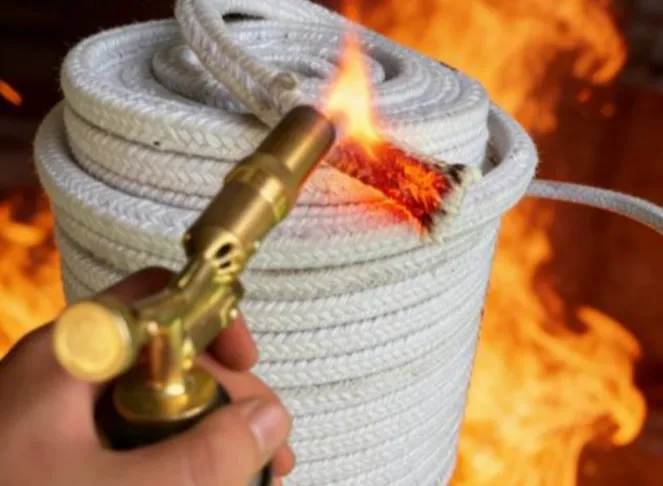
Indicative Factory Direct Price Ranges (FOB China Port)
The following ranges reflect AdTech’s pricing for standard catalog products in quantities above 500 kg. Prices vary with raw material markets and should be verified with a current quotation.
| Product | Grade | Diameter | Indicative Price (USD/m) |
|---|---|---|---|
| Round braid, unreinforced | 1000°C | 20 mm | 1.20–1.80 |
| Round braid, unreinforced | 1260°C | 20 mm | 1.50–2.25 |
| Round braid, SS304 wire reinforced | 1260°C | 25 mm | 3.20–4.80 |
| Square braid, unreinforced | 1260°C | 25 mm | 1.80–2.60 |
| Wire-reinforced, Inconel wire | 1260°C | 30 mm | 6.50–9.20 |
| Round braid, unreinforced | 1430°C ZAS | 20 mm | 3.30–5.00 |
| Twisted rope | 1000°C | 15 mm | 0.65–0.95 |
| Graphite-impregnated braid | 1260°C | 20 mm | 1.80–2.70 |
All prices are indicative FOB Chinese port. Actual quotations depend on current raw material prices, order quantity, and specific technical requirements.
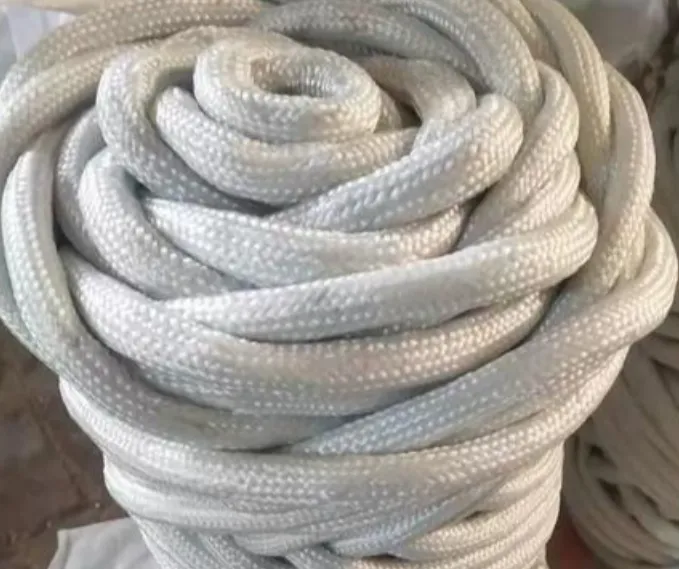
How to Evaluate a Ceramic Fiber Rope Supplier from China
This section addresses one of the most important questions international buyers ask: how do you separate a reliable, technically capable Chinese manufacturer from a trading company or low-quality producer?
The Manufacturer vs. Trading Company Distinction
China’s export market for industrial products includes both actual manufacturers and trading companies that purchase from manufacturers and resell with a markup. Trading companies typically:
- Have no production facility to visit.
- Cannot provide manufacturing process documentation.
- May change their underlying suppliers between orders without buyer knowledge.
- Cannot guarantee production quality because they do not control the production process.
Manufacturers like AdTech:
- Have verifiable factory addresses, registered with local industrial authorities.
- Can host factory audits and video inspections.
- Maintain consistent production quality because they control the process.
- Can provide traceability from raw material to finished product.
How to verify you are dealing with a manufacturer:
Request the supplier’s business license (营业执照), which will state the company’s registered business scope. Manufacturers’ licenses include “生产” (production) in the scope. Trading companies typically show “贸易” (trade) only. Additionally, Google Maps satellite view and Baidu Maps can confirm whether a physical factory exists at the registered address.
Key Supplier Evaluation Criteria
| Evaluation Criterion | What to Request | What Adequate Looks Like |
|---|---|---|
| Manufacturing capability | Factory photos, production capacity documentation | Visible braiding machines, fiber production equipment |
| Quality certification | ISO 9001 certificate (verify on certification body website) | Current certificate, scope covers ceramic fiber rope |
| Technical specification conformance | Test reports for the specific grade requested | Third-party or in-house accredited lab data |
| Chemical composition verification | XRF analysis per batch | Al₂O₃ content matches temperature grade claim |
| Sample provision | Request 2–5 meter samples before order | Willing to send samples with cost offset against first order |
| Reference customers | Request contact information for existing customers | Verifiable industrial customers in relevant industries |
| Export experience | Request export records, bill of lading samples | Regular shipments to target markets |
| Response quality | Evaluate technical questions in RFQ | Technical staff who can answer specification questions |
Red Flags That Indicate Low-Quality or Non-Manufacturer Suppliers
Certain patterns in the sales and quoting process indicate suppliers that are unlikely to meet industrial quality requirements:
Price significantly below market range: If a 1260°C wire-reinforced rope is quoted at 30–40% below our indicative price range, the supplier is either using lower-grade fiber (incorrect chemistry for the claimed temperature rating), lower-weight wire, or is misrepresenting the grade entirely.
No available test data: A legitimate manufacturer of industrial ceramic fiber products has routine production test data. Suppliers who cannot provide XRF composition data or tensile strength test results for a standard product are not operating a quality-controlled manufacturing process.
Generic product photos: Stock photography or non-specific product images that appear on multiple supplier websites indicate a trading company assembling offers from various sources rather than a dedicated manufacturer.
Inability to answer technical questions: If a sales contact cannot answer questions about rotor temperature limits, appropriate alloy for which wire grade, or the meaning of shot content — they are sales agents, not technical manufacturers.
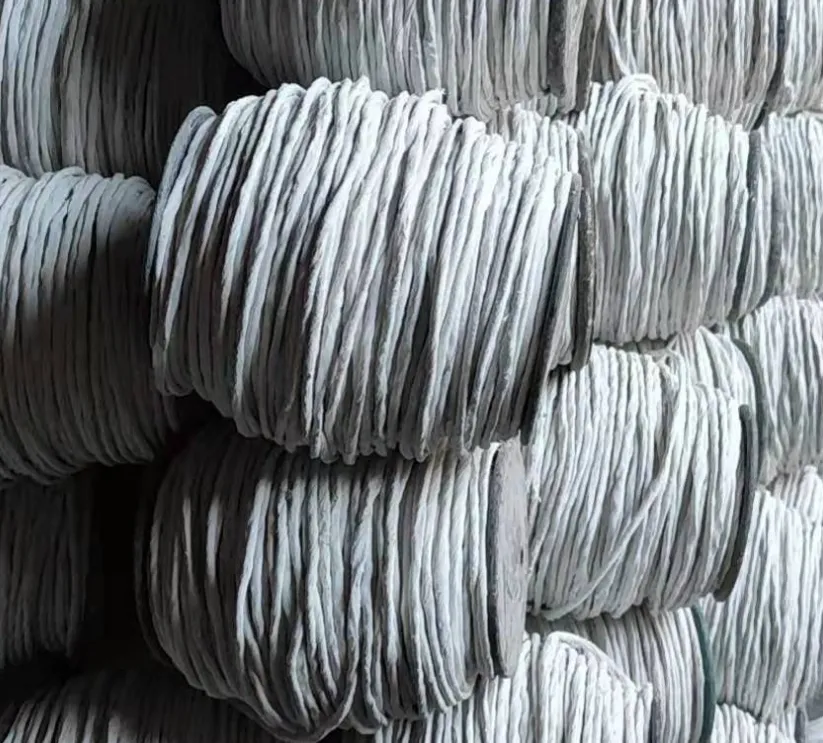
Shipping, Lead Times, and Export Documentation
Packaging for Export
Ceramic fiber rope is packaged for export in moisture-resistant packaging that protects the fiber structure during ocean shipping. AdTech’s standard export packaging:
Individual reel packaging: Each rope reel is wrapped in polyethylene film to prevent moisture absorption during transit. For wire-reinforced rope, the reel is also wrapped with foam padding to prevent coil deformation under stacking pressure.
Carton boxing: Individual reels are packed in corrugated carton boxes. Carton dimensions and weights are optimized for 20-foot and 40-foot FCL (full container load) packing efficiency. Standard carton gross weight is 15–25 kg.
Pallet configuration: Cartons are palletized on standard 1,100 × 1,100 mm wooden pallets, heat-treated and ISPM 15 compliant for import clearance in the USA, EU, Australia, and other phytosanitary-regulated markets.
Container utilization: A 20-foot FCL can accommodate approximately 15–22 metric tons of ceramic fiber rope depending on bulk density and diameter. A 40-foot FCL accommodates 28–40 metric tons.
Lead Times by Order Type
| Order Type | Production Lead Time | Shipping Transit (to major ports) |
|---|---|---|
| Stock items, LCL (less-than-container) | 3–7 business days | 18–35 days (destination-dependent) |
| Standard items, FCL | 10–20 business days | 18–35 days |
| Custom specification | 25–40 business days | 18–35 days |
| Sample orders | 3–5 business days | 5–10 days (express courier) |
Key transit times from Chinese ports to major destination ports:
| Destination | Typical Sea Freight Transit | Recommended Incoterms |
|---|---|---|
| Los Angeles / Long Beach (USA West) | 14–18 days | FOB Qingdao / Shanghai |
| New York / Savannah (USA East) | 28–35 days | FOB |
| Hamburg / Rotterdam (Europe) | 25–32 days | CFR / CIF |
| Dubai / Abu Dhabi (Middle East) | 16–22 days | CFR / CIF |
| Mumbai / Chennai (India) | 10–15 days | CFR |
| Sydney / Melbourne (Australia) | 18–24 days | CFR |
| Singapore / Kuala Lumpur | 5–8 days | CFR |
Standard Export Documentation
AdTech provides the following documents as standard with every export shipment:
| Document | Purpose | Notes |
|---|---|---|
| Commercial Invoice | Customs declaration, payment | In English and optionally Chinese |
| Packing List | Contents verification | Detailed per carton if requested |
| Bill of Lading (B/L) | Title document for sea freight | Original B/L issued by shipping line |
| Certificate of Origin | Tariff preference, customs | Form A or CO from local CCPIT |
| Quality Certificate | Product conformance | Signed by AdTech QC manager |
| Safety Data Sheet (SDS) | Regulatory compliance | GHS-compliant, English |
| Test Report | Technical verification | Per batch, available on request |
| REACH Declaration | EU chemical compliance | Available for EU buyers |
| Phytosanitary Certificate | Wooden pallet compliance | ISPM 15 certified |
Industry Applications and Which Rope Type Fits Each Use Case
Application-to-Rope-Type Selection Reference
Different industrial applications place distinct demands on ceramic fiber rope, and selecting the wrong construction type or diameter is one of the most common specification errors that leads to premature sealing failure.
| Industry | Application | Recommended Construction | Temperature Grade | Typical Diameter |
|---|---|---|---|---|
| Steel | Reheat furnace door seal | Square braid, SS310 wire | 1260°C | 25–50 mm |
| Steel | Continuous annealing expansion joint | Round braid, wire-reinforced | 1260°C | 20–35 mm |
| Aluminum | Holding furnace door seal | Square braid, SS304 wire | 1000°C | 20–40 mm |
| Glass | Float tank expansion joint | Round braid, Inconel wire | 1430°C ZAS | 30–50 mm |
| Glass | Lehr door seal | Square braid | 1000°C | 15–25 mm |
| Petrochemical | Fired heater joint packing | Round braid, wire-reinforced | 1260°C | 20–40 mm |
| Power | Boiler door rope gasket | Round braid, SS304 wire | 1260°C | 25–50 mm |
| Ceramics | Kiln car skirt seal | Square braid, wire-reinforced | 1260°C–1430°C | 20–35 mm |
| Cement | Kiln hood seal | Round braid, Inconel wire | 1260°C | 40–100 mm |
| Automotive | Exhaust component sealing | Twisted or round braid | 1000°C | 8–20 mm |
| Food processing | Oven door seal | Square braid | 1000°C | 10–20 mm |
| HVAC | High-temp exhaust duct joint | Twisted rope | 1000°C | 6–15 mm |
Special Application Notes for Global Markets
Middle East petrochemical sector: Fired heater and process vessel expansion joint sealing in this region commonly specifies 1260°C wire-reinforced rope in 25–40 mm diameter. High ambient temperatures and continuous operation profiles mean buyers in this market often specify 1400°C grade for additional safety margin even in applications where 1260°C would theoretically suffice.
European industrial sector: EU RCF (refractory ceramic fiber) regulations require products to carry hazard labeling under CLP Regulation (EC) 1272/2008, with Category 1B carcinogen classification for standard RCF products. For buyers in EU markets, we also supply alkaline earth silicate (AES/bio-soluble) fiber rope for applications up to 900°C, which qualifies for the EU Directive 97/69/EC carcinogen classification exemption.
North American OEM market: US and Canadian OEM furnace and oven manufacturers typically require MSDS/SDS compliance with OSHA Hazard Communication Standard (29 CFR 1910.1200), dimensional certification per ASTM standards, and country of origin documentation. AdTech’s standard export package covers all these requirements.
Southeast Asian industrial sector: This rapidly growing market for ceramic fiber rope is characterized by price sensitivity combined with increasingly stringent quality requirements from multinational customers. We have established distributor relationships in Vietnam, Thailand, Indonesia, and Malaysia for local technical support, while maintaining factory-direct pricing for large volume orders.
Frequently Asked Questions About Ceramic Fiber Rope from China Manufacturers
1: How do I verify that a Chinese ceramic fiber rope manufacturer is legitimate?
Verify by requesting the supplier’s ISO 9001 certificate and confirming its validity on the issuing certification body’s online verification system (DNV, Bureau Veritas, SGS, TÜV Rheinland all maintain searchable online registers). Additionally, request the Chinese business license (营业执照) and verify that the registered scope includes manufacturing. Request factory photos showing actual production equipment — braiding machines, fiber spinning equipment, and testing laboratory. The most reliable verification is a physical or video factory audit. AdTech welcomes factory visits and conducts scheduled video tours for buyers who cannot travel. Trading companies cannot provide verifiable production equipment evidence because they do not operate production facilities.
2: What is the minimum order quantity for ceramic fiber rope from AdTech?
Our standard minimum order quantity is 50 kg per specification (grade, diameter, and construction type combination), which allows buyers to conduct initial qualification trials without committing to large inventory. Sample orders of 2–5 meters are available at cost plus courier charges for pre-purchase evaluation. For regular production orders, the practical minimum for economical international shipping via sea freight is approximately 200–500 kg (sufficient for LCL consolidation shipment). FCL orders typically start at 3,000–5,000 kg. We accommodate mixed-specification orders where the total shipment meets the minimum freight volume even if individual specifications are below the standalone minimum.
3: What temperature grades are available and how do I choose the right one?
Four standard temperature grades are available: 1000°C, 1260°C, 1400°C, and 1430°C (zirconia grade). Selection should be based on the actual temperature at the sealing surface — not the furnace interior temperature — with a minimum 100°C safety margin. The sealing surface temperature is typically 50–200°C lower than the furnace interior depending on door construction and seal geometry. Most industrial furnace door sealing applications fall within the 1260°C grade’s capability. The 1000°C grade covers boiler seals, HVAC, and lower-temperature process equipment. The 1430°C grade is specified for glass tank expansion joints, high-fire ceramic kiln seals, and specialty applications where sealing surface temperatures regularly exceed 1300°C. Over-specifying temperature grade adds cost without performance benefit — the 1430°C ZAS rope costs approximately 2.2× the 1000°C grade at equivalent diameter.
4: What is the lead time for a first order from a Chinese ceramic fiber rope supplier?
For standard catalog items (common diameters and grades in stock), AdTech’s production and quality inspection lead time is 3–10 business days. Adding sea freight transit time: buyers in the Middle East receive goods in approximately 5–6 weeks from order confirmation. European buyers receive in approximately 7–9 weeks. North American buyers should plan for 9–12 weeks including customs clearance. For custom specifications (non-standard diameters, special impregnation, non-standard reel lengths), add 15–30 business days to production lead time. Planning initial qualification orders 10–14 weeks before the needed-by date provides adequate buffer for first-time international shipments where customs clearance may take longer than on subsequent regular shipments.
5: How is ceramic fiber rope shipped from China, and what are the typical freight costs?
Ceramic fiber rope ships by sea freight from major Chinese ports (Qingdao, Shanghai, Tianjin, Ningbo) under standard shipping terms. For small orders (50–500 kg), LCL (less-than-container-load) consolidation is used, with freight cost typically USD 200–600 per cubic meter depending on destination and current freight market. For larger orders (>2,000 kg per shipment), FCL (full container load) rates are more economical — a 20-foot container costs approximately USD 800–3,500 depending on destination (freight rates fluctuate significantly with market conditions). AdTech can arrange freight through our freight forwarder partners on CIF (cost, insurance, freight) terms or provide FOB pricing for buyers who prefer to arrange their own freight. All shipments include standard marine cargo insurance unless the buyer declines in writing.
6: What wire options are available for wire-reinforced ceramic fiber rope?
Three wire alloy options are standard in our production range. SS 304 stainless steel wire is the base option, suitable for applications where the wire reaches temperatures below approximately 750°C. SS 310 stainless steel provides better high-temperature strength maintenance to approximately 900°C and better oxidation resistance than 304 — recommended for most industrial furnace door sealing applications. Inconel 601 (nickel-chromium-aluminum alloy) wire maintains structural integrity to approximately 1100°C and provides excellent resistance to both oxidizing and carburizing atmospheres — specified for the most demanding applications including glass tank expansion joints and high-temperature kiln car seals. Wire diameter ranges from 0.3 mm to 1.2 mm depending on rope diameter and required tensile strength. Custom wire specifications (SS 316, Inconel 625, Hastelloy) are available on request for minimum order quantities.
7: Does AdTech offer bio-soluble (low-biopersistence) ceramic fiber rope for European markets?
Yes. AdTech produces alkaline earth silicate (AES) fiber rope rated to 900°C continuous service temperature for customers in European markets where the RCF carcinogen classification is a procurement or workplace health concern. AES fiber rope meets the dissolution rate criteria of EU Directive 97/69/EC (kdis >40 ng/cm²/hr in simulated lung fluid), qualifying for exemption from the Category 1B carcinogen classification applied to standard RCF products. AES rope is available in round braid and twisted constructions, diameters from 6 mm to 50 mm, with or without stainless steel wire reinforcement. For applications above 900°C, standard RCF fiber is required to maintain temperature performance — no commercially available bio-soluble fiber maintains adequate high-temperature stability above this threshold. We provide full regulatory documentation including the dissolution rate test certificates and CLP classification exemption justification with each European market shipment.
8: Can AdTech produce custom ceramic fiber rope to non-standard specifications?
Yes, custom specifications are a regular part of our production. Custom capabilities include: non-standard diameters (any diameter from 3 mm to 200 mm with sufficient order quantity), non-standard temperature grade combinations (specific Al₂O₃ targets within the fiber family), non-standard reel lengths, custom impregnation formulations, mixed construction (e.g., one face braided tightly, core loosely packed), custom cross-section shapes (oval, rectangular — achievable through specialized tooling), and co-branded packaging for OEM customers. Custom orders require a minimum order quantity that covers the tooling and setup cost, typically 200–500 kg depending on complexity. Samples of custom specifications are produced and approved before full production begins. Development lead time for new specifications is 4–8 weeks including sample production and buyer approval.
9: What quality documents does AdTech provide with each ceramic fiber rope shipment?
Every commercial shipment from AdTech includes as standard: Certificate of Conformance signed by the QC Manager confirming the shipment meets the purchase order specification; Chemical Composition Analysis (XRF) report showing Al₂O₃, SiO₂, and ZrO₂ (for 1430°C grade) content per production batch; Physical Property Test Report including rope diameter, weight per meter, and tensile strength; GHS-compliant Safety Data Sheet in English (and other languages on request); Packing List and Commercial Invoice; Certificate of Origin (Form A or general CO from CCPIT); and ISPM 15 phytosanitary certificate for wooden pallet. Optional documents available on request include: third-party test reports from SGS or Bureau Veritas, REACH compliance declaration, individual reel weight certificates, and extended batch traceability records linking the shipment to specific raw fiber production lots. These extended documents are standard for aerospace, pharmaceutical, and semiconductor industry customers.
10: How does AdTech’s factory direct pricing compare to buying through a distributor in my country?
Factory direct pricing from AdTech typically saves buyers 20–40% compared to purchasing equivalent product through a local distributor, with the saving varying by country, distributor margin structure, and product specification. The trade-off is that buying directly from China requires the buyer to manage import logistics, customs clearance, and inventory planning — tasks that a local distributor handles. For buyers who purchase irregularly (one or two orders per year) or in small quantities where the freight cost per unit is high, a local distributor may provide a lower total delivered cost despite the higher unit price. For buyers who order regularly (quarterly or more frequently), who purchase sufficient volume to fill at least an LCL shipment, and who have in-house logistics capability, factory-direct purchasing from AdTech provides significant cost advantage with full quality documentation equal to or exceeding what a distributor would provide. We also offer consignment stock arrangements with established distributors in key markets — contact our export team to discuss the most cost-effective supply model for your specific purchasing pattern and location.
Summary: Sourcing Ceramic Fiber Rope Directly from AdTech China
China’s ceramic fiber rope manufacturing industry offers genuinely competitive technical capability combined with the cost advantages of large-scale, vertically integrated production. The critical variable in leveraging these advantages is supplier selection — working with a verified manufacturer rather than a trading company, and confirming technical specifications through documentation rather than accepting sales claims at face value.
At AdTech, we have built our international customer base on a straightforward proposition: factory-direct pricing, fully documented quality conformance, and technical support that matches what buyers expect from domestic industrial suppliers. Our export team handles the documentation, logistics, and regulatory compliance requirements that can otherwise make direct China sourcing complex.
For buyers considering their first China-direct ceramic fiber rope purchase, we recommend beginning with a sample order covering the specific grade, diameter, and construction type required, reviewing the accompanying test documentation, and conducting a small trial installation before committing to volume orders. This sequence de-risks the qualification process and gives both parties the information needed to establish a supply relationship on solid technical foundations.
For current price quotations, technical specifications, or sample requests, contact the AdTech export sales team with your application details, required temperature grade, diameter, and annual volume estimate.
This article was prepared by the AdTech technical and commercial team based on manufacturing experience, export market knowledge, and technical application data accumulated across two decades of ceramic fiber product production and international supply. Content is updated regularly to reflect current product range, pricing structure, and regulatory requirements.
Last updated: 2026 | AdTech Technical Resource Library