

Our ceramic fiber paper roll is a lightweight, non-asbestos refractory material processed from high-purity alumina-silica fibers. Specifically engineered for high-temperature thermal insulation up to 1260℃ (2300℉), this flexible paper offers low thermal conductivity, excellent chemical stability, and superior resistance to thermal shock.
If your project requires the use of Ceramic Fiber Paper Roll, you can contact us for a free quote.
As a specialized manufacturer, we provide ceramic fiber paper rolls in various densities and thicknesses, ranging from 0.5mm to 10mm. Its uniform structure and smooth surface make it the premier choice for die-cut heat shield gaskets, furnace linings, and expansion joint sealing in the petrochemical, metallurgical, and glass industries.
Technical Highlights & Supply Specs:
-
Continuous Use Temp: 1050℃ (1922℉); Peak Temp: 1260℃ (2300℉).
-
Thickness Range: 0.5mm, 1mm, 2mm, 3mm, 5mm, up to 10mm.
-
Standard Widths: 610mm (24”) and 1220mm (48”) rolls.
-
Key Features: Low shot content, high tensile strength, and excellent dielectric strength.
-
Compliance: Non-combustible, REACH/RoHS certified, with full MTC available.
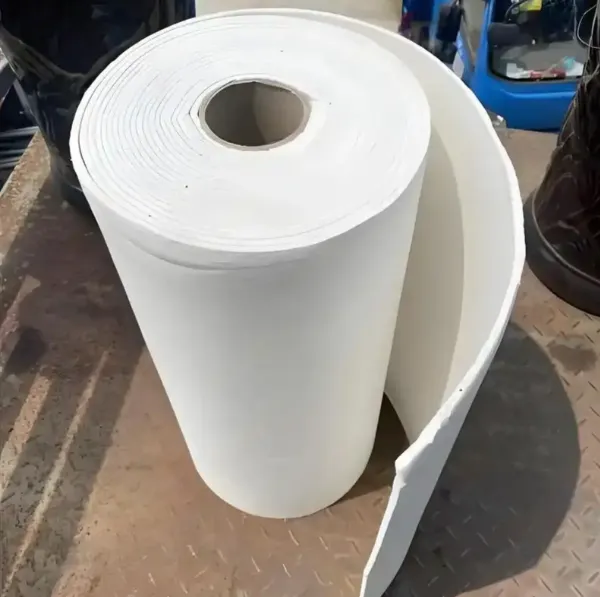
What is a 1260 °C ceramic fiber paper roll, and why do engineers specify it?
A ceramic fiber paper roll is a thin, flexible sheet made from aluminosilicate refractory fibers processed into a uniform mat, then bonded and calendered into controlled thickness. In purchasing language it is frequently called high temperature insulation paper, refractory ceramic fiber paper, RCF paper, or ceramic paper gasket stock.
The 1260 °C rating usually refers to the classification temperature of a common aluminosilicate fiber grade. That number is not a promise that every installation may run continuously at 1260 °C. It signals the fiber chemistry family, typical shrinkage behavior, and suitability at elevated hot face temperatures when design allows acceptable heat loss and dimensional change.
Why it matters:
- Thin section insulation: Paper thickness often sits in the 0.5 to 6 mm range, enabling insulation in tight assemblies where board cannot fit.
- Gasket behavior: Paper compresses, conforms to flange irregularities, and creates seal lines without high bolt loads.
- Thermal shock tolerance: Fiber networks handle rapid ramp up and cool down better than many rigid refractories.
- Converting efficiency: Rolls allow slitting, sheeting, kiss cutting, steel rule die cutting, and laminated stacks.
In practice, procurement teams like rolls since they reduce waste and simplify kitting, while design engineers like paper since it solves “one more millimeter” packaging problems without sacrificing temperature capability.
Also read: What is Ceramic Fiber Paper Used For?
Which materials and manufacturing steps control real world performance?
Leading manufacturer datasheets and industrial application notes tend to repeat the same idea: ceramic paper performance is not only “fiber type,” it is a sum of fiber chemistry, fiber length distribution, binder system, calendering, and quality control. Below is what matters most when specifying AdTech ceramic fiber paper.
Fiber chemistry: alumina and silica ratio, plus trace oxides
Most 1260 °C grade papers use aluminosilicate fibers. Higher alumina content generally increases high temperature stability and helps lower shrinkage at elevated temperature. Trace oxides affect devitrification behavior, which can increase brittleness after long exposure.
Key engineering takeaway: do not select solely by density or thickness; verify the classification temperature and linear shrinkage at a stated soak condition.
Fiberization quality: shot content and consistency
“Shot” means unfiberized particles. Lower shot content improves:
- Uniformity in thin sections.
- Die cutting edge quality.
- Tensile integrity, especially in very thin sheets.
- Dust reduction during handling.
Paper manufacturing typically includes refining steps to increase uniform dispersion; this is one reason paper often feels smoother than blanket.
Binder system: green strength, burnout, and odor control
Most ceramic papers include organic binders to provide handling strength. During initial heat exposure, binders burn out, potentially causing:
- Temporary smoke or odor.
- Minor thickness change.
- A short period of reduced sealing load until the fiber network settles.
In critical equipment, engineers frequently run a controlled first heat cycle or “burn off” step in a ventilated condition.
Calendering and thickness control: why gasket stock behaves differently than blanket
Calendering compresses the wet laid mat into a target thickness. This process influences:
- Density profile.
- Compressibility and recovery.
- Surface texture, which influences sealing line formation.
- Roll flatness, which affects automated converting.
A well controlled calendering step yields a more repeatable gasket material than improvised blanket stacking.
How does ceramic fiber paper compare with blanket, board, cloth, mica, and graphite?
Selection often starts with temperature rating, yet successful selection ends with mechanical behavior, cleanliness, and assembly method. The following table summarizes tradeoffs engineers and buyers commonly evaluate.
Comparison table: thin insulation material options
| Material type | Typical strengths | Typical limitations | Common uses |
|---|---|---|---|
| Ceramic fiber paper (1260 °C class) | Thin, flexible, die cut friendly, low thermal conductivity, conformable | Lower abrasion resistance than cloth, binder burnout smoke, shrinkage at high soak | Gasket stock, thermal breaks, wrap layers, appliance heat shields |
| Ceramic fiber blanket | High resilience, easy stuffing, good thermal shock | Bulky, harder to maintain precise thickness, edge fray | Furnace lining backup layers, expansion joints |
| Ceramic fiber board | Flat, rigid, machinable, good compressive stability | Less conformable, can crack under vibration | Burner blocks, furnace doors, baffles |
| Ceramic fiber cloth and tape | High tear resistance, good handling strength | Higher cost, thickness limits, may need reinforcement yarn | Curtains, removable covers, flange wraps |
| Mica paper and mica sheet | Excellent dielectric strength, stable in electrical heating assemblies | Brittle, limited gasket conformability, cutting complexity | Heating element insulation, electrical barriers |
| Flexible graphite sheet | Excellent sealing at moderate temperature in inert conditions | Oxidation in air at high temperature, conductivity may be unwanted | Flange gaskets in process piping, valve packing components |
A frequent outcome: ceramic fiber paper becomes the default choice when a design needs a thin barrier that behaves like a gasket and insulation layer at the same time, especially where metal to metal contact must be interrupted to reduce heat flow.
Which datasheet specifications actually predict field performance?
Search results on ceramic paper often overemphasize “temperature rating.” Engineers usually care more about a small set of measurable properties tied to the failure modes: heat loss, shrinkage, seal leakage, cracking, and electrical breakdown.
Core properties that should appear on a specification
- Thickness and tolerance (critical in stack ups and clamp load).
- Basis weight or density (affects compressibility and insulation value).
- Classification temperature (material family indicator).
- Recommended continuous use temperature (application dependent).
- Linear shrinkage at a defined soak temperature and time.
- Thermal conductivity at relevant mean temperatures.
- Tensile strength (important during converting and installation).
- Loss on ignition (LOI), proxy for binder amount.
- Dielectric strength (relevant in heaters and electrical enclosures).
- Chemical compatibility notes (contact with molten metals, alkalis, steam).
Typical specification ranges used in industrial purchasing
Values vary by grade; the table below provides realistic ranges commonly seen across reputable industrial suppliers. Final values should be taken from the AdTech product datasheet tied to the exact thickness and density ordered.
| Property | Typical range seen in 1260 °C class ceramic fiber paper | Why it matters |
|---|---|---|
| Thickness | 0.5 mm to 6 mm | Controls heat flux and gasket compression |
| Density | 180 kg/m³ to 260 kg/m³ | Higher density often improves handling, may reduce conformability |
| LOI (binder content) | 5% to 12% | Higher LOI can mean more smoke on first heat |
| Linear shrinkage | 2% to 4% at elevated soak conditions | Predicts gap formation and clamp load loss |
| Thermal conductivity | Low, temperature dependent | Determines external skin temperature and heat loss |
| Tensile strength | Varies with thickness | Predicts tear during die cutting and installation |
| Dielectric strength | High when dry | Used in heaters, battery thermal barriers, electrical cabinets |
Practical note: a thin paper that looks identical in photos can behave completely differently when bolted between flanges. Specification discipline reduces surprises.
What does the 1260 °C temperature rating mean in real service?
Many “People also ask” queries focus on this topic, since buyers want a simple number. Reality is more nuanced.
Classification temperature versus continuous service temperature
- Classification temperature relates to fiber chemistry and shrinkage behavior in standardized testing.
- Continuous service temperature depends on:
- Hot face temperature
- Thermal gradient across the paper.
- Atmosphere (oxidizing, reducing, steam).
- Mechanical load and vibration.
- Expected lifetime.
A gasket located on the cold side of a door can use 1260 °C class paper even if the furnace hot face reaches higher peaks, provided the paper itself stays within its working band.
Atmosphere and contamination effects
Common field issues:
- Alkali vapors can attack aluminosilicate fibers, raising shrinkage.
- Direct flame impingement can erode the surface.
- Molten metal splash can wet fibers depending on chemistry, leading to brittle crusts.
Temperature planning table: conservative decision logic
| Installation scenario | Hot face exposure | Mechanical stress | Conservative recommendation |
|---|---|---|---|
| Door gasket on heat treat furnace | Radiant heat, intermittent opening | Medium compression, cycling | 1260 °C class paper, layered stack, allow retightening after first heat |
| Burner flange thermal break | Local hot spots, potential flame lick | High vibration | Consider paper plus protective metal shield or upgrade to board in flame zone |
| Appliance heat shield | Moderate steady temperature | Low compression | Paper works well, focus on thickness and edge support |
| Lab kiln peephole seal | High radiant heat | Low compression | Thicker paper ring, verify shrinkage and re seal schedule |
A disciplined approach uses real temperature at the gasket location, not the furnace setpoint.
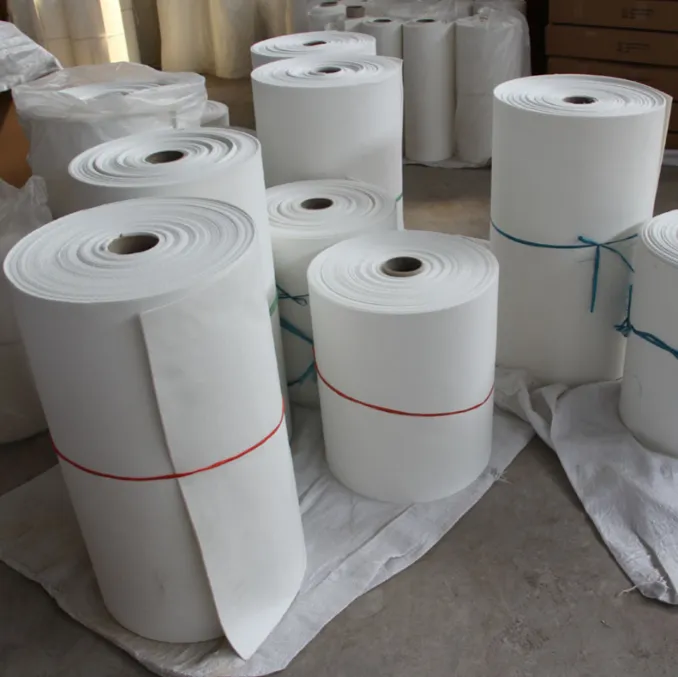
How should a gasket be designed using ceramic fiber paper stock?
Ceramic fiber paper behaves like a compressible, thermally stable mat. Gasket success depends on compression strategy, surface prep, and clamping maintenance.
Compression and recovery: what to expect
- Paper compresses readily, then shows partial recovery when load releases.
- Under sustained heat, some compression set occurs, especially after binder burnout.
- Bolt load may need a second tightening step after the first thermal cycle, depending on flange design.
Designers often use a slightly thicker paper, then compress to a target thickness, balancing seal line formation with creep management.
Flange surface condition and leak paths
Paper can conform to small scratches and waviness, yet deep tool marks can create leak channels. On air or gas seals, surface finish consistency becomes important.
Common engineering tactics:
- Use a smooth land area at the sealing line.
- Add a narrow raised bead in metal flanges when possible.
- Use layered paper stacks to increase conformability without excessive thickness.
Layering, laminating, and hybrid stacks
Paper can be stacked to tailor thickness and compressibility. Some plants laminate paper to:
- Thin stainless foil, improving tear resistance and radiant reflection.
- Woven glass or ceramic cloth, improving handling in removable seals.
- Pressure sensitive adhesive backing, improving installation speed in appliance assembly.
Adhesive selection must match service temperature and outgassing limits. Many high temperature assemblies rely on mechanical retention instead of adhesive.
Which industries and equipment benefit most from ceramic fiber paper rolls?
Search intent often splits into two groups: engineers designing high temperature equipment, and procurement teams replacing consumable seals. Both want application clarity.
Application matrix
| Industry | Typical equipment | Why paper is selected | Usual form |
|---|---|---|---|
| Heat treating | Box furnaces, vacuum furnace doors, quench tanks (cold side) | Seal integrity under cycling, quick replacement | Die cut rings, strips |
| Ceramics and pottery | Kiln door seals, peepholes, kiln car joints | Tight spaces, easy installation | Rolls, cut pads |
| Foundry | Ladle covers (non wetting zones), transfer chutes | Heat shielding, fast change out | Wrap layers, gaskets |
| Petrochemical | Heater doors, stack inspection ports | Reduces skin temperature, supports maintenance | Pre cut kits |
| Power generation | Burner access doors, insulation breaks | Heat loss reduction, electrical insulation | Sheets, strips |
| Appliance and HVAC | Stoves, boilers, ducting penetrations | Thin thermal barrier, low cost per part | Adhesive backed pieces, die cuts |
| Electronics and thermal management | Heat shields, dielectric barriers | Electrical isolation plus thermal resistance | Precision die cut parts |
What converting and fabrication methods yield consistent parts from paper rolls?
Purchasing teams often ask whether ceramic fiber paper can be cut with scissors or lasers. It can be cut manually, yet production grade repeatability usually relies on converting processes.
Cutting methods and suitability table
| Method | Suitability | Strengths | Limitations and notes |
|---|---|---|---|
| Scissors and utility knife | Prototyping, maintenance | Immediate, zero tooling | Edge fray, dimensional variation |
| Steel rule die cutting | Medium to high volume | Fast cycle time, consistent profiles | Tool wear, dust control needed |
| Flatbed cutting plotter | Low to medium volume | No hard tooling, quick revision | Slower than die cutting |
| Rotary die cutting | High volume | Excellent throughput | Requires stable roll flatness, tooling cost |
| Waterjet | Specialty use | Clean cut without heat | Material can absorb water, drying step needed |
| Laser cutting | Limited | High precision on some composites | Heat can char binder, edge hardening possible |
Dimensional control and tolerances
Paper is compressible, so tolerance control should specify:
- Uncompressed thickness tolerance.
- Cut width and length tolerance.
- Out of round limit on rings.
- Flatness and curl limits on sheets.
Buyers often ask suppliers to provide inspection data per lot, especially on thin grades used in automated assembly.
Dust and cleanliness during fabrication
Industrial best practice includes:
- Local extraction at cutting stations.
- Vacuum cleanup, not dry sweeping.
- Bagged scrap handling
- Protective packaging to prevent abrasion during shipping.
How should ceramic fiber paper be handled safely, stored, and installed?
Health and regulatory questions appear frequently in “People also ask” sections, usually phrased around asbestos, respiratory irritation, and workplace exposure.
Does ceramic fiber paper contain asbestos?
Refractory ceramic fiber paper is typically made from aluminosilicate fibers, not asbestos. Still, the material can create airborne fibers and dust during cutting and removal. Safety programs should treat it as a respirable particulate risk and follow the supplier SDS.
Practical workplace controls
- Use appropriate respirators when cutting or removing aged insulation, following site EHS rules.
- Wear gloves and long sleeves to reduce itching.
- Use eye protection during overhead work.
- Use ventilation during first heat cycle, since binder burnout can generate smoke and odor.
Storage and shelf condition management
Paper rolls should be stored:
- In original packaging
- In a dry area, away from oil mist and moisture.
- Away from vibration that can dent edges.
When adhesive backed options are used, storage temperature limits and shelf life should be tracked lot by lot.
Installation checklist used by maintenance teams
- Clean flange faces, remove old adhesive and brittle residue.
- Measure land width, confirm gasket width will not overhang into flame path.
- Pre fit the gasket dry, confirm bolt alignment.
- Apply compression evenly, tighten in a star pattern when applicable.
- Run first heat cycle with ventilation, then retighten if procedure allows.
- Document part number, thickness, and replacement interval.
How can procurement teams qualify a ceramic fiber paper supplier and reduce risk?
High ranking technical pages on insulation materials tend to focus on properties, yet procurement success hinges on consistent supply and documentation. A strong qualification process improves uptime and reduces emergency orders.
Supplier qualification checklist table
| Category | What to request | Why it matters |
|---|---|---|
| Traceability | Lot number and production date on each roll | Supports root cause analysis |
| Dimensional verification | Thickness mapping, width tolerance data | Prevents assembly jams, leak risk |
| Material certification | COA, basic chemistry family statement, SDS | Compliance and audit readiness |
| Change control | Notice period on binder or fiber source changes | Prevents unexpected smoke or shrinkage changes |
| Packaging | Edge protection, moisture barrier, labeling | Prevents transit damage and mixed inventory |
| Converting capability | Slitting, sheeting, die cutting, kitting | Reduces vendor count and lead time |
Purchase specification language that reduces ambiguity
Procurement documents should state:
- Classification temperature and target thickness
- Width, roll length, core ID, winding direction if relevant.
- Density or basis weight
- Maximum linear shrinkage at stated condition.
- Allowed binder content range if odor matters.
- Packaging and label requirements.
This shifts discussions from “high temp paper” toward measurable acceptance criteria.
What tests validate thermal insulation and gasket performance?
Engineering teams often validate ceramic fiber paper in both lab and field conditions.
Common lab test themes
- Thermal conductivity measured at relevant mean temperatures.
- Linear shrinkage after soak at temperature with defined dwell time.
- Tensile strength in machine direction and cross direction.
- Dielectric breakdown in dry condition when used in electrical systems.
- Outgassing and smoke observation during initial heat cycle when installed in enclosed equipment.
Field validation methods that correlate well with performance
- Infrared thermography on outer skins of doors and covers.
- Bolt torque retention checks after thermal cycling.
- Visual inspection of gasket edges, looking at erosion and brittleness.
- Leak testing with low pressure air when sealing combustion gas paths
A small pilot install on one furnace door often prevents plant wide downtime.
What failure modes occur most often, and how are they corrected?
Ceramic paper failures tend to fall into a handful of patterns. The table below helps maintenance and engineering teams troubleshoot quickly.
Troubleshooting table
| Symptom | Likely cause | Corrective action |
|---|---|---|
| Seal leaks after first heat cycle | Binder burnout, compression set, insufficient retightening | Add retightening step, increase thickness, adjust flange load |
| Edges erode or powder | Flame impingement, high velocity gas | Add shield, move gasket out of flow, use cloth facing |
| Gasket shrinks and gaps appear | Temperature at gasket exceeds design, chemical attack | Upgrade grade, add thermal break layer, relocate gasket |
| Paper tears during installation | Too thin, poor handling, sharp flange edges | Increase thickness, radius edges, use laminated facing |
| Excess smoke on first heat | High binder content, poor ventilation | Specify lower LOI, add controlled burn off cycle |
| Electrical breakdown | Moisture, contamination, insufficient creepage distance | Drying step, improve clearance, add mica layer if needed |
What customization options matter most when specifying AdTech ceramic fiber paper?
AdTech customers typically request one of three outcomes: raw roll supply, precision converted components, or kitted insulation sets aligned to equipment maintenance intervals.
Common customization routes
- Roll width and length matched to existing die cutters and plotters..
- Tight thickness control grades aimed at gasket stock use.
- Slit rolls and sheets to reduce plant side labor.
- Die cut gaskets, rings, washers, and port seals.
- Laminated constructions combining paper with foil or fabric facing.
- Pre assembled kits labeled by equipment tag number.
A good practice is to send a drawing plus service details: hot face temperature estimate, atmosphere description, compression load, target lifetime, and any odor limits.
FAQs: Ceramic Fiber Paper Roll rated 1260 °C
Ceramic Fiber Paper: 10/10 Technical FAQ
Precision Gasketing, Thermal Barriers, and Installation Secrets
1. Can ceramic fiber paper be used as a gasket material?
Yes. It is an industry standard for gasket stock in furnace doors, access panels, ducting covers, and burner inspection ports. It is particularly valued in applications where a low clamp load and thin-section insulation are priorities, providing a reliable seal against hot gases.
2. Is 1260°C a continuous working temperature?
3. Does ceramic fiber paper contain asbestos?
4. Will the paper smoke the first time it heats up?
THERMAL TIP
Yes, it can. Most ceramic papers use an organic binder to maintain their flexible, paper-like structure. This binder burns out during the first heat cycle, often producing temporary smoke or a distinct odor. A controlled initial “burn-off” cycle in a ventilated area is recommended.
5. How do I choose thickness for a door seal?
Start by measuring the flange gap. A common engineering rule is to select a thickness that allows for 20% to 40% compression under clamp load. This ensures enough stored energy in the fibers to maintain the seal even as the metal components expand and contract during thermal cycling.
6. Can ceramic fiber paper be cut with scissors?
7. Does ceramic fiber paper shrink over time?
8. Is ceramic fiber paper electrically insulating?
9. Can I bond ceramic fiber paper to metal?
10. Ceramic Fiber Paper vs. Blanket: What is the difference?
Quick specification template (copy ready) used by engineers and buyers
Ceramic Fiber Paper Roll, 1260 °C class, gasket stock
- Brand: AdTech
- Form: roll, slit roll, or sheets
- Classification temperature: 1260 °C class aluminosilicate ceramic fiber paper
- Thickness: ___ mm, tolerance ___
- Width: ___ mm, tolerance ___
- Roll length: ___ m, core ID ___
- Density or basis weight: ___
- Maximum linear shrinkage: ___% at ___ °C, ___ h
- LOI: target ___%
- Required documents: COA per lot, SDS, dimensional inspection record
- Packaging: edge protection, moisture barrier bag, label with lot and date.