
As Qatar continues its massive North Field Expansion and infrastructure upgrades, the demand for high-performance thermal management is at an all-time high. AdTech stands out among ceramic fiber blanket manufacturers in Qatar by providing specialized refractory materials engineered for the extreme heat of LNG processing, oil refining, and gas-to-liquids (GTL) plants.
If your project requires the use of Ceramic Fiber Blanket, you can contact us for a free quote.
Our 1260℃ (2300℉) and 1430℃ (2600℉) Zirconia-grade blankets are designed to withstand not only intense operational temperatures but also the harsh, corrosive coastal environments of industrial hubs like Mesaieed and Ras Laffan. AdTech ensures your projects meet international safety and efficiency standards, offering superior fire protection and thermal insulation for Qatar’s most critical energy assets.
Qatar-Specific Supply & Project Capabilities:
-
Energy Sector Compliance: Fully aligned with the rigorous material specifications required for QatarEnergy and petrochemical projects.
-
Extreme Heat Resilience: Rated for peak protection up to 1430℃, ideal for high-capacity furnace and boiler linings.
-
Corrosion & Stability: Low shot content and high-purity alumina-silica chemistry ensure stability in saline and humid coastal climates.
-
Applications in Qatar: Fireproofing for LNG storage tanks, desalination plant insulation, and expansion joints in gas pipelines.
-
Local Logistics: Strategic supply chain nodes for rapid dispatch to Doha, Mesaieed Industrial City, and Ras Laffan.
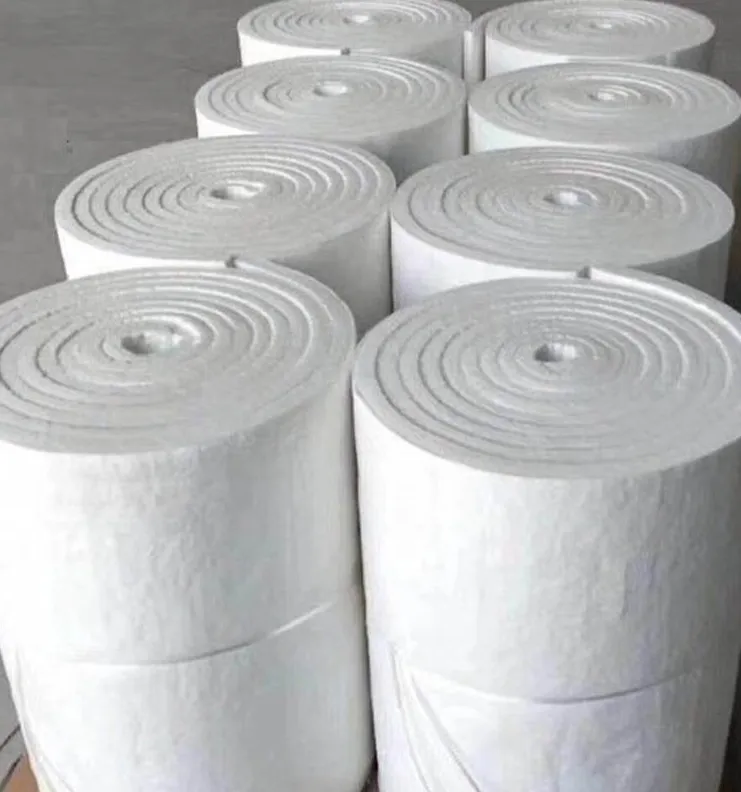
What is ceramic fiber blanket, and where is it used in Qatar?
Ceramic fiber blanket is a flexible high-temperature insulation material made mainly from alumina-silica fibers. It is usually needle-punched, lightweight, low in thermal conductivity, and designed to retain performance in demanding thermal environments. Because it bends easily and can be cut on site, it suits complex shapes better than many rigid insulating products.
How is the material made?
The blanket is produced from spun or blown refractory fibers, then formed into a continuous mat and mechanically interlocked through needling. Many industrial grades are binder-free, which helps when low smoke, clean burn-off, or stable thermal behavior is needed during the first heat-up.
Why is it widely used in Qatar?
Qatar has a strong concentration of heat-intensive industry. Ceramic fiber blanket appears in:
- Furnace and kiln linings.
- Heater and boiler access doors.
- Expansion joints.
- Turbine and exhaust insulation.
- Ducting and stack systems.
- Pipe wrapping in high-temperature zones.
- Backup insulation behind dense refractory.
- Firestop and heat shield assemblies when system approval exists.
- Offshore and marine thermal barriers.
- Metal treatment, glass, and ceramic processing units.
What makes it attractive is the combination of light weight, fast installation, low heat storage, and thermal shock resistance. When compared with heavy refractory bricks, it helps cut heat-up time and energy loss.
Core product characteristics at a glance
| Property | Common market range in Qatar | Why buyers care |
|---|---|---|
| Main chemistry | Alumina-silica RCF, high purity grades, zirconia-containing grades | Sets temperature class and resistance profile |
| Classification temperature | 1260°C, 1360°C, 1430°C | First screening point during selection |
| Typical continuous use | Roughly 900°C to 1350°C, depending on design and atmosphere | Must match real service conditions, not only catalog headline |
| Density | 64, 96, 128 kg/m³, sometimes 160 kg/m³ | Affects handling, resilience, and lining design |
| Thickness | 6 mm, 12.5 mm, 25 mm, 38 mm, 50 mm | Controls thermal resistance and layer build-up |
| Roll width | Usually 610 mm, sometimes 1220 mm | Site fit-up and waste control |
| Roll length | Varies by thickness, often 1.8 m to 14.4 m | Impacts packing and take-off calculations |
| Form | Plain blanket, foil-backed versions, module feedstock | Depends on application |
| Surface behavior | Flexible, compressible, easy to cut | Speeds installation in irregular areas |
Which grades, densities, and sizes are most requested in Qatar?
The most requested products in Qatar are usually not exotic custom grades. They are standard industrial blanket items that move quickly during maintenance and shutdown work. In our experience, fast-moving demand tends to cluster around 1260°C and 1430°C grades, with 96 kg/m³ and 128 kg/m³ density leading the market.
A common mistake is thinking that a higher density always means a better product. It does not work that way. Density affects durability, recovery after compression, and lining layout. The right selection depends on temperature, vibration, mechanical abuse, and installation method.
Typical sale-ready items buyers ask about
| Common request | Typical specification | Usual application in Qatar |
|---|---|---|
| Standard blanket roll | 1260°C, 96 kg/m³, 25 mm | General furnace backup, ducting, access doors |
| Heavy-duty blanket roll | 1260°C, 128 kg/m³, 25 mm or 50 mm | Hotter equipment, more abuse, better handling strength |
| High purity blanket | 1360°C, 128 kg/m³ | Process units with tighter performance demand |
| Zirconia grade blanket | 1430°C, 128 kg/m³ | Severe-temperature lining zones |
| Thin blanket | 6 mm or 12.5 mm | Wrapping, joints, seals, layered lining |
| Thick blanket | 38 mm or 50 mm | Heat-loss reduction in multi-layer systems |
Which roll dimensions are seen most often?
The following sizes are common in trading catalogs and warehouse stock:
- 7.2 m x 610 mm x 12.5 mm
- 3.6 m x 610 mm x 25 mm
- 1.8 m x 610 mm x 50 mm
Thickness changes the roll length, so buyers should compare square meter quantity, not only roll count. We have seen quotations that look cheaper until the actual covered area is calculated.
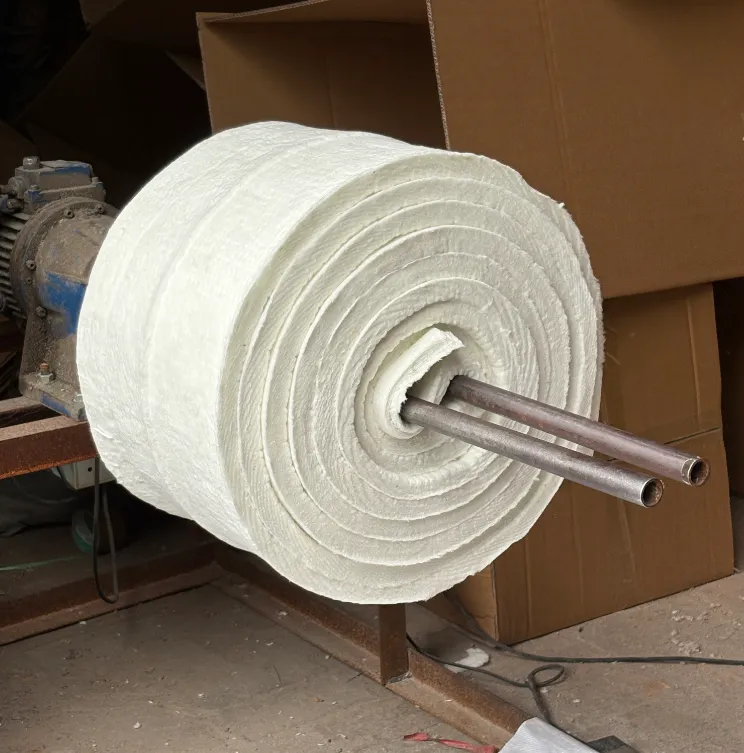
How should we match grade to application?
| Service situation | Suitable blanket class | Density range | Notes |
|---|---|---|---|
| General high-temperature backup insulation | 1260°C | 96 to 128 kg/m³ | Most common stock item |
| Furnace doors and removable panels | 1260°C or 1360°C | 128 kg/m³ | Better resilience helps repeated opening |
| Hoter process equipment with safety margin needed | 1360°C | 128 kg/m³ | Good middle position |
| Severe-temperature hot-face or layered refractory systems | 1430°C | 128 kg/m³ | Verify actual atmosphere and shrinkage data |
| Expansion joints and irregular contours | 1260°C to 1430°C | 96 to 128 kg/m³ | Flexibility and recovery matter |
| Marine and offshore thermal barriers | Project-specific | Project-specific | Ask for approved system details |
How does the Qatar supply chain really work, and what should we verify?
In Qatar, ceramic fiber blanket reaches the buyer through several channels. Knowing the channel helps us judge lead time, risk, and technical accountability.
What types of sellers exist?
| Seller type | What they usually do | Strength | Risk to watch |
|---|---|---|---|
| Overseas manufacturer | Produces the blanket in its own mill | Factory traceability, broad range | Longer delivery unless local stock exists |
| Authorized distributor in Qatar | Keeps inventory and supports local sales | Faster dispatch, local contact, easier documentation | Stock depth may be limited to common grades |
| Industrial insulation contractor | Supplies material together with installation | Strong application support | Material choice may be tied to contract margin |
| Project trader | Sources after order confirmation | Can quote many brands | Greater uncertainty on lead time and actual origin |
| GCC regional stockist | Holds goods outside Qatar, ships on demand | Wider range than some local stores | “In stock” may mean outside Qatar, not immediate local delivery |
Why does this matter so much?
Because a warehouse label in the GCC is not the same as material physically available in Doha. One frequent issue in industrial procurement is that the quotation says “ready stock,” but the rolls are actually in another country and still need customs clearance, transport booking, and local delivery coordination. On a shutdown job, that can destroy the schedule.
How do we verify a manufacturer claim?
We advise asking these direct questions:
- What is the factory address?
- Can you share the mill test report from the production batch?
- Who is the authorized Qatari sales channel?
- Is the blanket in Qatar now, or in a GCC warehouse?
- Can you send date-stamped warehouse photos with batch labels?
- Can you provide technical data tied to the same batch being offered?
A serious supplier answers without hesitation. A weak trader often responds with only a generic brochure.
Why local support still matters when the product is imported
Even when the material comes from China, India, Europe, or another major production base, local support remains essential. Buyers in Qatar often need:
- Same-day document submission.
- Vendor registration support.
- Site delivery coordination.
- Cutting and packing advice.
- Replacement rolls during installation.
- Confirmation that the item matches approved specifications.
That is why the strongest supplier in practice is often the one that combines factory access with local stock and application competence.
Also read: AdTech Ceramic Fiber Insulation Blanket Roll: 1260℃ Refractory Supply.
What technical properties should engineers review before purchase?
Many product pages stop at temperature class, density, and thickness. That is not enough. Engineers should go deeper, because insulation failure usually comes from missed technical detail, not from the sales headline.
Why is classification temperature not the same as service temperature?
Classification temperature is a laboratory reference point. It does not mean the blanket should operate continuously at that exact temperature in every industrial atmosphere. We should always compare the real operating condition, hot-face temperature, heating cycle, atmosphere, contaminants, gas velocity, and lining design. A blanket labeled 1260°C may be excellent in one duty and under-specified in another.
Which properties matter most?
| Property | What it tells us | Good buying practice |
|---|---|---|
| Classification temperature | Temperature class of the material | Use only as the first filter |
| Recommended continuous use | Practical operating limit in a real system | Match with process data and safety margin |
| Linear shrinkage | Dimensional stability after heat exposure | Ask for tested values and test conditions |
| Thermal conductivity | Heat-loss performance at various temperatures | Request data at mean temperatures relevant to the process |
| Density | Mass per volume | Select based on design, not habit |
| Tensile strength and resilience | Handling strength, recovery after compression | Important in removable panels and complex shapes |
| Shot content | Amount of unfiberized particles | Lower shot often means better flexibility |
| Chemical composition | Alumina, silica, zirconia, impurities | Helps judge temperature capability and chemical resistance |
| Moisture condition and packaging | Storage quality | Check upon receipt in Qatar’s yard conditions |
| Safety data | Handling requirements | Essential in industrial HSE systems |
What about chemical resistance?
Ceramic fiber blanket performs well in many hot, dry applications, but it can be attacked by certain alkalis, phosphates, and contaminants. Molten metal splash, aggressive vapor, and high-velocity abrasion can shorten service life. That means the cheapest blanket is rarely the right one if the atmosphere is chemically severe.
Why is linear shrinkage so important?
We have seen projects where the nominal temperature class looked acceptable, but the installed lining opened gaps after exposure because shrinkage was not properly checked. Once shrinkage increases, joints can separate, heat leakage rises, and hot spots appear on the shell. That is why good buyers ask not only “What temperature is this?” but also “How much will it move after heating?”
Does thicker always mean better?
Not always. Thickness should come from the thermal design. More thickness may reduce heat loss, yet it can also complicate fit-up, anchor length, door closing pressure, and weight on removable panels. Selection should be based on required cold-face temperature and system layout, not guesswork.
How do price, stock depth, and delivery terms shape the final deal?
Price in Qatar is rarely a simple material number. The final deal depends on several commercial and logistical factors.
Main factors that move price
| Cost factor | Effect on quotation | What buyers should ask |
|---|---|---|
| Grade and chemistry | Higher temperature classes cost more | Is 1430°C truly needed, or is 1260°C enough? |
| Density | Heavier grades often cost more per roll | Compare cost per square meter and per cubic meter |
| Thickness | Thicker rolls increase material value and freight volume | Verify area coverage per roll |
| Origin | Different mills and regions have different pricing structures | Request origin declaration |
| Stock position | Local inventory saves time but may carry carrying cost | Is it already in Qatar? |
| Delivery term | Ex-warehouse, delivered site, or custom-cleared supply | Compare like with like |
| Documentation | Extra testing and approvals can add cost | Clarify document package early |
| Packaging quality | Better packing reduces damage risk | Important during transport and yard storage |
| Project quantity | Full container or bulk order lowers unit cost | Consolidate orders when possible |
| Urgency | Shutdown demand can increase price sharply | Secure stock before outage date |
Why can the cheapest quote become the most expensive?
Because downtime costs far more than blanket cost. If an insulation package is late, incorrectly graded, or poorly documented, the buyer can lose work hours, crane time, scaffold access, manpower, and approval windows. In industrial plants, schedule failure is often more expensive than material failure.
How should we compare offers fairly?
Use one comparison sheet with these fixed columns:
- Classification temperature.
- Continuous use recommendation.
- Density
- Roll dimensions and total coverage.
- Country of origin.
- Stock location.
- Delivery time.
- Data sheet and batch traceability.
- Included taxes and transport.
- Payment terms.
- Warranty or replacement commitment.
Without a normalized comparison, quotation review becomes guesswork.
What documents, certifications, and compliance records should buyers request in Qatar?
Qatari industrial buyers should insist on a full document package. This is not paperwork for its own sake. It is how we reduce technical and commercial risk.
Minimum document set
- Technical data sheet.
- Safety data sheet.
- Certificate of origin.
- Batch or lot identification.
- Mill test report, if available.
- Commercial invoice and packing list.
- Delivery note with quantity breakdown.
- Quality certificate or conformity statement.
- ISO 9001 certificate of the factory or supplier, where relevant.
- Installation instructions if the supplier also supports application.
Which standard references are useful?
ASTM C892 is a common reference point in high-temperature fiber blanket discussions. Certain clients may also request internal project specifications, refinery-approved vendor lists, or EPC-specific submittal formats. The key is not the logo count. The key is whether the documents tie clearly to the exact product being sold.
What about health and safety compliance?
This matters a great deal. Some ceramic fiber products contain refractory ceramic fibers that need controlled handling. Buyers should request the latest safety data sheet and ensure site teams use suitable PPE, dust control, and cleanup procedures. In enclosed spaces or projects with strict occupational health criteria, bio-soluble alternatives may be preferred if the service temperature allows it.
Why are traceability and labeling important?
A batch label lets us connect the installed material to the technical record. If there is a quality dispute later, traceability can save a great deal of time. Unlabeled or mixed-stock rolls should trigger caution.
How does ceramic fiber blanket compare with mineral wool, calcium silicate, and aerogel?
No insulation material wins in every case. Ceramic fiber blanket is strong in high-temperature flexibility and low mass, but other materials may suit lower temperatures, mechanical load, or tight energy targets.
| Material | Typical temperature capability | Main strength | Main limitation | Common use case in Qatar |
|---|---|---|---|---|
| Ceramic fiber blanket | Very high, depending on grade | Flexible, light, quick to install, strong thermal shock resistance | Fiber handling precautions, mechanical damage risk | Furnaces, kilns, hot ducts, heater doors |
| Mineral wool | Medium temperature range | Cost-effective, good acoustic performance | Not suitable in the hottest process zones | Building services, lower-temperature industrial insulation |
| Calcium silicate | Medium to high, depending on grade | Rigid, strong under compression, good on pipes and equipment | Heavier, slower installation in complex shapes | Pipe sections, rigid insulation systems |
| Aerogel blanket | High efficiency at small thickness | Very low thermal conductivity, useful where space is limited | Higher cost, temperature range depends on product | Space-constrained piping and energy-saving retrofits |
| Microporous insulation | Very high thermal efficiency | Excellent where minimal thickness is critical | Premium cost, careful design needed | Specialized high-performance thermal barriers |
When is ceramic fiber blanket the clear choice?
It stands out when the equipment reaches high temperature, the geometry is awkward, weight must stay low, and quick installation matters. That is why it appears so often in removable covers, furnace doors, expansion joints, and backup linings.
When should we consider another material?
If the system needs rigid load-bearing insulation, lower fiber release, or very low conductivity at limited thickness, another option may be better. Material selection should come from duty conditions, not habit.
What installation practices prevent heat loss, shrinkage, and premature failure?
Good material can still fail if installed badly. We have seen excellent blanket perform poorly due to poor joint treatment, overcompression, and incorrect anchoring.
What are the main installation rules?
First, match the installation method to the equipment. A flat furnace wall, a duct elbow, and a removable door panel should not be handled in the same way.
Second, keep blanket clean and dry before installation. Yard contamination, oil, and water can affect the system and complicate heat-up.
Third, install with correct overlap and joint staggering when multiple layers are used. Straight-through joints can create heat leakage paths.
Fourth, use suitable anchors, studs, speed washers, mesh, or cladding based on temperature and service conditions. Hardware failure can destroy the lining even when the blanket itself is good.
Why is overcompression a problem?
Installers sometimes compress blanket too much in an effort to “make it tight.” That can change thickness, reduce designed thermal resistance, and create uneven density. Controlled fit is better than brute force.
What about rigidizer and surface protection?
Some high-temperature systems use rigidizer or protective coatings on exposed hot faces. This depends on design. In other cases, blanket works behind a dense refractory or metal lining. The exact method should come from the refractory or insulation design package.
What safety practices should site teams follow?
- Wear suitable respiratory protection when cutting or removing blanket..
- Use gloves and protective clothing.
- Control dust with proper work methods.
- Clean with industrial vacuum systems rather than dry sweeping.
- Follow the latest safety data sheet.
- Dispose of waste according to site rules and local regulations.
Why does first heat-up matter?
The first heating cycle reveals installation quality. Fast, uneven heat-up can stress the system and expose weak joints. Where the process permits, a controlled ramp-up is usually a smarter approach.
What mistakes do procurement teams and contractors make most often?
The same errors appear again and again in ceramic fiber blanket procurement across Gulf industrial projects.
Common buying mistakes
- Choosing grade only by catalog headline temperature.
- Ignoring actual stock location.
- Comparing quotations by roll count instead of covered area.
- Accepting generic brochures without batch traceability.
- Missing shrinkage data
- Treating higher density like a universal quality marker.
- Forgetting installation hardware in the material package.
- Ignoring HSE requirements related to fiber handling.
- Ordering too late in relation to shutdown date.
- Failing to confirm if the product matches approved project specifications.
We have also seen buyers approve a sample but receive a different batch later. The cure is simple: link approval to the exact product code and lot reference.
Also read: Ceramic Fiber Blanket Manufacturers in India.
How can we select the right ceramic fiber blanket in Qatar step by step?
A clear selection process helps both engineers and buyers. We usually work through the following sequence.
Step 1: Define the operating duty
Record:
- Maximum continuous temperature.
- Short-term peak temperature.
- Heating cycle
- Atmosphere type.
- Mechanical vibration.
- Chemical exposure.
- Cold-face target or allowable heat loss.
Step 2: Define the installation layout
Ask whether the blanket will be:
- A hot-face layer
- Backup insulation behind dense refractory.
- A removable cover fill.
- A door seal or expansion joint packing.
- Wrapped around a duct or vessel.
Step 3: Match the blanket class and density
Use a practical matrix like this:
| Application | Typical duty | Blanket class often selected | Density often selected | Extra notes |
|---|---|---|---|---|
| Furnace backup lining | High heat, static wall | 1260°C or 1360°C | 96 or 128 kg/m³ | Multi-layer layout often used |
| Heater door panel | Repeated opening, compression | 1260°C or 1360°C | 128 kg/m³ | Recovery after compression matters |
| Expansion joint | Movement and irregular shape | 1260°C to 1430°C | 96 or 128 kg/m³ | Flexibility is important |
| Severe-temperature zone | High process temperature | 1430°C | 128 kg/m³ | Check atmosphere and shrinkage carefully |
| Hot duct or exhaust wrap | Heat retention and access | 1260°C | 96 or 128 kg/m³ | Cladding and fastening plan required |
| Temporary shutdown repair | Fast availability needed | Stock grade near spec | Stock-dependent | Lead time may decide final choice |
Step 4: Verify stock and documents
Before issuing a purchase order, confirm:
- Quantity physically available
- Location of stock
- Delivery timing
- Batch labels
- Technical and safety documents.
- Replacement availability if site damage occurs.
Step 5: Coordinate with installation planning
Blanket should never be bought in isolation from anchors, mesh, studs, cladding, sealants, and labor sequence. A complete package reduces site delay.
Where can buyers find ceramic fiber blanket stock or sale offers in Qatar without taking quality risks?
The safest route is to target industrial insulation suppliers that serve energy, petrochemical, utility, marine, and maintenance sectors inside Qatar. Buyers should give priority to companies that can do the following on the same day:
- Confirm stock by product code.
- Share warehouse photos or inventory proof.
- Issue a formal technical submittal.
- Explain application suitability.
- Commit to delivery terms inside Qatar.
- Support urgent shutdown demand.
In practice, many “sale” listings refer only to standard grades and common thicknesses. If the project needs uncommon density, foil-backed material, special roll width, module-grade blanket, or a strict client-approved brand, lead time rises.
We also advise buyers to ask one very direct question: “If we release the order today, when will the rolls arrive at our site gate?” That question cuts through marketing language and reveals the supplier’s real operating strength.
FAQs about ceramic fiber blanket in Qatar
Ceramic Fiber FAQ: Qatar Market Insights
1. Is ceramic fiber blanket manufactured inside Qatar?
Currently, large-scale primary production of refractory ceramic fiber is limited within Qatar. Most of the high-quality material used in the state is imported from global manufacturing hubs (like China or Europe) and managed by local distributors and stockists in industrial areas like Mesaieed or Ras Laffan.
2. Most common ceramic fiber blanket grades in Qatar?
The most frequently requested grades are 1260°C (Standard/High Purity) and 1430°C (Zirconia Grade). For Qatar’s heavy industry, densities of 96 kg/m³ and 128 kg/m³ are the gold standard, typically in 25mm or 50mm thicknesses.
3. Difference between 1260°C and 1430°C blanket?
The primary difference is the chemical composition. The 1430°C grade contains Zirconia (ZrO2), which provides higher thermal stability and resistance to shrinkage at extreme temperatures. While 1260°C is sufficient for most backup insulation, 1430°C is chosen for the most demanding “hot-face” furnace linings.
4. Is ceramic fiber blanket safe to handle?
Yes, with proper precautions. It is essential to use personal protective equipment (PPE) including P2/N95 masks, gloves, and long sleeves to avoid skin and respiratory irritation from loose fibers. Qatar’s HSE (Health, Safety, and Environment) standards for petrochemical sites strictly enforce these handling protocols.
5. Can ceramic fiber blanket be used outdoors?
Only if it is fully protected by cladding (usually stainless steel or aluminum jackets). Exposed blankets will absorb moisture and sand, leading to a total loss of insulation efficiency and potential structural failure. In Qatar’s humid coastal climate, high-quality weather-proofing is mandatory.
6. How to verify real stock in Qatar?
Do not rely solely on “GCC stock” claims. For urgent maintenance in Qatar, request current warehouse photos with date stamps or batch labels. Verify if the stock is physically in a Qatar-based warehouse (like in Doha Industrial Area) to avoid cross-border customs delays from neighboring countries.
7. What documents should come with each shipment?
For industrial compliance in Qatar, ensure you receive:
- Technical Data Sheet (TDS): For engineering approval.
- Material Safety Data Sheet (MSDS): For HSE compliance.
- Certificate of Origin (COO): Essential for Qatar Customs.
- Batch Test Report: Verifying actual density and shrinkage.
8. Which industries in Qatar use it most often?
The primary users are LNG facilities (North Field), petrochemical complexes, cement plants, and power generation units. It is also vital for marine service providers who maintain high-temperature exhaust systems on offshore vessels.
9. What products are often bought together?
Complete insulation kits usually include SS304/SS310 anchors and studs, ceramic fiber paper (for gaskets), ceramic fiber board (for rigid sections), and high-temperature adhesive or rigidizers to harden the surface of the blanket.
10. How should we compare quotations?
Compare the delivered price to site. A lower unit price from an overseas supplier may end up costing more after factoring in ocean freight, port handling at Hamad Port, and local transport. Always weigh the cost against the reliability of local technical support.
What should buyers remember before placing the final order?
Ceramic fiber blanket in Qatar is a technical purchase, not a commodity line item. The winning supplier is usually the one that combines dependable stock, accurate documentation, realistic lead time, and true understanding of high-temperature service. We recommend checking temperature class, shrinkage behavior, density, roll coverage, origin, safety records, and site delivery capability before issuing any purchase order. If we do that well, we reduce downtime risk, protect thermal performance, and buy with confidence rather than guesswork.