

Indonesia’s ceramic fiber blanket market at 1260°C specification is served by a combination of domestic manufacturers, regional trading companies, and authorized distributors of international brands — with key suppliers concentrated in Java (Jakarta, Surabaya, Cikarang industrial zones) and Sumatra, offering bulk wholesale pricing from IDR 85,000 to IDR 320,000 per roll depending on density, thickness, and order volume, making Indonesia one of Southeast Asia’s most cost-competitive sourcing destinations for 1260°C refractory insulation products.
If your project requires the use of Ceramic Fiber Blanket, you can contact us for a free quote.
At AdTech, we have worked closely with procurement teams across Indonesian manufacturing sectors — from palm oil processing plants in Sumatra to cement kilns in East Java and nickel smelting operations in Sulawesi. The question of where to source 1260°C ceramic fiber blankets locally versus importing from China, India, or Japan comes up in nearly every project conversation. The answer depends on more variables than most buyers initially expect: fiber chemistry consistency, density verification, available certifications, and supply chain flexibility for urgent maintenance orders.
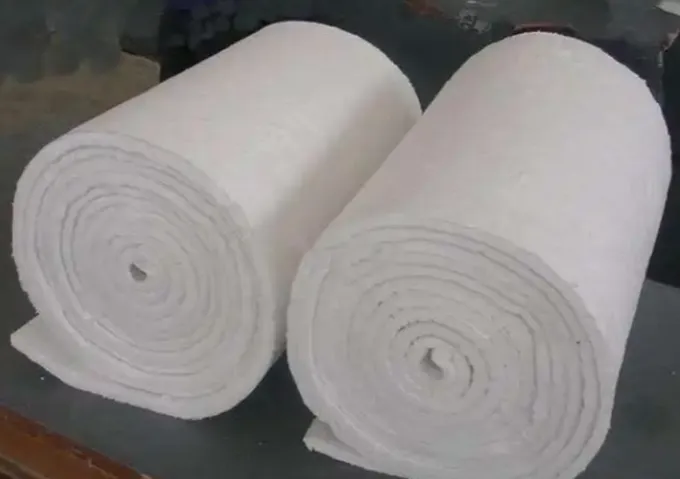
What Is a 1260°C Ceramic Fiber Blanket and Why This Temperature Grade Dominates Southeast Asia
A 1260°C ceramic fiber blanket is a flexible, lightweight refractory insulation product manufactured from spun or blown alumina-silica fibers, rated for continuous service at temperatures up to 1260°C (2300°F). The fiber matrix is amorphous (non-crystalline) in its manufactured state, which gives it excellent thermal shock resistance and flexibility. Beyond the 1260°C threshold, the fiber begins an irreversible transformation into crystalline phases — primarily mullite and cristobalite — causing dimensional shrinkage, embrittlement, and eventual loss of structural integrity.
The 1260°C grade is, without question, the highest-volume ceramic fiber blanket specification across Southeast Asia, and Indonesia is no exception. Why this particular temperature class dominates rather than lower-rated (1000°C, 1100°C) or higher-rated (1400°C, 1600°C) products comes down to the industrial profile of the region:
- Palm oil and rubber processing: Boiler systems and dryers typically operate in the 800–1100°C range, making 1260°C a comfortable safety margin above operating conditions
- Cement manufacturing: Indonesia is the world’s fourth-largest cement producer; rotary kilns, preheater cyclones, and clinker coolers operate between 900–1300°C
- Steel and ferro-alloy processing: Indonesian electric arc furnaces and ladle heating equipment operate in the 1100–1250°C range
- Nickel laterite smelting: A rapidly expanding sector in Sulawesi and Maluku using rotary kilns and RKEF (Rotary Kiln Electric Furnace) technology requiring insulation rated at the 1260°C threshold
- Ceramic and tile manufacturing: Industrial kilns in Java’s ceramics manufacturing corridor (Tangerang, Surabaya) regularly specify 1260°C blanket
The 1260°C grade represents the sweet spot between performance and economy — it outperforms lower-rated alternatives in the applications above while costing substantially less than 1400°C or high-alumina grades. This is why, when Indonesian buyers request “standard ceramic fiber blanket,” they almost universally mean 1260°C.
Also read: Ceramic Fiber Blanket Manufacturers in USA: 2300F Wholesale.
How 1260°C Specification Is Defined Technically
The 1260°C continuous service temperature rating is not simply a marketing number. It corresponds to a specific performance criterion: linear thermal shrinkage must remain below 2–3% after 24 hours of exposure at rated temperature, as tested per international standards (ASTM C892 or ISO 10635). Products failing this criterion at 1260°C should be reclassified to a lower temperature grade.
Temperature classifications commonly used in the Indonesian market:
| Temperature Class | Continuous Service Limit | Common Designation | Primary Use Case |
|---|---|---|---|
| STD 1000 | 1000°C (1832°F) | Low-duty grade | Ovens, food processing |
| STD 1100 | 1100°C (2012°F) | Economy grade | Hot air ducts, low-temp kilns |
| STD 1260 | 1260°C (2300°F) | Standard grade | Furnaces, kilns, boilers |
| STD 1400 | 1400°C (2552°F) | High-duty grade | Petrochemical, high-temp kilns |
| STD 1600 | 1600°C (2912°F) | Polycrystalline | Extreme heat applications |
Ceramic Fiber Blanket Manufacturers and Suppliers Operating in Indonesia
Indonesia does not have large-scale domestic ceramic fiber spinning mills at the same production capacity as China, India, or Japan. The Indonesian supply chain for 1260°C blankets operates through three distinct channels: authorized distributors of international brands, regional importers with local warehousing, and a small number of domestic converters who import raw fiber and process it into finished blanket form.
International Brand Authorized Distributors in Indonesia
1. Morgan Thermal Ceramics (PT distributor network)
Morgan Advanced Materials maintains authorized distribution partners in Jakarta and Surabaya. Their Superwool and Kaowool product lines (1260°C rated) are the most widely recognized brands in Indonesian industrial specifications. Morgan’s local partners stock standard rolls and can access custom specifications through regional warehouses in Singapore or directly from Morgan’s Asian production facilities.
2. Unifrax Indonesia Distribution
Unifrax (now part of Unifrax Holdings following mergers) distributes Fiberfrax products through authorized agents in Indonesia. Coverage is strongest in the Java industrial corridor (Bekasi-Karawang-Cikarang manufacturing zone).
3. IBIDEN and Nichias (Japanese Brands)
Japanese ceramic fiber brands have a presence in Indonesia through trading companies, primarily serving Japanese-invested manufacturing facilities (automotive component plants, electronics manufacturers) that specify Japanese-standard materials by default.
4. Yeso Insulations Indonesia
A regionally established insulation supplier with warehousing in Jakarta and Surabaya. Yeso stocks multiple brands of 1260°C blanket and offers local technical support for installation projects.
Domestic Importers and Trading Companies
Indonesia has a robust network of insulation materials trading companies that import ceramic fiber blanket from Chinese manufacturers (primarily from Shandong, Zhengzhou, and Hebei provinces) and resell through local channels. Major trading hubs include:
- Glodok / Mangga Dua area, Jakarta: Concentrated market for industrial materials including ceramic fiber
- Rungkut Industrial Area, Surabaya: East Java distribution hub
- Batam Free Trade Zone: Entry point for goods from Singapore, with re-distribution to Java and Sumatra
These trading companies typically offer the most competitive pricing for standard 1260°C blanket without specific brand requirements, though quality verification requires more due diligence compared to authorized brand distributors.
Domestic Converter Operations
A small number of Indonesian businesses import raw ceramic fiber (loose fiber or unprocessed wool) and convert it into blanket form through needling and binding processes. This model allows some cost reduction versus importing finished blanket, but quality consistency depends heavily on the supplier’s production controls.
Indonesian Supplier Overview Table
| Supplier Type | Location | Brands Handled | Min Order | Delivery Coverage | Price Level |
|---|---|---|---|---|---|
| Morgan Authorized Distributor | Jakarta, Surabaya | Kaowool, Superwool | 1 pallet | Java, Sumatra | Premium |
| Unifrax Authorized Agent | Jakarta, Cikarang | Fiberfrax | 1 pallet | Java nationwide | Premium |
| Established Trading Company | Jakarta, Surabaya, Batam | Multiple Chinese brands | 5 rolls | Indonesia nationwide | Mid-range |
| General Insulation Supplier | Java, Sumatra cities | Mixed brands | 1 roll | Local city radius | Variable |
| Domestic Converter | Jakarta, Tangerang | Unbranded / house brand | 10 rolls | Java + shipping | Economy |
| Direct Import (buyer-arranged) | Chinese mills | Chinese brands | Full container | Buyer manages | Lowest |
Technical Specifications: 1260°C Blanket Grades, Density Options, and Physical Properties
Standard Physical Properties for 1260°C Ceramic Fiber Blanket
The following table summarizes typical physical properties for 1260°C ceramic fiber blanket sold in the Indonesian market. Values represent industry norms across major brands; individual product specifications may vary slightly.
| Property | Test Method | 96 kg/m³ (6 lb/ft³) | 128 kg/m³ (8 lb/ft³) | 160 kg/m³ (10 lb/ft³) |
|---|---|---|---|---|
| Classification Temperature | ASTM C892 | 1260°C | 1260°C | 1260°C |
| Continuous Use Temperature | Manufacturer cert | 1260°C | 1260°C | 1260°C |
| Density | ASTM C167 | 96 kg/m³ ±10% | 128 kg/m³ ±10% | 160 kg/m³ ±10% |
| Linear Shrinkage @ 1260°C/24h | ASTM C356 | ≤2.5% | ≤2.0% | ≤2.0% |
| Tensile Strength | ASTM C1454 | 35–50 kPa | 50–70 kPa | 70–95 kPa |
| Thermal Conductivity @ 400°C | ASTM C177 | 0.12 W/mK | 0.11 W/mK | 0.11 W/mK |
| Thermal Conductivity @ 800°C | ASTM C177 | 0.24 W/mK | 0.22 W/mK | 0.21 W/mK |
| Thermal Conductivity @ 1000°C | ASTM C177 | 0.38 W/mK | 0.34 W/mK | 0.32 W/mK |
| Specific Heat | Calorimetry | ~1.0 kJ/kgK | ~1.0 kJ/kgK | ~1.0 kJ/kgK |
| Max Use Velocity (gas erosion) | Field guideline | 10 m/s | 15 m/s | 20 m/s |
Standard Roll Dimensions Available in Indonesia
Indonesian suppliers typically stock the following standard roll formats. Custom dimensions are available through fabricators with waterjet or band-saw cutting capability.
| Roll Specification | Width × Length × Thickness | Coverage per Roll | Approx. Weight (96 kg/m³) |
|---|---|---|---|
| Standard small roll | 600mm × 7.3m × 25mm | ~4.4 m² | ~4.3 kg |
| Standard medium roll | 600mm × 7.3m × 50mm | ~4.4 m² | ~8.6 kg |
| Wide roll (1″) | 1200mm × 7.3m × 25mm | ~8.8 m² | ~8.4 kg |
| Wide roll (2″) | 1200mm × 7.3m × 50mm | ~8.8 m² | ~16.8 kg |
| Long format roll | 600mm × 14.6m × 25mm | ~8.8 m² | ~8.5 kg |
| Large industrial roll | 1200mm × 14.6m × 50mm | ~17.5 m² | ~33.6 kg |
Fiber Diameter and Its Importance
A specification point frequently overlooked by Indonesian procurement teams is mean fiber diameter (MFD). For standard 1260°C blanket:
- Standard grade: MFD typically 2.5–3.5 micrometers
- High-purity grade: MFD 2.0–2.8 micrometers (finer fibers, lower thermal conductivity, higher cost)
Coarser fibers (>4 micrometers) indicate lower production quality, reduced insulation efficiency, and may fall outside health-protective criteria. When reviewing supplier documentation, request the fiber diameter specification alongside the temperature rating.
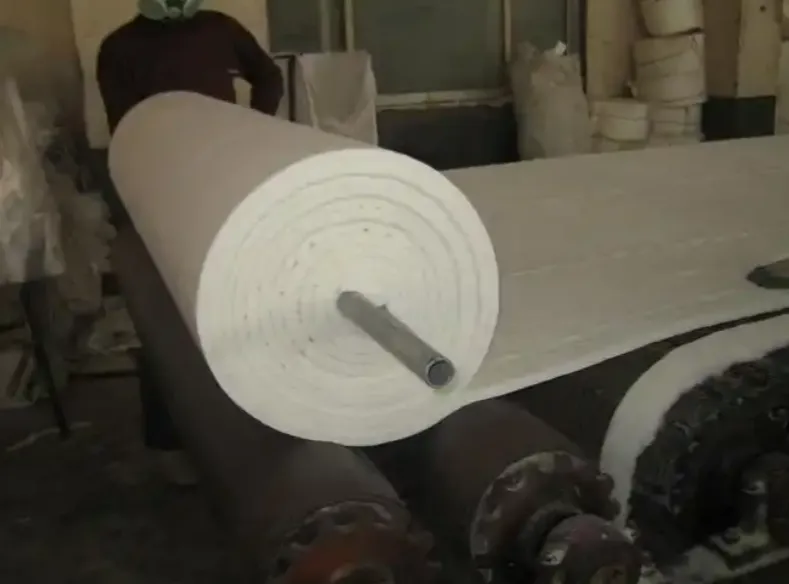
Alumina-Silica Chemistry Behind 1260°C Performance
Standard Fiber Composition for 1260°C Grade
The 1260°C temperature rating corresponds specifically to the alumina-silica fiber system in its standard composition range:
- Al₂O₃ content: 43–47%
- SiO₂ content: 52–56%
- Other oxides (Fe₂O₃, TiO₂, Na₂O, K₂O): combined < 1%
This composition places the fiber chemistry in the vicinity of the Al₂O₃-SiO₂ eutectic zone, producing an amorphous glass-phase fiber that is thermally stable up to the 1260°C limit. The amorphous structure is what gives the fiber its flexibility and thermal shock resistance — crystalline ceramics would fracture under the same thermal cycling conditions.
Phase Transformation and Its Practical Meaning
When a 1260°C blanket is exposed to temperatures approaching or exceeding its rating, the amorphous fiber structure transforms:
- Mullite formation (3Al₂O₃·2SiO₂): Begins at approximately 1000–1100°C under prolonged exposure; accelerates at 1260°C and above
- Cristobalite formation (SiO₂ crystalline phase): Occurs simultaneously at similar temperatures, particularly in higher-silica compositions
- Fiber embrittlement and shrinkage: The combined effect of these transformations causes irreversible dimensional change and mechanical brittleness
For Indonesian buyers managing furnace relining cycles, understanding this transformation explains why a 1260°C blanket operating at 1200°C in a continuously running furnace may last 5–8 years, while the same product in a furnace that regularly peaks at 1280–1300°C may need replacement in 1–3 years.
Chemical Resistance Profile
| Chemical Environment | Compatibility with 1260°C RCF | Notes |
|---|---|---|
| Oxidizing atmospheres (air, O₂) | Excellent | Standard operating environment |
| Reducing atmospheres (H₂, CO) | Good | Some binder degradation at very low O₂; fiber stable |
| Steam / water vapor | Moderate | Hydrothermal attack possible above 900°C |
| Alkali compounds (Na₂O, K₂O) | Poor | Accelerated fiber dissolution; avoid in glass or cement alkali contact |
| Acidic gases (HCl, SO₂) | Moderate | Silica-rich surface may leach; monitor in petrochemical applications |
| Molten aluminum | Not suitable | Chemical attack on fiber; use refractory board or castable instead |
| Molten glass | Not suitable | Flux attack on fiber matrix |
Wholesale Pricing in Indonesia: IDR and USD Benchmarks for 2025–2026
Pricing for 1260°C ceramic fiber blanket in Indonesia varies based on brand, density, order volume, and whether the product is domestically stocked or imported on order. The following benchmarks reflect market conditions during 2025–2026, sourced from multiple supplier quotations across Java and Sumatra.
Pricing by Brand Tier (IDR per roll, standard 600mm × 7.3m × 50mm, 96 kg/m³)
| Brand Tier | Example Brands | Small Order (1–9 rolls) | Wholesale (10–49 rolls) | Bulk (50+ rolls) |
|---|---|---|---|---|
| Premium International | Kaowool, Fiberfrax | IDR 280,000–340,000 | IDR 230,000–280,000 | IDR 190,000–230,000 |
| Mid-Tier International | Chinese Grade A brands | IDR 180,000–230,000 | IDR 145,000–185,000 | IDR 115,000–150,000 |
| Economy / Unbranded | Generic Chinese import | IDR 95,000–140,000 | IDR 80,000–115,000 | IDR 65,000–95,000 |
Pricing by Density (IDR per roll, 600mm × 7.3m × 50mm, mid-tier brand)
| Density | IDR per Roll (Wholesale) | Premium vs. 96 kg/m³ |
|---|---|---|
| 64 kg/m³ (4 lb/ft³) | IDR 110,000–140,000 | -20% to -25% |
| 96 kg/m³ (6 lb/ft³) | IDR 145,000–185,000 | Baseline |
| 128 kg/m³ (8 lb/ft³) | IDR 185,000–230,000 | +25% to +35% |
| 160 kg/m³ (10 lb/ft³) | IDR 235,000–290,000 | +55% to +65% |
USD Equivalent Pricing for International Buyers (2026 reference rate: USD 1 = IDR 16,000)
| Product Spec | Density | USD per Roll (Wholesale) | USD per m² |
|---|---|---|---|
| 25mm, 600mm × 7.3m | 96 kg/m³ | USD 5.50–8.00 | USD 1.25–1.80 |
| 50mm, 600mm × 7.3m | 96 kg/m³ | USD 9.00–12.00 | USD 2.05–2.70 |
| 50mm, 1200mm × 7.3m | 96 kg/m³ | USD 17.00–23.00 | USD 1.95–2.60 |
| 50mm, 600mm × 7.3m | 128 kg/m³ | USD 12.00–15.50 | USD 2.70–3.50 |
Price Factors Specific to the Indonesian Market
Several dynamics shape ceramic fiber pricing in Indonesia that differ from Western markets:
- Import duty structure: Indonesia imposes import duties of 5–15% on ceramic fiber blanket (HS Code 6806.10), plus 11% VAT (PPN). These duties add meaningfully to landed cost from Chinese or Indian mills.
- Currency volatility: The IDR/USD exchange rate has historically fluctuated significantly (IDR 14,500–16,500 per USD range over 2022–2025). Buyers on long-term contracts often negotiate USD-denominated pricing or include currency adjustment clauses.
- Logistics costs within Indonesia: Shipping ceramic fiber from Jakarta to Kalimantan, Sulawesi, or Papua adds freight costs that can represent 15–30% of product cost. Air freight for urgent orders to remote mining and smelting sites can temporarily double the effective per-roll cost.
- Port congestion at Tanjung Priok: Jakarta’s primary port periodically experiences significant congestion, extending clearing times for import shipments by 1–3 weeks during peak periods.
Density and Thickness Selection Logic for Indonesian Industrial Applications
The Density Decision Framework
We consistently advise Indonesian procurement teams to approach density selection as a functional engineering decision, not a cost-cutting exercise. The two questions that govern density selection are:
Question 1: Is there gas flow across the blanket surface?
If yes, and gas velocity exceeds 8–10 m/s, move to 128 kg/m³ minimum. Lighter density blanket in high-velocity gas environments suffers progressive surface fiber erosion that shortens service life.
Question 2: Is compressive resistance required (gasket, seal, or compression-fit application)?
If yes, higher density (128–160 kg/m³) maintains its geometry under compression, while lower densities permanently deform.
For all other standard furnace lining applications, 96 kg/m³ provides the best balance of thermal performance, handleability, and cost.
Thickness Selection for Indonesian Climate Considerations
Indonesia’s tropical climate introduces a factor not typically considered in Western insulation design: ambient temperature effects on cold-face temperature limits. In a European or North American facility where the ambient temperature outside the furnace shell is 10–20°C, a furnace shell running at 60°C feels warm but is manageable. In a facility in Sumatra or Kalimantan where ambient temperatures regularly reach 32–38°C, the same 60°C shell temperature creates a much more severe working environment and may push the need for an additional insulation layer.
When we work with Indonesian plant managers on lining design, we typically target a cold-face temperature of 50°C maximum in tropical environments, compared to the 60–70°C target common in temperate-climate designs. This frequently means specifying one additional inch (25mm) of blanket thickness compared to what a European equivalent application would use.
Application-Specific Selection Matrix for Indonesian Industries
| Industry / Application | Recommended Density | Recommended Thickness | Key Consideration |
|---|---|---|---|
| Palm oil boiler insulation | 96 kg/m³ | 50mm (2 layers 25mm) | Moisture resistance; use with vapor barrier on cold face |
| Cement rotary kiln backup | 128 kg/m³ | 50mm | High thermal cycling; needled blanket preferred |
| Nickel RKEF kiln lining | 128 kg/m³ | 75–100mm | Aggressive dust and gas environment |
| Ceramic tile kiln lining | 96 kg/m³ | 50–75mm | Fast cycling; low thermal mass priority |
| Steel ladle preheater | 128 kg/m³ | 50mm | Mechanical impact resistance |
| Geothermal pipe insulation | 96 kg/m³ | 25–50mm | Conformability to pipe curvature |
| Industrial oven door seal | 128 kg/m³ | 25mm | Compression resistance |
| Rubber vulcanization autoclave | 96 kg/m³ | 25–50mm | Steam resistance; check chemical compatibility |
| Aluminium die casting furnace | 128 kg/m³ | 50mm | Erosion from metal vapor and flux |
| Textile stenter frame | 96 kg/m³ | 25mm | Lightweight; ease of replacement |
Flexible Supply Chain: MOQ, Delivery Coverage, and Import vs. Domestic Sourcing
Understanding MOQ Tiers in the Indonesian Market
Unlike the US market where pallet quantities are the standard wholesale threshold, Indonesian suppliers — particularly trading companies — often accept smaller minimum orders, reflecting the large number of small-to-medium industrial buyers in the market.
| Order Tier | Typical MOQ | Price Category | Fulfillment Time |
|---|---|---|---|
| Single roll | 1 roll | Retail | Same day (local pickup) |
| Small project order | 5–10 rolls | Small wholesale | 1–3 business days |
| Standard wholesale | 20–50 rolls | Wholesale | 2–5 business days |
| Project supply | 50–200 rolls | Volume wholesale | 3–7 business days |
| Container import | 500+ rolls | Direct mill pricing | 30–60 days |
Regional Delivery Coverage
Ceramic fiber blanket distribution across Indonesia’s 17,000+ islands is one of the most complex logistics challenges in the Southeast Asian industrial supply chain. Java-based suppliers have reasonable coverage across the main islands:
- Java (all provinces): Next-day to 3-day delivery from Jakarta/Surabaya hubs
- Sumatra: 2–4 day delivery via truck/ferry from Jakarta or Batam
- Kalimantan: 3–5 day delivery; sea freight to Balikpapan, Banjarmasin, Pontianak
- Sulawesi: 4–7 days; sea freight to Makassar, then local distribution
- Papua: 7–14 days; limited carrier options, significantly higher freight costs
For mining and smelting operations in Sulawesi, Maluku, and Papua — sectors experiencing rapid growth due to Indonesia’s nickel processing expansion — supply chain reliability is a critical factor that often justifies stocking 3–6 months of ceramic fiber inventory on-site.
Import Direct vs. Domestic Stock: Decision Framework
| Factor | Domestic Stock Purchase | Direct Import from China/India |
|---|---|---|
| Lead time | 1–7 days | 30–60 days |
| MOQ | Low (5+ rolls) | High (full container, 500+ rolls) |
| Price per roll | Higher (includes importer margin + duty) | Lower (mill price + duty + freight) |
| Quality verification | Easier (inspect locally) | Requires factory inspection or third-party audit |
| Currency risk | IDR pricing | USD pricing with exchange rate exposure |
| Best for | Maintenance, small projects | Large planned projects with advance scheduling |
Certifications and Quality Standards Applicable to the Indonesian Market
Indonesian National Standards (SNI)
Indonesia’s national standardization body (BSN – Badan Standardisasi Nasional) does not currently maintain a dedicated SNI standard specifically for refractory ceramic fiber blanket products. Ceramic fiber blankets are typically evaluated against international standards, with ASTM (American Society for Testing and Materials) and ISO being the most widely referenced in Indonesian industrial specifications.
However, imported ceramic fiber products are subject to Indonesian customs and import regulations including:
- SNI certification for products on the mandatory certification list (ceramic fiber blanket is currently not on this list as of 2025, but regulatory frameworks evolve)
- BPOM clearance is not required (ceramic fiber is an industrial, not consumer product)
- MSDS/SDS documentation in Bahasa Indonesia is increasingly requested by Indonesian HSE departments
International Quality Standards Referenced in Indonesia
| Standard | Issuing Body | What It Covers | Relevance to Indonesian Buyers |
|---|---|---|---|
| ASTM C892 | ASTM International | High-temp fiber blanket classification | Most commonly cited in industrial specs |
| ISO 10635 | ISO | Thermal insulation testing methods | Referenced in engineering specifications |
| ISO 8301/8302 | ISO | Thermal resistance measurement | Relevant for thermal conductivity data |
| JIS A 9504 | Japanese Standards | Ceramic fiber performance | Referenced by Japanese-brand products |
| GB/T 3003 | Chinese Standards | Refractory fiber products | Referenced for Chinese-origin products |
Third-Party Quality Verification Options
For Indonesian buyers importing directly from Chinese or Indian mills, third-party inspection is strongly recommended. Reputable inspection agencies operating in Indonesia and in Chinese ceramic fiber production regions include:
- SGS Indonesia (PT SGS Indonesia): Factory audits, product testing, and shipping inspection
- Bureau Veritas Indonesia: Pre-shipment inspection and quality audits
- Intertek Indonesia: Product testing and certification support
We have consistently found that first-time import orders from new suppliers without third-party inspection carry a meaningful risk of receiving product that does not meet the stated density or temperature classification — particularly for economy-tier suppliers.
Ceramic Fiber Blanket vs. Alternative Insulation Materials Used in Indonesia
The Competitive Landscape in Indonesian Refractory Insulation
Indonesian industrial buyers frequently choose between ceramic fiber blanket and several alternative materials. The decision framework differs from Western markets because some materials widely used elsewhere are more cost-competitive in Indonesia due to local production.
Comparative Analysis Table
| Property | Ceramic Fiber Blanket 1260°C | Castable Refractory (dense) | Lightweight Castable | Calcium Silicate Board | Rock Wool Blanket |
|---|---|---|---|---|---|
| Max Service Temp | 1260°C | 1400–1700°C | 1200–1400°C | 950°C | 700–850°C |
| Thermal Conductivity @ 800°C | 0.24 W/mK | 0.85–1.5 W/mK | 0.35–0.6 W/mK | 0.20–0.30 W/mK | N/A (exceeds rating) |
| Density | 96–160 kg/m³ | 1800–2400 kg/m³ | 600–1200 kg/m³ | 200–300 kg/m³ | 80–150 kg/m³ |
| Installation Speed | Fast | Very slow (curing required) | Slow | Medium | Fast |
| Flexibility | Excellent | None | None | None | Good |
| Resistance to alkali attack | Poor | Good | Moderate | Poor | Poor |
| Local availability in Indonesia | Good (import-dependent) | Excellent (local production) | Good | Good | Excellent (local production) |
| Relative cost | Medium | Low-medium | Medium | Medium | Low |
Key Differentiators for Indonesian Market Context
Rock wool vs. ceramic fiber: Indonesia has domestic rock wool production (PT Rockwool Indonesia, among others), making rock wool pricing very competitive for applications below 700°C. For applications between 700°C and 1260°C, ceramic fiber blanket has no viable rock wool substitute.
Calcium silicate board: Widely available in Indonesia and frequently used as a backup layer behind ceramic fiber blanket. The combination of ceramic fiber working layer + calcium silicate backup is cost-effective for many boiler and kiln applications.
Dense castable refractory: Indonesian producers (including several Surabaya-based manufacturers) produce dense castable refractory locally at competitive pricing. For applications requiring direct mechanical abrasion resistance or molten material contact, castable remains the standard choice — ceramic fiber cannot replace it in these zones.
Installation Guidelines and Field Application Practices
Attachment Systems Used in Indonesia
Indonesian industrial practice for ceramic fiber blanket attachment largely mirrors international standards, with some adaptations to locally available hardware:
Welded stud and washer system: Most common in Indonesian furnace construction. Carbon steel studs (or SS304 for higher-temperature zones) are welded to the furnace shell, and ceramic fiber blanket is pushed onto the studs, secured with clips or ceramic washers. This method is well-understood by Indonesian refractory contractors.
Ceramic fiber module system: Pre-compressed modules are gaining adoption in Indonesian cement and nickel processing industries, where the speed of installation during planned shutdown maintenance windows is critically important.
Wire mesh facing: In applications with moderate gas velocity (cement preheater ducts, dryer systems), a stainless steel wire mesh is stretched over the ceramic fiber surface and secured at edges to prevent surface erosion. This is particularly common in Indonesian palm oil processing plants where combustion gas carries particulate matter.
Layer Staggering Practice
Whether working in single or multiple layers, staggering joints between layers is standard practice in Indonesia as elsewhere. We recommend a minimum 150mm offset between layer joints in the same plane. In applications with significant thermal cycling (ceramic kilns, batch heat-treat furnaces), corners should be constructed with folded blanket rather than butted pieces to prevent joint opening under cyclic expansion.
Initial Heat-Up Protocol
This step is often overlooked in Indonesian field practice, particularly in smaller industrial operations. After ceramic fiber blanket installation, the first heat-up should follow a controlled ramp:
- 0 to 200°C: Hold for 1–2 hours (moisture removal)
- 200 to 600°C: Slow ramp at 50°C/hour (organic binder burnout)
- 600°C to operating temperature: Normal ramp rate acceptable
Skipping the controlled initial heat-up can cause steam-driven delamination of blanket layers or cracking of any applied rigidizer coating.
Health, Safety, and Regulatory Considerations in Indonesia
Indonesian Occupational Health Framework
Indonesia’s primary occupational health regulation governing workplace chemical exposure is Permenaker (Ministry of Manpower Regulation) No. 5 of 2018 on occupational safety and health in the work environment. This regulation establishes Nilai Ambang Batas (NAB — threshold limit values) for workplace airborne contaminants.
For refractory ceramic fiber, the current Indonesian NAB for respirable fibers aligns with general fiber limits. Indonesian HSE professionals increasingly reference IARC Group 2B classification for RCF when developing workplace exposure programs.
Required PPE for Ceramic Fiber Handling in Indonesian Workplaces
| Work Activity | Minimum PPE (Indonesian K3 Standard) |
|---|---|
| Unrolling and basic cutting | Safety glasses, cotton or nitrile gloves, N95 respirator |
| Overhead installation | Full face shield, P2/P100 respirator, coveralls |
| Module installation or compression fitting | Gloves, P2 respirator, safety glasses |
| Demolition / removal of used blanket | Full coveralls, P100 respirator, double-glove |
| Working in confined spaces with ceramic fiber | Supplied air respirator; consult K3 officer |
Disposal Practice in Indonesia
Indonesia’s hazardous waste regulations (PP No. 22 of 2021 regarding environmental protection) classify waste materials based on their characteristics. Standard alumina-silica ceramic fiber waste does not meet the Indonesian hazardous waste classification criteria under current regulations, and is typically disposed of in Class II (non-hazardous industrial waste) landfill facilities. However:
- Ceramic fiber waste contaminated with heavy metals (from furnace operation with lead, chromium, or nickel content) may require hazardous waste treatment
- Local government (dinas lingkungan hidup) requirements vary by province and should be verified before disposal arrangements are made
Proposition 65 / International Health Label Requirements
For Indonesian manufacturers exporting finished products to the USA, California Proposition 65 requirements for products containing RCF may apply. This is increasingly relevant for Indonesian industrial component manufacturers selling to US industrial buyers.
Frequently Asked Questions (FAQs)
1260°C Ceramic Fiber Blanket
Technical & Procurement FAQ for Indonesia Industrial Market
1. What does 1260°C mean, and is it the same as 2300°F?
Yes. 1260°C and 2300°F are equivalent temperature ratings. This is the most common grade of ceramic fiber blanket globally. Indonesian suppliers typically use Celsius (°C) in technical documents, while products from US-origin data sheets use Fahrenheit (°F). Both refer to the classification temperature where the fiber begins to crystallize and shrink irreversibly.
2. Where can I buy 1260°C ceramic fiber in Jakarta or Surabaya?
In Jakarta, major distributors are concentrated in the industrial areas of Cikarang, Cibitung, and Glodok. In Surabaya, look towards the Rungkut Industrial Estate (SIER) and surrounding Gresik areas. For immediate stock, trading companies usually carry 96 kg/m³ and 128 kg/m³ densities in 25mm and 50mm thicknesses.
3. What is the difference between 96 kg/m³ and 128 kg/m³ density?
- 96 kg/m³: Standard choice for backup insulation; cost-effective and lighter.
- 128 kg/m³: 33% more fiber mass, offering superior erosion resistance, higher compressive strength, and slightly better thermal efficiency. Recommended for high gas-flow environments.
4. Can 1260°C blanket be used in palm oil processing boilers?
Yes. Most palm oil boilers operate between 900°C and 1150°C, which is well within the 1260°C grade’s capability. It is excellent for furnace walls and door seals. Tip: In biomass-fired boilers, pairing the blanket with a stainless steel wire mesh facing helps protect the fibers from the abrasive ash in combustion gases.
5. How do I verify quality from an Indonesian trading company?
Always request a Mill Test Certificate (MTC) showing density (ASTM C167) and linear shrinkage (ASTM C356). A quick field check: a standard 96 kg/m³ roll (0.6m x 7.3m x 0.05m) should weigh approximately 21 kg. Significant deviations usually indicate the supplier is providing a lower density than invoiced.
6. Is ceramic fiber blanket subject to import duties in Indonesia?
7. What is the shelf life in Indonesia’s tropical climate?
8. How long does the lining last in Indonesian cement kilns?
In preheater cyclones and riser ducts, 1260°C blanket typically lasts 3 to 6 years. However, in zones with alkali-rich gas or high mechanical stress, this may drop to 1–3 years. Annual inspection via infrared thermography is the best way to monitor degradation.
9. Are there bio-soluble ceramic fiber options in Indonesia?
Yes, bio-soluble options (like Superwool) are available through authorized networks but carry a 20–40% price premium. While adoption has been slower in Indonesia, companies operating under ISO 45001 or international health standards are increasingly specifying them for improved worker safety.
10. Can I get custom-cut ceramic fiber shapes in Indonesia?
Summary and Recommendations for Indonesian Buyers
The 1260°C ceramic fiber blanket market in Indonesia is a functional, reasonably well-supplied sector with multiple sourcing channels — from premium international brands through local authorized distributors to economy-grade imports through trading companies. The right sourcing decision depends on your application’s technical requirements, order volume, required lead time, and quality documentation standards.
Key takeaways from AdTech’s assessment of the Indonesian ceramic fiber market:
- Temperature rating verification matters: Always request linear shrinkage test data — the 1260°C label alone does not guarantee performance without supporting documentation
- Density selection should be application-driven: Default to 96 kg/m³ for standard furnace lining; specify 128 kg/m³ for gas-erosion or compression applications
- Indonesian climate adds a thickness requirement: Target 50°C maximum cold-face temperature rather than Western norms of 60–70°C, often adding one insulation layer
- Regional logistics complexity is real: Budget both time and cost for delivery to outer island locations; maintain strategic on-site stock for critical operations
- Import duty economics favor domestic stocking for most buyers: Unless buying container quantities for large planned projects, domestic distribution is usually more cost-effective after accounting for 5% duty and 11% PPN
- Bio-soluble alternatives are available but niche: Standard RCF blanket dominates; bio-soluble grades are available for compliance-driven specifications
- PPE and disposal compliance should meet K3 standards: Permenaker No. 5/2018 applies; document disposal to Class II industrial waste facilities