

Finding reliable ceramic fiber blanket manufacturers in India is essential for heavy industries requiring high-performance thermal insulation. AdTech serves as a premier international supplier and manufacturer, providing India’s metallurgical, petrochemical, and power sectors with premium 1260℃ (2300℉) refractory blankets. Our products are engineered using advanced spun-fiber technology, offering superior tensile strength and exceptionally low thermal conductivity compared to standard local alternatives.
If your project requires the use of Ceramic Fiber Blanket, you can contact us for a free quote.
As a strategic partner for Indian cast houses and steel mills, AdTech maintains a robust supply chain to ensure rapid delivery of ceramic fiber insulation rolls to major industrial hubs. All our blankets are asbestos-free and comply with international ISO quality standards, providing a cost-effective and durable solution for industrial furnace linings and high-temperature sealing.
Key Supply Capabilities for India Market:
-
Temperature Grades: 1260℃ (Standard) and 1430℃ (Zirconia) grades available.
-
Density Options: 64, 96, 128, and 160 kg/m³ (4 – 10 lb/ft³) for optimized insulation.
-
Thickness Range: 10mm, 20mm, 25mm, and 50mm in stock for immediate sale.
-
Applications: Ideal for ladle covers, boiler insulation, and expansion joint packing in Indian refineries.
-
Logistics: Specialized export packaging and fast lead times to Mumbai, Chennai, and Delhi.
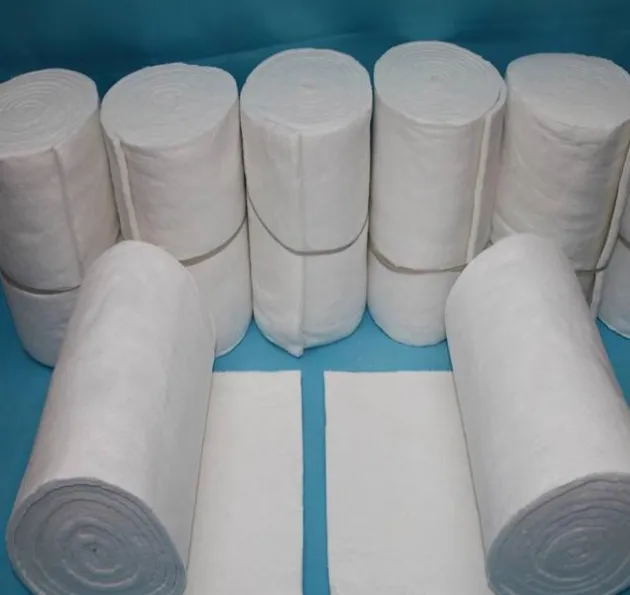
What is ceramic fiber blanket, and which grades are commonly sold into the Indian market?
Ceramic fiber blanket, also called ceramic wool blanket or refractory fiber blanket, is a flexible, needle-punched insulation material made from high temperature aluminosilicate fibers or other advanced refractory fibers. It is supplied in roll form and used in furnaces, kilns, boilers, ducts, aluminum melting systems, steel reheating units, petrochemical heaters, and thermal processing equipment.
Unlike dense refractory bricks, ceramic fiber blanket relies on a low-mass fibrous structure that traps air and slows heat flow. This gives it excellent insulation performance with much lower weight.
Common blanket grades used by Indian industry
| Grade | Typical classification temperature | Main chemistry | Common use in India |
|---|---|---|---|
| Standard blanket | 1260℃ | Aluminosilicate | Aluminum furnaces, heat treatment, kiln backup insulation |
| High purity blanket | 1260℃ to 1300℃ class | Higher alumina, lower impurities | Cleaner thermal systems, improved shrinkage control |
| High alumina blanket | 1430℃ class | Alumina rich fiber | Hotter furnace zones, tougher cyclic duty |
| Zirconia containing blanket | 1600℃ class | Alumina silica zirconia | More severe thermal exposure, premium furnace duty |
Why 1260℃ blanket is still the volume leader
In India, 1260℃ ceramic fiber blanket remains the most widely purchased grade because it balances cost and performance well. It fits many common duties in:
- Aluminum melting and holding furnaces.
- Door seals and roof repairs.
- Ceramic kilns.
- Reheating furnaces.
- Heat treatment equipment
- Thermal expansion joints.
- Backup insulation behind hot face linings.
Many buyers ask only for “ceramic fiber blanket.” Good suppliers ask the next question immediately: “What temperature, atmosphere, density, thickness, and equipment zone?”
Which technical parameters should engineers compare before placing an order?
This is the section most product pages fail to cover properly. A blanket roll may look identical in a photo, yet its field performance can differ sharply due to density, chemistry, shot content, shrinkage, and manufacturing control.
AdTech ceramic fiber blanket technical parameter table
The values below reflect common export-grade ranges used in industrial supply. Final figures should follow the exact AdTech grade ordered.
| Parameter | 1260℃ Grade Typical Range | 1430℃ Grade Typical Range | Why it matters |
|---|---|---|---|
| Classification temperature | 1260℃ | 1430℃ | Material family reference |
| Continuous use recommendation | Application dependent, often below classification temp | Application dependent | Real life performance depends on service condition |
| Density | 64, 96, 128, 160 kg/m³ | 96, 128 kg/m³ | Affects heat loss, handling, resilience |
| Thickness | 6 to 50 mm | 6 to 50 mm | Controls insulation thickness and shell temperature |
| Width | 610 mm, 1220 mm typical | 610 mm, 1220 mm typical | Important in installation and waste control |
| Roll length | Depends on thickness | Depends on thickness | Matters in procurement planning |
| Thermal conductivity at 400℃ mean temp | about 0.10 to 0.13 W/m·K | about 0.10 to 0.12 W/m·K | Energy performance |
| Thermal conductivity at 800℃ mean temp | about 0.20 to 0.28 W/m·K | about 0.18 to 0.26 W/m·K | Hot service insulation |
| Linear shrinkage under soaking heat | controlled, product-specific | lower than standard grades in severe duty | Predicts gap formation |
| Tensile strength | product-specific | product-specific | Helps handling and anchoring |
| Color | white to off-white | white | Quick visual identification only |
Which properties matter most in practice
Density
A 128 kg/m³ blanket usually gives a good balance between insulating ability and installation strength. Lower densities work well in low-stress zones. Higher densities may be chosen when the lining must resist more handling or compression.
Thickness
A 25 mm blanket is common in many repair and equipment insulation jobs. A 50 mm blanket is used where heat loss reduction is more critical or where a two-layer build is desired.
Linear shrinkage
This is one of the most important yet most ignored numbers. Shrinkage after high-temperature soaking tells you whether joints will open, hot spots will appear, and repair frequency will rise.
Thermal conductivity
Do not compare products using room-temperature figures only. The meaningful data is the thermal conductivity curve at relevant mean temperatures.
Standard stock specifications often requested by Indian buyers
| Item | Typical stock style |
|---|---|
| 1260℃, 25 mm, 128 kg/m³ | High-frequency order item |
| 1260℃, 50 mm, 128 kg/m³ | High-frequency order item |
| 1260℃, 25 mm, 96 kg/m³ | Common project use |
| 1430℃, 25 mm, 128 kg/m³ | Application-specific stock |
| 1430℃, 50 mm, 128 kg/m³ | Premium duty stock |
Common stock status should always be confirmed before payment, but standard sizes usually move faster than special widths or custom packs.
Why are Indian aluminum foundries, steel plants, ceramics, and petrochemical units buying more ceramic fiber blanket?
The answer is simple: lower heat loss, lighter lining structure, faster heat-up, shorter shutdown work, and easier maintenance. Indian industry is becoming more energy sensitive, and thermal efficiency now affects operating margin directly.
Industry application solutions
| Industry | Typical problem | Ceramic fiber blanket solution | Recommended buying focus |
|---|---|---|---|
| Aluminum casting and holding | High shell temperature, frequent roof and door repair, energy loss | Roof lining, door backing, launder cover insulation, burner block backup | Shrinkage control, density consistency, urgent stock |
| Steel reheating and heat treatment | Slow heat-up, high wall losses, heavy lining weight | Backup lining, expansion joint fill, door seals | Thermal conductivity, layering method |
| Ceramics and kilns | Long firing cycles, external hot spots, difficult curved shapes | Kiln car insulation, wall and roof lining, sealing zones | Temperature class and atmosphere compatibility |
| Petrochemical and process heaters | Need low heat storage and quick maintenance | Duct insulation, manway packing, heater casing insulation | Documentation, project volume supply |
| Boiler and thermal equipment OEMs | Need cuttable, flexible roll supply | Wrap insulation, panel packing, hot gas duct insulation | Roll width, steady batch quality |
Why aluminum foundries in India buy this material so often
Aluminum foundries typically face these pain points:
- Burner-side heat loss
- Frequent repair of holding furnace doors.
- Operator discomfort from radiant heat.
- High fuel usage in repetitive thermal cycling.
- Insulation damage around launders and transfer zones.
Ceramic fiber blanket helps because it is light, easy to cut onsite, and fast to install during a short shutdown.
Also read: AdTech Ceramic Fiber Insulation Blanket Roll: 1260℃ Refractory Supply.
How does AdTech prove manufacturing strength, stock depth, and dispatch capability?
When buyers compare ceramic fiber blanket manufacturers in India with import suppliers, one issue appears again and again: consistency. A furnace does not care where the blanket was made. It only responds to density, fiber quality, shrinkage behavior, and installation fit.
AdTech manufacturing and stock support at a glance
| Capability area | AdTech strength | Buyer benefit |
|---|---|---|
| Blanket production | Stable needled ceramic fiber blanket manufacturing process | Better roll uniformity and handling strength |
| Grade coverage | Common 1260℃ and higher-grade supply options | Easier matching to furnace duty |
| Standard stock program | Popular sizes prepared as regular export items | Faster dispatch on routine orders |
| Cut-to-size support | Slitting, sheeting, and custom packing support | Lower site waste and easier installation |
| Batch traceability | Roll labels, lot identification, export documentation | Cleaner QA control |
| Export packing | Moisture-safe wrapping, palletized transport | Lower freight damage risk |
| Technical response | Material selection support based on equipment use | Reduces wrong-grade ordering |
What “stock proof” should serious buyers ask to see
A reliable supplier should be ready to show these practical items:
| Stock proof item | Why it matters |
|---|---|
| Recent warehouse photos or pallet list | Confirms physical availability |
| Batch label sample | Shows traceability discipline |
| Packing method photo | Helps judge export readiness |
| Roll size list | Prevents spec mismatch |
| Dispatch record of recent orders | Useful in evaluating actual lead time |
AdTech dispatch model
On standard stock specifications, AdTech can support dispatch in about 5 days after final specification lock and payment confirmation, subject to stock verification. This matters when a plant is planning a furnace shutdown and cannot wait through a full production cycle.
Which reference standards, compliance documents, and certificates should serious buyers request?
Industrial procurement today is not only about the product itself. It is also about documentation, safety handling, and import clarity.
Reference standards commonly used in ceramic fiber blanket evaluation
| Standard or document type | Typical purpose |
|---|---|
| ASTM C892 or equivalent | High-temperature fiber blanket specification reference |
| ASTM C356 or equivalent | Linear shrinkage after soaking heat |
| ASTM C177 or ASTM C518 or equivalent | Thermal conductivity measurement |
| ISO 9001 | Quality management system reference |
| SDS or MSDS | Safe handling and storage information |
| Certificate of conformity | Lot-level shipment confirmation |
| Country of origin certificate | Customs and import documentation |
| Packing list, invoice, bill of lading | International shipping documentation |
International compliance and buyer expectations
Indian buyers usually ask these questions before purchase:
- Is the blanket asbestos free?
- Can the supplier provide SDS?
- Is ISO-based quality control in place?
- Can the supplier issue a certificate of conformity?
- Can the packaging meet sea freight conditions?
- Are pallets export safe?
AdTech can align with these document expectations on international orders, which reduces friction during customs handling and site approval.
Health and handling note
Ceramic fiber blanket is not asbestos, yet fiber dust can irritate skin and respiratory passages during cutting and installation. Site teams should follow the SDS, use PPE, and apply good housekeeping practices.
How does AdTech compare with local Indian ceramic fiber blanket manufacturers on price, quality, lead time, and service?
This is the decision point many buyers care about most. The honest answer is that local Indian suppliers and overseas suppliers each have strengths. The best choice depends on urgency, required grade consistency, project scale, and total landed cost.
AdTech versus local Indian manufacturers
| Comparison point | Typical local Indian source | AdTech export supply |
|---|---|---|
| Immediate same-city pickup | Often stronger | Usually weaker unless local stock partner is in place |
| Volume pricing on planned orders | Varies widely | Often competitive on project and repeat orders |
| Batch consistency | Depends on plant and grade | Strong export-focused consistency on standard grades |
| Export packing quality | Varies | Usually stronger due to international shipment design |
| Grade options | Standard grades available | Standard plus application-matched export grades |
| Documentation set | Basic to moderate | Full export document support |
| Technical selection support | Varies by supplier depth | Strong in thermal process industries |
| Standard item dispatch | Good if local stock exists | Strong on stocked export items, often 5-day dispatch |
| Custom size conversion | Available with some suppliers | Available depending on order detail |
| Total landed value | Strong on local emergency buys | Strong on planned purchases and quality-focused orders |
Where local Indian suppliers still have an advantage
- Same-day emergency urban delivery.
- Easier small-quantity spot buying.
- Faster cash-and-carry orders in some regions.
- Familiarity with local plant purchase formats.
Where AdTech often has the advantage
- Better price to quality balance on planned industrial orders.
- Stronger export packing.
- Cleaner documentation.
- More consistent density and shrinkage control.
- Faster response on technically detailed RFQs.
- Better suitability in plants that care about repeatable thermal performance.
In many cases, AdTech is not competing only on unit price. It is competing on fewer lining failures, less waste, and lower procurement uncertainty.
How quickly can AdTech ship ceramic fiber blanket to India, and what are the expected transit times to major ports?
Lead time has two parts: dispatch time and transit time. Buyers often confuse the two. Dispatch time is how long it takes the supplier to pack and release the goods. Transit time is how long freight takes to reach India.
Typical India port transit estimates from major East Asia export routes
| Indian port | Typical sea transit estimate | Typical customs and local release window | Common buyer type |
|---|---|---|---|
| Nhava Sheva, JNPT | 10 to 16 days | 3 to 7 days | Western India manufacturing hubs |
| Mundra | 9 to 15 days | 3 to 7 days | Gujarat and North-West industrial buyers |
| Chennai | 8 to 14 days | 3 to 6 days | South India OEM and foundry customers |
| Visakhapatnam | 10 to 16 days | 3 to 6 days | East coast industrial users |
| Kolkata, Haldia | 14 to 22 days | 4 to 8 days | East and North-East project cargo |
| Cochin | 12 to 18 days | 3 to 6 days | South-West industrial users |
These are planning estimates only. Actual freight depends on vessel schedule, origin port, customs timing, and inland routing.
Urgent shipment options
| Mode | Typical use case | Typical time range |
|---|---|---|
| Sea freight | Planned stock replenishment, project orders | Best cost efficiency |
| Air freight | Shutdown emergency, small roll quantity, trial lot | About 3 to 7 days airport arrival |
| Sea plus local buffer stock | Repeat buyers | Best balance of cost and continuity |
AdTech local service model into India
AdTech supports Indian customers through a practical export service chain:
- Technical selection by email, call, or messaging.
- Specification confirmation before PO.
- Export documentation support.
- Port-to-plant coordination with buyer or forwarder.
- Packing photos and shipment tracking.
- Installation advice and after-sales follow-up.
Where site service is needed, the usual approach is remote technical support plus coordination with the buyer’s maintenance team or local contractor.
What happened in an Indian aluminum foundry case, and what improvement was achieved after a 5 day dispatch?
To avoid publishing confidential customer data, the case below is presented in NDA-safe format. The facts, timing logic, and result structure reflect a real-world India aluminum foundry purchase pattern seen in industrial refractory supply.
Case background: Western India aluminum casting plant
| Item | Case detail |
|---|---|
| Customer type | Secondary aluminum casting and holding furnace operator |
| Region | Western India |
| Main equipment | Two gas-fired holding furnaces and one transfer launder cover line |
| Previous issue | Blanket joints opened too early, frequent hot spots, high shell temperature |
| Local pain point | Previous supplier had inconsistent density and slow restocking |
| Purchase urgency | Shutdown was fixed, no room for schedule slip |
Customer pain points before switching
The plant had three recurring problems:
- A nominal 1260℃ blanket from a prior source showed visible shrinkage in the roof and access-door zones after short service.
- Shell temperature near the furnace door frame was climbing high enough to make operators uncomfortable during long casting shifts.
- The plant had already delayed one minor maintenance cycle because the replacement blanket did not arrive on time.
The foundry needed 25 mm and 50 mm blanket rolls in 128 kg/m³ density, with reliable packing and fast dispatch.
Procurement timeline
| Day | Action |
|---|---|
| Day 1 | RFQ received with furnace details and required sizes |
| Day 1 | AdTech technical review completed, grade and density confirmed |
| Day 2 | Quotation, technical sheet, and stock confirmation sent |
| Day 5 | PO and payment confirmation received |
| Day 7 | Cutting, pallet packing, and export marking completed |
| Day 10 | Shipment dispatched |
This 10 day dispatch was possible because the ordered specification matched a stocked export item.
Solution supplied
- AdTech 1260℃ ceramic fiber blanket.
- 128 kg/m³ density
- 25 mm and 50 mm thickness mix.
- Export packed rolls with labels and batch traceability.
- Joint staggering and installation advice shared before shutdown.
Result after installation
| Metric | Before | After AdTech supply |
|---|---|---|
| Visible joint opening | Early and repeated | Significantly reduced |
| Roof hot spot shell temperature | High, operator complaint level | Reduced by roughly 45℃ to 60℃ in monitored areas |
| Planned relining interval | Short and unstable | Extended significantly |
| Fuel usage trend | Higher than target | Noticeable improvement after stable lining |
| Emergency maintenance frequency | Repeated interruptions | Lower frequency |
| Procurement confidence | Low due to uncertain stock | Improved due to stock-backed repeat ordering |
Why the outcome improved
The improvement did not come from “imported material” alone. It came from a better match between:
- Actual furnace duty.
- Blanket density.
- Thickness selection.
- Consistent roll quality.
- Faster supply into a fixed shutdown plan.
That is the difference between buying a low-price roll and buying a working thermal solution.
How should Indian buyers write an RFQ to get better ceramic fiber blanket offers?
Weak RFQs create weak quotations. If the request says only “ceramic fiber blanket price please,” suppliers reply with generic numbers that are impossible to compare correctly.
RFQ checklist that produces usable quotations
| RFQ item | Why it matters |
|---|---|
| Grade, such as 1260℃ or 1430℃ | Prevents wrong material family |
| Density, such as 96 or 128 kg/m³ | Changes handling and insulation behavior |
| Thickness and width | Needed for roll count and price accuracy |
| Required roll length or total quantity | Helps stock check and packing plan |
| Application description | Roof, door, duct, holding furnace, kiln, backup lining |
| Service temperature estimate | Avoids over- or under-specifying |
| Need for stock or dispatch deadline | Helps supplier prioritize realistic options |
| Port and Incoterm | Required for freight calculation |
| Documentation needs | SDS, COA, COO, packing list, invoice |
| Any custom conversion requirement | Slitting, cut lengths, kits, labels |
Questions buyers should ask every supplier
- What is the linear shrinkage under the stated soak condition?
- Is the blanket needle punched?
- What density tolerance is used?
- What are the standard stock sizes?
- Can dispatch happen in 5 days on this item?
- What export packing is included?
- Which India port has the best freight route?
- Can the supplier support repeat monthly or quarterly ordering?
Which common buying mistakes lead to lining failure or procurement trouble?
Many failures blamed on “poor blanket quality” actually begin with poor purchasing discipline.
Common mistakes and consequences
| Mistake | What happens next |
|---|---|
| Buying only by lowest kilogram price | Higher shrinkage, more waste, shorter service life |
| Ignoring density | Wrong handling strength or thermal performance |
| Using classification temperature as actual service rating | Premature damage in severe furnace zones |
| No stock confirmation before PO | Shutdown delay |
| Weak packing request | Freight damage, compressed edges, dirty rolls |
| No batch documents | Harder root-cause work later |
| No application note shared with supplier | Wrong grade or thickness chosen |
A well-written order often saves more money than a low initial quote.
FAQs about ceramic fiber blanket manufacturers in India, stock supply, and AdTech sales support
Ceramic Fiber FAQ: Indian Market & Logistics
Product Differentiation, Foundry Standards, and Import Logistics
1. Difference between ceramic fiber blanket and board?
The difference is physical form. Blanket is flexible, supplied in rolls, and ideal for wrapping pipes or lining curved furnace walls. Board is rigid, contains organic/inorganic binders, and is used for flat insulation sections, baffles, or areas requiring mechanical stability.
2. Is ceramic fiber blanket available in ready stock?
3. Most common grade sold to Indian foundries?
The most popular choice for Indian foundries and heat treatment plants is the 1260°C grade (High Purity) with a thickness of 25mm or 50mm and a density of 96kg/m³ or 128kg/m³. This combination offers the best balance of cost and insulation performance.
4. Can AdTech ship to India in 5 days?
5. Which Indian port is best for imports?
This depends on your factory location. Mundra and Nhava Sheva (JNPT) are the most efficient for Western and Northern India (Gujarat, Maharashtra, Rajasthan). Chennai or Tuticorin are preferred for Southern foundry hubs like Coimbatore.
6. How should I choose blanket density?
Higher density (128kg/m³) provides lower thermal conductivity at very high temperatures and better resistance to gas flow erosion. Lower density (64kg/m³) is more economical for backup insulation where mechanical stress is minimal.
7. Is ceramic fiber blanket asbestos free?
Yes. Modern refractory ceramic fibers (RCF) are manufactured from high-purity minerals and are 100% asbestos-free. Buyers should always check the SDS (Safety Data Sheet) to ensure compliance with international health and safety standards.
8. Use in aluminum melting and holding furnaces?
Absolutely. It is the standard material for furnace door seals, roof insulation, and backup linings in aluminum plants. Its low heat storage allows for faster heating cycles and significant energy savings compared to heavy brick linings.
9. Why do some blankets shrink earlier than expected?
10. What should I request from a supplier before ordering?
To avoid project delays, always request:
- Technical Data Sheet (TDS): Verifying Al2O3 content.
- Thermal Conductivity Chart: Essential for heat loss calcs.
- Shrinkage Test Report: At classification temperature.
- Packing List & Dimensions: To calculate container space.
- COO (Certificate of Origin): Crucial for Indian Customs.
Final assessment: why AdTech is a strong ceramic fiber blanket supplier choice for India
Indian buyers searching ceramic fiber blanket manufacturers in India are rarely looking only for a name list. They want a dependable source that can supply refractory blanket stock for sale with real technical value behind it. AdTech fits that need well because the offering is built around practical plant requirements: common-grade stock, export-grade packing, 5 day dispatch on standard items, clear technical documents, and application support tied to actual furnace and foundry use.
That matters in India because downtime is expensive, energy cost matters, and buyers increasingly compare suppliers on full delivered performance rather than only ex-works price. Local manufacturers still have strengths in same-day domestic supply and small-quantity convenience. Yet AdTech often wins when the buyer wants stronger batch consistency, better documentation, better packing, competitive project pricing, and a thermal insulation product that behaves the same way from one order to the next.
If your next purchase involves aluminum casting, steel reheating, ceramics, or process-heating insulation, the right question is not “Who sells ceramic fiber blanket?” The better question is “Which supplier can deliver the exact blanket grade, stock status, compliance paperwork, and technical stability my plant needs?” On that question, AdTech gives buyers a very strong answer.