

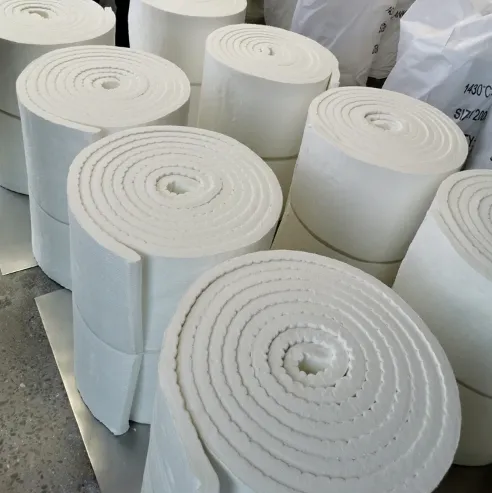
Ceramic fiber blankets do not possess “Cold Crushing Strength” (CCS) in the traditional engineering sense. CCS is a metric reserved for rigid refractory materials like firebricks or AdTech’s Ceramic Insulation Boards. Attempting to measure the CCS of a flexible blanket results in compression rather than crushing. For engineers and purchasers evaluating the durability of ceramic fiber blankets, the correct mechanical properties to prioritize are Tensile Strength (resistance to tearing during installation) and Resiliency (compression recovery). A standard 128kg/m³ density ceramic fiber blanket typically exhibits a tensile strength between 0.08 and 0.12 MPa. If your application requires load-bearing capability or high Cold Crushing Strength, you must select a rigid product like Ceramic Insulation Board, not a blanket. AdTech specializes in manufacturing both high-tensile blankets for wrapping and high-CCS boards for structural insulation in aluminum casting foundries.
The Misconception of Crushing Strength in Flexible Refractories
In the refractory industry, confusion often arises regarding the terminology of physical strength. Purchase orders or technical data sheets (TDS) sometimes incorrectly request “Cold Crushing Strength” for fiber blankets. Understanding the physics behind these materials is vital for selecting the right insulation for aluminum filtration and degassing equipment.
Cold Crushing Strength measures the load per unit area that a refractory material can withstand before failing (crushing) at room temperature. This test follows standards like ASTM C133. However, ceramic fiber blankets are manufactured using spun or blown alumina-silicate fibers intertwined to form a flexible mat. When a load is applied, the blanket does not “crush” or fracture; it compresses and densifies.
Therefore, when evaluating AdTech’s ceramic fiber blankets for your facility, focus on these three verified mechanical metrics:
-
Tensile Strength: The maximum stress the material can withstand while being stretched or pulled before breaking.
-
Compressive Stress (at X% Deformation): The force required to compress the material to a specific percentage of its original thickness.
-
Linear Shrinkage: The dimensional stability under high heat.

Critical Mechanical Properties: Tensile Strength vs. Density
Since CCS is inapplicable, Tensile Strength becomes the primary indicator of a blanket’s structural integrity. This property is directly influenced by the bulk density of the product and the manufacturing method (spun vs. blown fibers). Spun fibers, which AdTech utilizes, generally offer superior length and intertwining, resulting in higher tensile strength compared to blown fibers.
Higher density blankets contain more fiber mass per volume, creating a tighter matrix that resists tearing. This is particularly important during the installation of lining in ladles or launders, where the material is often pulled around corners or anchored with pins.
Table 1: Correlation Between Density and Tensile Strength in Alumina-Silicate Blankets
| Bulk Density ( kg/m ³) | Typical Tensile Strength (MPa) | Compression Resistance (Relative) | Recommended Application |
| 64 (Low) | 0.04 – 0.05 | Low | Back-up insulation, expansion joint filling |
| 96 (Standard) | 0.06 – 0.08 | Moderate | Furnace linings, duct insulation |
| 128 (High – AdTech Std) | 0.08 – 0.12 | High | Launder covers, molten metal transport, hot face lining. |
| 160 (Ultra-High) | > 0.15 | Very High | Areas with high gas velocity or vibration |
Note: Data reflects typical industry averages for spun fiber blankets. AdTech blankets are engineered to meet or exceed the upper bounds of these ranges.
When Cold Crushing Strength Matters: The Role of Ceramic Boards
If your engineering requirements specifically demand Cold Crushing Strength, your application likely involves load-bearing insulation or areas subject to mechanical erosion from molten aluminum flow. In this scenario, a flexible blanket is insufficient.
You should opt for Ceramic Insulation Boards. These are vacuum-formed products using the same alumina-silicate chemistry but with added organic and inorganic binders. These binders rigidify the structure, giving it a measurable CCS.
AdTech Ceramic Insulation Board Capabilities
For aluminum foundries using our degassing units or filtration boxes, we recommend rigid boards for the structural lining. A high-quality ceramic board typically exhibits a Cold Crushing Strength in the range of 0.3 to 0.5 MPa (depending on formulation and firing).
Table 2: Mechanical Property Comparison – Blanket vs. Board
| Feature | Ceramic Fiber Blanket | Ceramic Insulation Board (AdTech) |
| Primary Strength Metric | Tensile Strength | Cold Crushing Strength (CCS) |
| Standard Value | 0.08 MPa (Tensile) | 0.35 MPa (CCS) |
| Flexibility | High (Wrappable) | None (Rigid/Brittle) |
| Resistance to Metal Flow | Low (Requires coating) | High (Resists erosion) |
| Installation Method | Anchors, Pins, Glue | Mortar, Press-fit, Brick-laying |
Factors Influencing Fiber Durability and Performance
Whether dealing with the tensile capabilities of a blanket or the crushing strength of a board, the microscopic quality of the fiber dictates performance. At AdTech, we strictly control three parameters during the manufacturing of our consumables, including Ceramic Fiber Ropes and Blankets.
1. Shot Content
“Shot” refers to the non-fibrous ceramic particles (unfiberized droplets) created during production. High shot content is detrimental. It adds weight without adding strength and acts as a stress concentration point.
-
Low Shot Content: Increases tensile strength and thermal efficiency.
-
AdTech Standard: We utilize advanced double-needling technology and air-separation to minimize shot content, ensuring the fiber matrix is consistent and strong.
2. Fiber Diameter and Length
Thicker and longer fibers provide better interlocking.
-
Spun Fibers: Typically longer (up to 100mm+), offering high tensile integrity.
-
Blown Fibers: Shorter, often resulting in blankets that tear more easily.
3. Thermal History
Exposure to temperatures above the classification rating causes crystallization (devitrification). This transforms the amorphous fiber into crystalline mullite or cristobalite.
-
Effect: The material loses strength and becomes brittle. A blanket that was once flexible will crumble (lose tensile strength) and a board will lose CCS.
-
Solution: Always select a grade (Standard, High Purity, Zirconia) rated at least 150°C higher than your operating temperature.
Testing Standards for Refractory Fiber Materials
To ensure compliance with global engineering requirements, it is essential to reference the correct testing protocols. Confusion often stems from applying brick standards to fiber products.
-
ASTM C892: Standard Specification for High-Temperature Fiber Blanket Thermal Insulation. This standard defines the requirements for tensile strength, not CCS.
-
ASTM C165: Standard Test Method for Measuring Compressive Properties of Thermal Insulations. This is used to measure how much a blanket compresses under load, which is the closest proxy to CCS for flexible materials.
-
ASTM C133: Standard Test Methods for Cold Crushing Strength and Modulus of Rupture of Refractories. This applies to AdTech Ceramic Insulation Boards, not blankets.
Engineers creating technical specifications for aluminum plant upgrades must cite ASTM C892 for blankets to avoid vendor confusion.
Applications in Aluminum Casting: Where Strength Matters
AdTech serves the aluminum casting industry, providing solutions for degassing and filtration. The mechanical strength of fiber products plays a distinct role in specific areas of the foundry.
1. Launder and Tundish Linings
Here, the insulation is sandwiched between the steel shell and the refractory castable.
-
Requirement: The blanket must have high Resiliency. It needs to push back against the expanding refractory to prevent gaps where molten aluminum could penetrate.
-
Product: AdTech Ceramic Fiber Blanket (128kg/m³).
2. Filtration Box Insulation
Surrounding the Ceramic Foam Filter (CFF) setup, rigid insulation is required to hold the filter plate in place.
-
Requirement: High Cold Crushing Strength to support the weight of the filter and the molten metal pressure.
-
Product: AdTech Ceramic Insulation Board or Vacuum Formed Shapes.
3. Gasketing and Sealing
Sealing the lids of degassing units or furnace doors.
-
Requirement: High Tensile Strength and abrasion resistance to withstand repeated opening and closing.
-
Product: AdTech Ceramic Fiber Rope (reinforced with steel wire or glass fiber).
Enhancing Refractory Life with Correct Material Selection
Selecting a material based on the wrong strength metric leads to premature failure. If an engineer specifies a blanket hoping for load-bearing capacity (CCS), the insulation will compress over time, leading to heat leaks and steel shell deformation. Conversely, using a rigid board where flexibility is needed results in cracking due to thermal expansion mismatch.
AdTech’s Engineering Recommendation:
-
Define the mechanical stress: Is it tension (pulling) or compression (crushing)?
-
For Tension/Wrapping: Use AdTech Ceramic Fiber Blanket.
-
For Compression/Structure: Use AdTech Ceramic Insulation Board.
-
For Sealing/Abrasion: Use AdTech Ceramic Fiber Rope.
Our manufacturing process ensures that the alumina-silicate chemistry is optimized for the specific mechanical demands of each form factor, ensuring longevity in harsh aluminum processing environments.
Ceramic Fiber Strength & Mechanical Properties: FAQ
1. Does ceramic fiber blanket have a Cold Crushing Strength (CCS) value?
2. What is the typical tensile strength of a standard ceramic fiber blanket?
3. How does density affect the strength of the blanket?
4. Can I use ceramic fiber blanket to support heavy loads?
5. What is the difference between spun and blown fiber strength?
6. Why does “shot content” matter for material strength?
7. What happens to the strength of the blanket after it is heated?
8. Which AdTech product should I use if I need high Cold Crushing Strength?
9. Is there a standard test for measuring the strength of fiber blankets?
10. Can ceramic fiber rope be used where high tensile strength is needed?
Product Reference:
AdTech is a dedicated manufacturer serving the aluminum casting industry. Our portfolio includes:
-
Ceramic Fiber Blanket: High tensile strength for efficient insulation.
-
Ceramic Insulation Board: High Cold Crushing Strength for structural applications.
-
Ceramic Fiber Rope: Reinforced for superior sealing and durability.
-
Ceramic Foam Filters: Precision filtration for molten aluminum.
For detailed technical specifications or to request a quote, please contact the AdTech engineering team.