

An aluminum launder system is the most efficient method for controlled, safe transfer of molten aluminum between melting, holding, treatment, and casting stations; when specified correctly it reduces metal loss, minimizes inclusion formation, improves workplace safety, and lowers operating energy costs. For foundries and die casting plants that prioritize consistent melt quality and predictable throughput, investing in a heated, well-insulated launder fitted with appropriate refractory, level control, filtration and maintenance protocols delivers measurable improvements in yield and process reliability.
What an aluminum launder system is and why it matters
A launder system is a channeling and distribution assembly that carries molten aluminum by gravity or assisted flow from a melting furnace toward holding furnaces, degassing/filtration stations, tundishes, or casting machines. Its purpose is to preserve metal quality, control flow rate, and protect workers during transfer. Launder systems can be prefabricated steel shells lined with refractory, or modular precast sections engineered to form long distribution runs. Proper selection reduces turbulence, limits oxidation and inclusion entrainment, and supports higher plant throughput.
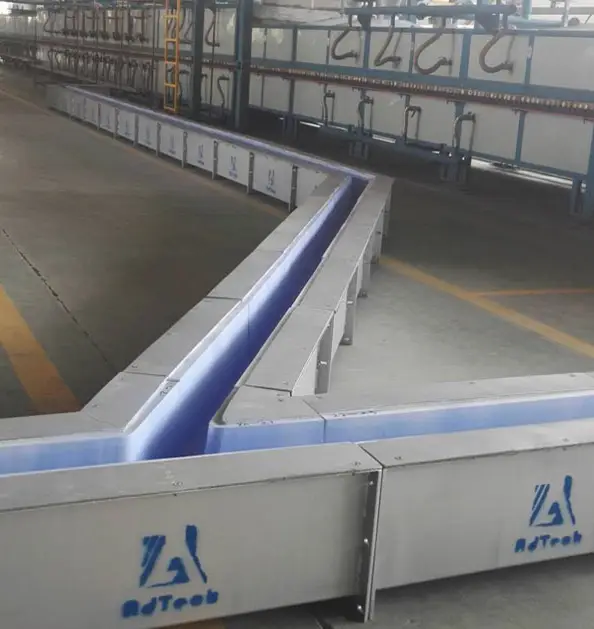
Core functions and process roles
-
Continuous distribution of molten metal from central melt sources to multiple downstream consumers.
-
Thermal conditioning, preserving temperature uniformity until metal reaches the casting point.
-
Debris control by housing filters and enabling controlled dross removal.
-
Flow metering and level management to coordinate filling of tundishes, ladles or casting machines.
-
Worker safety, replacing manual transport with sealed, heated channels that lower burn and spill risk.
Key operational benefits include improved casting consistency, less scrap, and simplified coordination between melting and casting operations. Schaefer Group reports large-scale launders serving hundreds of feet of distribution that link melting to multiple holding points with clear productivity gains.
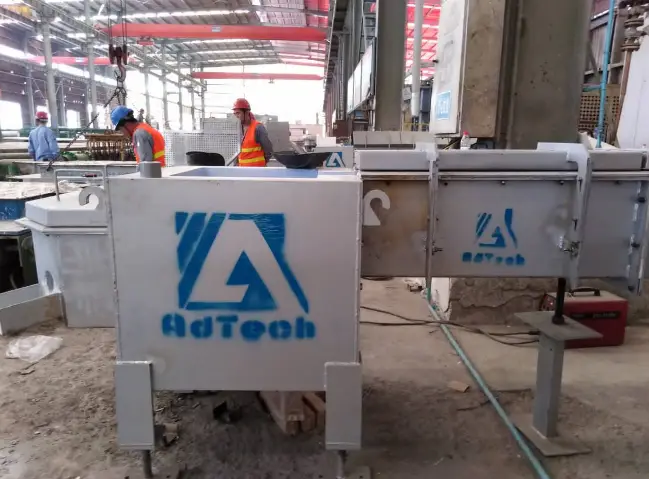
Main launder types and selection guidance
Common launder variants
Direct trough launder
A straight channel used for long distance transfer where minimal direction change is required. Preferred when layout permits gravity flow without multiple bends.
Inclined launder
Used when elevation changes exist between furnaces and casting cells. Slope design controls velocity and minimizes turbulence.
Distribution launder
Features branching points, dams or gates that distribute molten metal to multiple downstream stations.
Corner and elbow launder
Engineered curved segments that maintain laminar flow across changes in direction.
Lifting or telescoping launder
Designed for variable height fill points or where mobile equipment introduces vertical variability.
Selection criteria checklist
-
Distance between melt source and casting point.
-
Required throughput in kg/h or tons/h.
-
Number of downstream consumers and distribution complexity.
-
Plant floor elevation differences.
-
Integration with inline filtration and degassing.
-
Maintenance access and replacement logistics.
Vendors typically supply modular sections to simplify transport and installation, keeping individual segment lengths manageable for lifting and alignment.
Materials and refractory choices
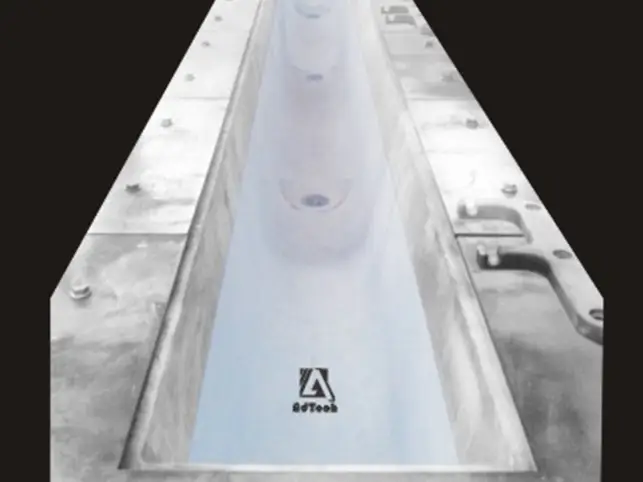
Choosing the right hot face and backup refractory is central to launder longevity and melt quality. Launders generally consist of a steel shell, a primary hot-face refractory lining, backup insulation, and an external cover. Below is a condensed comparison table with common options.
Table 1: Typical refractory materials and properties
| Material family | Typical use | Key properties | Practical lifetime range |
|---|---|---|---|
| High alumina castable | Hot face for general aluminum alloys | Good thermal stability, abrasion resistance | 6–24 months, plant dependent |
| Ceramic foam / precast shapes | Hot face or filter housings | Low thermal conductivity, low metal reaction | 12–36 months if protected |
| Silicon carbide bonded castable | High wear areas | High thermal conductivity, abrasion resistance | 12–36 months |
| Insulating castables / ceramic fiber | Backup insulation | Low thermal loss, light weight | Long term if protected from mechanical damage |
Material choice depends on alloy chemistry, operating temperature, local abrasion, and required maintenance cadence. Proper matching reduces chemical interaction between molten metal and lining that could generate inclusions. Vesuvius and Pyrotek technical notes emphasize the importance of selecting lining types by part role within the launder system.
Design factors that affect metal quality and safety
Flow geometry and hydraulic considerations
Controlling flow velocity prevents surface entrainment of oxides. Gentle slopes and rounded cross sections reduce localized turbulence that forms dross. Distribution points benefit from stilling sections and well-positioned overflow channels.
Thermal management
Effective internal heating and layered insulation keep metal above pouring temperature and prevent premature solidification. Many systems use electric trace heating embedded in the lining or fiber-embedded elements recessed into the cover to maintain temperature uniformity. Maintaining a narrow temperature band improves casting yield and reduces remelts. Manufacturer descriptions highlight heated elements recessed above sealing surfaces to maintain a constant head of metal.
Filtration and dross control
Filter boxes with ceramic foam filters or prefabricated filter housings are commonly installed between the melt source and casting location. Properly sized filters trap nonmetallic inclusions and oxides without inducing pressure drops that cause flow instability. Integrating filtration into the launder run shortens cycle time and improves final casting cleanliness.
Structural steelwork and access
A robust support frame with accessible covers simplifies inspection and refractory replacement. Hinged covers and removable panels permit rapid maintenance while preserving insulation integrity. HPI and others stress hinged designs for safe access and reduced downtime.
Instrumentation, level control and automation
Modern launders use sensors and PLC integration to provide precise level control, flow coordination, and safety interlocks. Typical instrumentation includes:
-
Thermocouples for distributed temperature monitoring.
-
Radar or non-contact sensors for liquid level measurement in open or closed launders.
-
Flow gates, motorized valves and servo actuators for distribution control.
-
Interlocks with degassing and casting machines for synchronized pours.
Radar-based level measurement delivers sub-millimeter accuracy even at metal temperatures above 1000 degrees Celsius, which allows automated filling of downstream vessels without manual intervention. Integrated control reduces spills and scrap.
Filtration, degassing and inline treatment integration
A design that places a filter box and degassing cell in the launder run permits treatment without intermediate ladling. Typical inline components:
-
Ceramic foam or porous plate filters to trap dross
-
Rotary degassing units or flux injection upstream or downstream of filter boxes
-
Thermocouple arrays and sampling ports to validate metal chemistry before casting
This inline arrangement minimizes ladle handling, reduces oxide formation, and cuts labor. Vendors report that launders linked to filtration and degassing yield better product consistency and lower rework rates.
Energy use, insulation and efficiency strategies
Insulation strategy drives energy consumption. Use of low density insulating layers, multilayer blankets and optimized hot-face thickness reduces reheating needs. Some suppliers highlight lower density refractories that require less energy to maintain operating temperature; that can allow reductions in furnace set points while preserving melt temperature at the casting point, contributing to energy savings. Proper thermal design also reduces the required heating power for trace elements.
Table 2: Energy vs maintenance tradeoffs (typical)
| Strategy | Energy impact | Maintenance implication |
|---|---|---|
| Thicker hotface refractory | Higher stored heat, slower loss | Harder to remove during rebuild |
| High-grade insulating backup | Lower steady-state power | Minimal maintenance if protected |
| Electric embedded heating | Precise control, mid power | Requires electrical inspection |
| Removable refractory modules | Moderate energy loss | Faster replacement, lower downtime |
Installation, commissioning and plant layout considerations
-
Plan the launder route to minimize turns and elevation changes while matching the casting cell footprint
-
Specify modular sections sized for crane and door clearance
-
Provide structural tie points and earthquake restraint where local codes require
-
Commissioning should include cold alignment checks, heating ramp procedures and sensor calibration
-
Validate metallurgy by sampling after initial runs and adjust filter sizing if inclusion counts exceed target limits
Schafer and other integrators report substantial benefits from preinstalled support frames and prefabricated sections that reduce onsite labor.
Routine maintenance, troubleshooting and lifecycle planning
A proactive maintenance plan prolongs lining life and prevents unplanned stoppages. Typical tasks and suggested frequencies follow.
Table 3: Suggested maintenance checklist
| Task | Frequency | Rationale |
|---|---|---|
| Visual inspection of cover seals and hinges | Daily | Prevent heat loss, detect leaks |
| Thermocouple verification | Weekly | Ensure accurate temperature control |
| Filter box inspection and filter change | Per shift or per run depending on contamination | Maintain metal cleanliness |
| Refractory thickness survey | Monthly | Plan rebuild before failure |
| Electrical heating elements test | Quarterly | Prevent heating element failure |
| Level sensor calibration | Quarterly | Maintain accurate automated fills |
Root-cause analysis of recurring contamination often highlights worn linings, improperly sized filters, or poor melt handling upstream.
Environmental, health and safety best practices
-
Use sealed covers with handling tools for dross removal to reduce dust and fume release.
-
Implement interlocked gates that stop flow if a downstream vessel is not present or full.
-
Provide spill containment areas and refractory catch pans to limit molten metal escape.
-
Train staff on emergency stop procedures and personal protective equipment standards.
Manufacturers emphasize enclosed distribution lines because manual ladling increases both accident risk and metal oxidation.
Cost drivers and total cost of ownership
Key cost influences include refractory selection, automation level, filter system complexity, length of launder run, and installation logistics. While initial capital for a heated, instrumented launder system can be higher than manual handling equipment, total cost of ownership tends to be lower when considering reduced scrap, improved yield and lower labor risk.
A simple model to estimate payback:
-
Calculate current scrap and dross loss per month
-
Estimate reduction in loss following launder installation (use vendor case studies for conservative ranges)
-
Add energy changes and maintenance costs to compute net monthly savings
-
Divide capital cost by monthly net savings to estimate simple payback
Schaefer and other suppliers provide project-level case studies that help populate realistic inputs for these models.
Specification checklist for procurement
-
Alloy compatibility and maximum operating temperature
-
Throughput requirement in kg/h or t/h
-
Required heated sections and power rating for embedded heaters
-
Refractory hot-face specification and modularity requirement
-
Filter box type and filtration rating (pore size, flow resistance)
-
Level sensor type and control interface (e.g., radar with PLC communications)
-
Number and placement of sample ports and thermocouples
-
Support frame drawings and access requirements
-
Safety features: interlocks, spill trays, hinged covers, emergency stops
Providing a filled checklist to vendors shortens engineering cycles and ensures quotes reflect true scope.
Practical engineering example
For a plant that melts 10 t/day and serves three die casting cells a common choice is a prefabricated heated launder with distribution manifold, inline ceramic foam filter housing sized to 200–400 mm face area, and radar level control at the main feed plus thermocouples at 2 m intervals. Heating power typically ranges from 1–3 kW per meter for embedded trace systems, depending on insulation and ambient conditions. Vendors provide project-specific modeling to finalize element sizing.
Launder vs. Ladle: System Integration & Logistics FAQ
1. What is the main difference between a launder and a ladle?
2. Can launders handle all aluminum alloys?
3. How often must filter elements in the launder be changed?
4. Is electric heating required for launder systems?
5. How does level control work in an open launder?
6. What safety features are standard in automated launders?
7. Can I retrofit an existing plant with a launder system?
8. What are common failure modes in these systems?
Common issues include:
- Hot-face wear: Gradual refractory erosion.
- Element burnout: Failure of electrical heating components.
- Sensor drift: Loss of calibration in level sensors.
- Filter blinding: Rapid clogging due to unexpected oxide spikes.
9. How much does a typical launder system cost?
10. What documentation should a supplier provide?
A comprehensive project hand-over should include:
- Thermal models: Showing predicted heat loss.
- Electrical schematics and PLC control logic.
- Refractory specifications and maintenance procedures.
- Recommended spare parts list for critical components.
Final recommendations for specification writing
-
Define throughput and alloy mix first
-
Require vendor thermal and civil drawings before procurement
-
Insist on modular refractory sections for faster onsite swaps
-
Specify sensor types and communication protocols to match plant automation standards
-
Include a realistic maintenance schedule and spare parts package in the contract
Closing note
A well-specified aluminum launder system is core infrastructure for any modern aluminum casting or die casting operation. When selected with attention to flow geometry, refractory chemistry, filtration, and level control, a launder improves metal cleanliness and operational safety while lowering lifetime costs. For a tailored engineering package, provide your throughput, alloy range, plant layout and desired automation level to prospective suppliers; they will supply thermal calculations and a rebuild schedule that matches your production targets.