

An aluminum aging furnace is a critical thermal processing unit designed to elevate the mechanical properties of aluminum alloys through precipitation hardening. By sustaining precise temperatures—typically between 175°C and 205°C (350°F to 400°F)—for specific soak durations, these furnaces facilitate the controlled precipitation of alloying elements. This process transforms soft, extruded, or cast aluminum into high-strength, durable components suitable for aerospace, automotive, and construction applications. For industrial buyers, the efficiency of an aging furnace directly determines the final hardness (T6 status), tensile strength, and operational costs of the production line.
The Mechanics of Precipitation Hardening
To understand the necessity of an aging furnace, one must grasp the metallurgy occurring inside the chamber. Aluminum alloys, particularly the 6xxx and 7xxx series, do not achieve their full strength immediately after extrusion or casting. They require a two-step thermal cycle.
First, the metal undergoes solution heat treatment. Here, alloying elements like magnesium and silicon dissolve into the aluminum matrix. Rapid cooling (quenching) traps these elements in a supersaturated solid solution. The metal remains relatively soft and workable at this stage.
The second step is where the ADtech Aluminum Aging Furnace proves vital. This step is “Artificial Aging.”
During this phase, the furnace heats the material to a moderate temperature. The added thermal energy allows the trapped atoms to diffuse through the metal lattice. They form fine precipitates (clusters) that impede the movement of dislocations within the crystal structure. This resistance to dislocation movement is what we measure as increased hardness and strength.
If the furnace temperature fluctuates even slightly, the precipitates may grow too large (over-aging), reducing strength, or fail to form adequately (under-aging). Therefore, the primary function of our equipment is not just heating, but absolute thermal precision.
Types of Aluminum Aging Furnaces
Industrial facilities have distinct needs based on throughput and floor space. We generally categorize these units into two primary configurations.
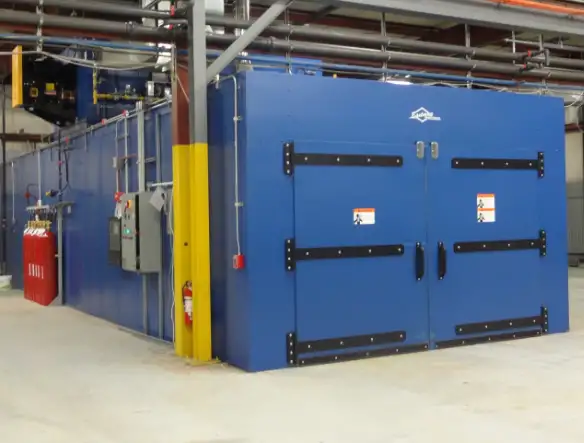
1. Batch Aging Ovens
Batch ovens process discrete loads of aluminum. A forklift or automated trolley system loads a rack of profiles or parts into the chamber. The doors seal, and the heating cycle begins.
-
Best for: Facilities with varying product sizes or those requiring different aging cycles for different alloys (e.g., switching between 6061 and 6063).
-
ADtech Advantage: Our batch units utilize high-velocity reversible airflow. This guarantees that profiles in the center of the stack reach the same temperature as those on the exterior.
2. Continuous Aging Furnaces
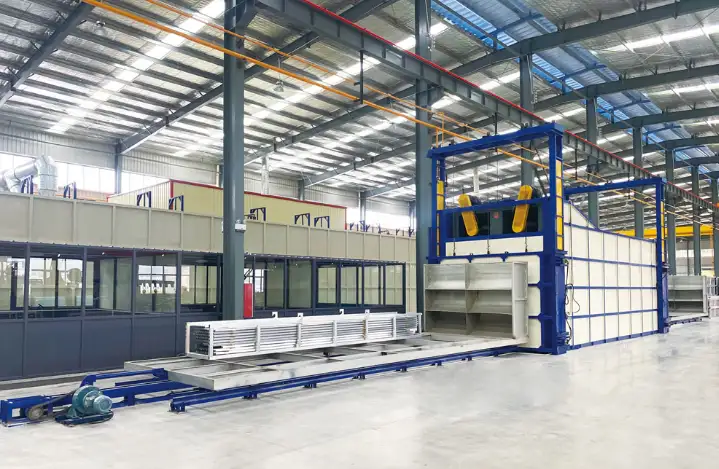
These systems utilize a conveyor or roller hearth. Aluminum profiles move through the heating chamber at a set speed. The length of the furnace and the travel speed determine the soak time.
-
Best for: High-volume production lines producing a single alloy type with consistent dimensions.
-
Operational Benefit: Eliminates loading/unloading downtime between cycles, streamlining workflow integration with extrusion presses.
Comparison of Furnace Configurations
The following table breaks down the operational differences to assist in selecting the right machinery for your plant.
| Feature | Batch Aging Furnace | Continuous Aging Furnace |
| Flexibility | High (can change cycles per load) | Low (designed for steady state) |
| Footprint | Compact, vertical options available | Requires significant linear floor space |
| Energy Consumption | Higher per unit (heat loss during door opening) | Lower (steady thermal retention) |
| Throughput | Limited by cycle time + loading | Continuous high volume |
| Ideal Application | Custom extrusions, diverse alloy mix | Standardized mass production |
Critical Parameters for T6 Heat Treatment
Achieving T6 temper is the standard goal for structural aluminum. This temper designates that the metal has been solution heat treated and artificially aged. To hit this target consistently, ADtech engineers focus on three non-negotiable variables.
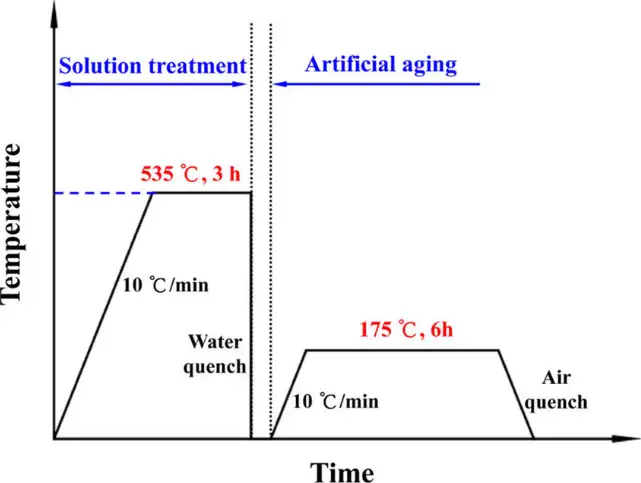
Schematic illustration of T6 heat treatment procedure
Temperature Uniformity
The margin for error is slim. Standard aerospace specifications (like AMS 2750) often demand uniformity within plus or minus 3°C to 5°C.
If the top of the oven is 200°C but the bottom is 190°C, the batch will have inconsistent mechanical properties. Parts from the bottom may fail yield strength tests, while parts from the top might be brittle.
ADtech solution: We employ distinct zoning controls and Variable Frequency Drive (VFD) fans to balance air pressure and heat distribution dynamically.
Soak Time Precision
Soak time starts only when the coldest thermocouple in the load reaches the setpoint. Prematurely starting the timer results in under-aged material. Conversely, extending the time wastes fuel and can degrade the metal.
Modern PLC systems on ADtech furnaces monitor core metal temperature, not just air temperature, triggering the soak timer only when the load is truly saturated.
Heating Rate (Ramp-Up)
Rapid heating is desirable for throughput, but thermal shock must be avoided for complex geometries. Our burners and heating elements are modulated to provide a swift yet controlled ramp-up, reducing cycle times without warping the aluminum profiles.
ADtech Engineering: Why Equipment Build Quality Matters
Buying an aging furnace is a capital expenditure meant to last decades. The difference between a generic oven and an ADtech specific solution lies in the construction details.
Insulation and Thermal Efficiency
Energy costs constitute a massive portion of operational expenses (OPEX). We utilize high-density ceramic fiber modules rather than standard brick. This material has low thermal mass, meaning it does not absorb heat. Instead, it reflects heat back into the load. This results in faster heat-up times and reduced gas or electricity consumption.
Airflow Dynamics
Stagnant air is the enemy of heat treatment. Heat transfer in these temperature ranges relies heavily on convection, not radiation.
Our designs feature High-Volume, Low-Velocity airflow systems.
-
High Volume: Ensures fresh heated air constantly passes over the metal.
-
Low Velocity: Prevents thin aluminum profiles from blowing around or scratching each other inside the chamber.
Economic Analysis: Gas vs. Electric Heating
A frequent query from facility managers involves the energy source. The choice depends on local utility rates and infrastructure.
Natural Gas / LPG:
-
Pros: Generally lower operational cost in many regions; faster heat-up rates due to high BTU output.
-
Cons: Requires exhaust systems; more maintenance on burners; precise tuning needed to prevent combustion byproducts from affecting surface finish (though rare in indirect fired systems).
Electric Resistance:
-
Pros: 100% clean atmosphere; silent operation; nearly 100% thermal efficiency (source to chamber); lower maintenance.
-
Cons: Electricity often costs more per kW/equivalent than gas; slower ramp-up times unless element density is very high.
The table below provides a generic cost-benefit view for a mid-sized facility.
| Cost Driver | Gas-Fired Systems | Electric Systems |
| Initial CAPEX | Moderate | Lower |
| Fuel Cost | Low (Region dependent) | High (Region dependent) |
| Maintenance | High (Burner tuning, flu maintenance) | Low (Element replacement) |
| Temperature Control | Excellent (with modulation) | Superior (SCR controls) |
| Carbon Footprint | Higher (Direct emissions) | Lower (Grid dependent) |
Case Study: 15% Efficiency Boost in Ohio Manufacturing Plant
To demonstrate the impact of upgrading to an ADtech Aluminum Aging Furnace, we examine a recent retrofit project.
Client Profile: An automotive components manufacturer based in Dayton, Ohio, USA.
Project Date: March 2023.
The Challenge: The client operated two aging ovens dating back to 1998. They faced two major issues:
-
Inconsistent Hardness: Webster hardness readings varied significantly across a single batch of 6061 bumpers.
-
Energy Waste: The outer shell of the old furnaces was hot to the touch (approx. 60°C), indicating massive heat loss.
The ADtech Solution:
We installed a Double-End Door Batch Furnace sized for 8-meter profiles.
-
Insulation: Upgraded to 250mm thick ceramic fiber.
-
Circulation: Installed a cross-flow air system with auto-reversing fans every 15 minutes.
-
Control: Integrated a SCADA system for data logging and remote monitoring.
The Results (Validated June 2023):
-
Energy Reduction: Gas consumption dropped by 15.4% per ton of aluminum processed.
-
Quality: Hardness deviation reduced to near zero. Every part passed QC.
-
Throughput: The rapid ramp-up time shaved 45 minutes off each cycle, allowing for one extra load every 48 hours.
Maintenance and Troubleshooting Guide
Even the most robust machinery requires care. Neglecting maintenance leads to “cold spots” in the furnace, which directly translates to soft metal and rejected claims.
Routine Inspection Schedule
-
Weekly: Check thermocouple readings against a master probe.
-
Monthly: Inspect door seals. Leaking seals are the number one cause of temperature variance near the door zone.
-
Quarterly: Clean blower fans. Aluminum dust can accumulate on fan blades, causing imbalance and reducing airflow volume.
Troubleshooting Common Defects
| Defect / Symptom | Probable Cause | Corrective Action |
| Low Hardness (Under-aging) | Temperature too low or cycle too short. | Verify thermocouple accuracy; Extend soak time. |
| Blistering on Surface | Temperature too high (Over-heating). | Check for temperature overshoot during ramp-up; Calibrate controller. |
| Inconsistent Color/Hardness | Poor airflow circulation. | Check fan rotation; Ensure load spacing allows air to pass through. |
| Slow Heat-Up | Burner malfunction or element failure. | Check gas pressure; Test resistance on heating elements. |
Future Trends in Aluminum Heat Treatment
The industry is shifting toward “Smart Thermal Processing.” ADtech is at the forefront of this evolution.
Data-Driven Decisions:
Modern buyers demand traceability. Our systems now record every second of the heat cycle. This data is attached to the batch ID. If a client questions the quality of a beam utilized in a bridge five years from now, the manufacturer can pull the exact heating curve from that production day.
Waste Heat Recovery:
For gas furnaces, we are implementing heat exchangers that capture exhaust heat to pre-heat the combustion air. This technology pushes efficiency ratings higher, aligning with global sustainability goals.
Alloy-Specific Algorithms:
Newer controllers feature pre-set recipes for emerging alloys (like aluminum-lithium). The operator simply selects the alloy grade, and the furnace adjusts ramp rates and soak times automatically to prevent operator error.
Frequently Asked Questions (FAQs)
Here are the answers to the most common inquiries regarding aluminum aging furnaces and processes.
1. What is the standard temperature for aging 6061 aluminum?
For 6061 aluminum to achieve T6 temper, the standard temperature is typically 177°C (350°F) held for approximately 8 hours. However, time and temperature can be traded; higher temperatures (205°C) require shorter times (2-3 hours) but may sacrifice some tensile strength.
2. What is the difference between natural aging and artificial aging?
Natural aging occurs at room temperature over a period of days (T4 temper). It increases strength slightly but is slow and unstable. Artificial aging occurs in a furnace at elevated temperatures (T6 temper), providing maximum strength and stability rapidly.
3. Why is airflow circulation so important in an aging oven?
At 200°C, heat transfer is primarily convective. Without strong air circulation, the radiant heat from the walls will cook the outside of the load while the center remains cool. Circulation guarantees the entire load hits the target temperature simultaneously.
4. Can I use the same furnace for different aluminum alloys?
Yes, but you must adjust the cycle parameters. 6063 requires different time/temperature settings compared to 7075. An ADtech programmable controller allows you to save “Recipes” for each alloy.
5. How do I know if my aluminum is over-aged?
Over-aged aluminum loses tensile strength and hardness. It effectively becomes softer. This happens if the temperature was too high or the metal remained in the furnace too long, causing the precipitates to grow too coarse.
6. What is the typical lifespan of an ADtech aging furnace?
With proper maintenance of the lining and mechanical components, the structural shell and insulation system can last over 20 years. Electronic components and burners typically require refurbishment every 5-7 years.
7. How much energy does an aluminum aging furnace consume?
This varies by load density and insulation quality. A highly efficient ADtech furnace typically consumes between 18 to 25 cubic meters of natural gas per ton of aluminum processed during the cycle.
8. What safety features are included?
Standard features include over-temperature limit controllers (independent of the main PLC), flame safety relays (for gas), explosion relief panels, and door safety interlocks that cut power to fans/heaters when opened.
9. Does the position of the aluminum in the oven affect quality?
In a poorly designed oven, yes. In an ADtech oven, no. We test our ovens to ensure the temperature deviation is within standard limits across the entire volume, top-to-bottom and front-to-back.
10. Can I retrofit my existing furnace to improve performance?
Yes. Retrofitting new burners, upgrading insulation, or installing a modern control system with VFD fans is a cost-effective way to restore performance without buying a completely new shell.
Conclusion
The selection of an aluminum aging furnace is not merely a purchase of utility; it is an investment in product capability. Whether you are producing architectural extrusions or aerospace components, the reliability of your heat treatment process defines your reputation in the market.
ADtech combines metallurgical expertise with advanced thermal engineering to deliver furnaces that guarantee uniformity, energy efficiency, and durability. By controlling the invisible variables—airflow, thermal ramp, and precise soaking—we ensure the tangible quality of your aluminum products.