

At AdTech, we have worked alongside foundries and aluminium casting operations for years, and the single most consistent factor separating good castings from rejected ones is hydrogen content. The aluminium degassing process is not optional — it is the foundational quality control step that determines mechanical strength, surface integrity, and dimensional accuracy of every cast part. Aluminium melt absorbs hydrogen readily from atmospheric moisture, and if that hydrogen is not removed before solidification, it forms porosity defects that compromise structural performance.
If your project requires the use of Aluminium Degassing Unit, you can contact us for a free quote.
Why Hydrogen Is the Primary Enemy of Aluminium Castings
Hydrogen is the only gas that dissolves in aluminium in significant quantities under normal casting conditions. Unlike steel or copper alloys that can absorb multiple gas species, aluminium’s primary contamination challenge is almost entirely hydrogen-related. We see this repeatedly in quality audits: parts that fail radiographic inspection almost always trace back to elevated hydrogen content in the melt, combined with inadequate degassing time or improperly maintained equipment.
The reason hydrogen is so damaging lies in its solubility behavior. Liquid aluminium at 750°C can dissolve approximately 0.65–0.70 mL of hydrogen per 100 grams of metal. When the metal solidifies, that solubility drops dramatically — to roughly 0.034 mL per 100 grams in solid aluminium. That means nearly all dissolved hydrogen must leave the metal during solidification. If it cannot escape, it forms microscopic bubbles trapped within the solidifying microstructure, creating gas porosity.
The resulting porosity appears as:
- Spherical pores (from dissolved hydrogen rejection).
- Shrinkage-related porosity (often worsened by existing hydrogen).
- Surface blistering during heat treatment.
- Reduced tensile strength and elongation values.
- Pressure leakage in hydraulic and pneumatic castings.
For structural automotive components, aerospace parts, and pressure-tight castings, even marginal porosity causes field failures. The degassing process is therefore not an efficiency option — it is the mechanism that makes reliable aluminium casting possible.
How Hydrogen Enters Aluminium Melt: Sources and Absorption Mechanisms
Understanding where hydrogen comes from is the first step toward controlling it. In our experience working with various foundries, most operations underestimate how many different entry points hydrogen has into the melt.
Also read: How to Reduce Porosity in Aluminium Casting?
Primary Hydrogen Sources
1. Atmospheric Moisture
Water vapor in the air reacts with molten aluminium at the melt surface. The reaction is:
2Al + 3H₂O → Al₂O₃ + 6[H]
The atomic hydrogen generated immediately dissolves into the melt. Higher relative humidity in the foundry directly translates to faster hydrogen pickup rates.
2. Wet or Contaminated Charge Materials
Scrap aluminium that has been exposed to rain, stored improperly, or not pre-dried before charging introduces significant moisture. Even condensation on cold ingots added to a hot furnace generates a burst of hydrogen absorption. Oily or organic contamination on scrap also contributes hydrogen when burned.
3. Refractory Materials and Tools
Furnace linings, launders, transfer ladles, and degassing equipment made of refractory materials can retain moisture. When these materials are not properly dried before contact with the melt, they release steam directly into the liquid metal. We have traced entire batch rejections to a single undried ladle preheated insufficiently.
4. Alloying Additions and Master Alloys
Certain master alloys, particularly those with high surface area or hygroscopic characteristics, introduce hydrogen when added to the melt. Magnesium-containing alloys are especially prone to this because magnesium itself reacts with moisture.
5. Flux Residues
Some fluxes, if not properly stored or if applied incorrectly, contain moisture or generate hydrogen-bearing gases during their reaction with the melt.
Hydrogen Absorption Rate Factors
| Factor | Effect on Hydrogen Pickup |
|---|---|
| Melt temperature increase (+50°C) | Higher solubility, faster absorption |
| Relative humidity increase (10% RH) | Proportional increase in absorption rate |
| Turbulent melt surface | Dramatically increases gas/metal contact |
| Oxide film disruption | Exposes fresh metal, accelerates pickup |
| Extended holding time | Cumulative absorption over time |
| Magnesium alloy content | Mg reacts with moisture independently |
The Science Behind Aluminium Degassing: Thermodynamics and Kinetics
The physical chemistry of hydrogen removal from aluminium melts is governed by Sievert’s Law, which states that the solubility of a diatomic gas in a metal is proportional to the square root of the partial pressure of that gas above the melt:
[H] = K × √(P_H₂)
Where [H] is the dissolved hydrogen concentration, K is the temperature-dependent solubility constant, and P_H₂ is the partial pressure of hydrogen in the atmosphere above the melt.
This relationship has direct practical consequences. To remove hydrogen from the melt, we must either:
- Reduce the partial pressure of hydrogen above the melt surface (vacuum degassing).
- Introduce inert gas bubbles that have a very low hydrogen partial pressure, causing hydrogen to diffuse from the melt into the bubbles.
The Bubble Mechanism
When an inert gas bubble rises through aluminium melt, hydrogen atoms dissolved in the metal diffuse across the metal-bubble interface and enter the bubble. The driving force is the difference in hydrogen partial pressure between the metal (high) and the bubble interior (near zero for pure argon or nitrogen).
The efficiency of this process depends on:
- Bubble size: Smaller bubbles have greater surface area per unit volume, improving mass transfer.
- Bubble distribution: Bubbles must contact as much of the melt volume as possible.
- Rise time: Slower rising bubbles (smaller) provide longer contact time.
- Metal temperature: Higher temperatures increase diffusion rates but also increase hydrogen solubility.
The mathematical relationship governing degassing rate follows first-order kinetics:
C(t) = C₀ × e^(-kt)
Where C(t) is hydrogen concentration at time t, C₀ is initial concentration, and k is the degassing rate constant that depends on equipment design and gas flow rate.
Why Larger Bubbles Are Inefficient
One of the most common misconceptions we encounter in foundry audits is that “more gas equals faster degassing.” This is partially true, but beyond a certain flow rate, the bubbles coalesce into large slugs that rise quickly without meaningful hydrogen removal. The ideal is to produce a dense cloud of fine bubbles uniformly distributed throughout the melt — which is exactly what well-designed rotary impellers achieve.
Rotary Degassing Method: How It Works and Why It Dominates
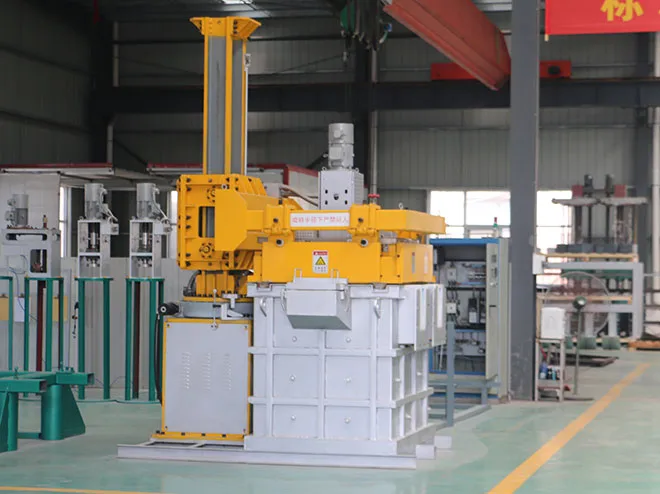
Rotary impeller degassing has become the standard approach in virtually all modern aluminium casting operations because it combines mechanical bubble generation with continuous gas injection to produce optimal bubble characteristics.
Operating Principle
A rotary degassing unit consists of:
- A rotating graphite shaft connected to a drive motor.
- A graphite impeller at the base of the shaft, submerged in the melt.
- A gas supply system delivering inert gas through the hollow shaft to the impeller.
- A speed controller to adjust RPM.
The impeller rotates at typically 200–600 RPM. Inert gas fed through the shaft exits at the impeller, where the rotating blades shear the gas into fine bubbles and disperse them radially and vertically throughout the melt. The shear forces generated by impeller rotation are what create the small bubble diameters (1–5 mm range) critical for efficient hydrogen removal.
Rotary Degassing Performance Data
| RPM Setting | Average Bubble Diameter | Hydrogen Removal Efficiency |
|---|---|---|
| 200 RPM | 8–12 mm | 45–55% |
| 350 RPM | 3–6 mm | 65–75% |
| 500 RPM | 1–3 mm | 80–90% |
| Above 600 RPM | Vortex formation | Decreasing (oxide entrapment) |
Note: Above approximately 600 RPM, the impeller begins creating a surface vortex that draws oxide films and atmospheric gases into the melt, negating the degassing benefit. Optimum speed is typically 300–450 RPM depending on vessel geometry and fill level.
Inline vs Batch Rotary Degassing
Batch Degassing treats each ladle or furnace individually. It is suitable for operations with variable alloy changes, lower volumes, or when flexibility matters more than throughput continuity.
Inline Degassing uses a continuous flow-through degassing box positioned between the furnace and the casting station. Metal enters one side, is treated as it flows through the unit with rotating impellers, and exits at the casting side. This approach is standard in high-volume die casting and continuous casting operations.
| Parameter | Batch Rotary | Inline Rotary |
|---|---|---|
| Typical treatment time | 10–20 minutes | Continuous |
| Capital cost | Lower | Higher |
| Flexibility | High | Lower |
| Consistency | Variable | High |
| Best application | Job shops, R&D, alloy changes | Mass production, HPDC |
Flux and Chemical Degassing: Applications, Limitations, and When to Use Them
Before rotary impeller systems became widespread, flux-based degassing was the standard method. Even today, it remains relevant in specific applications and as a supplementary treatment.
How Flux Degassing Works
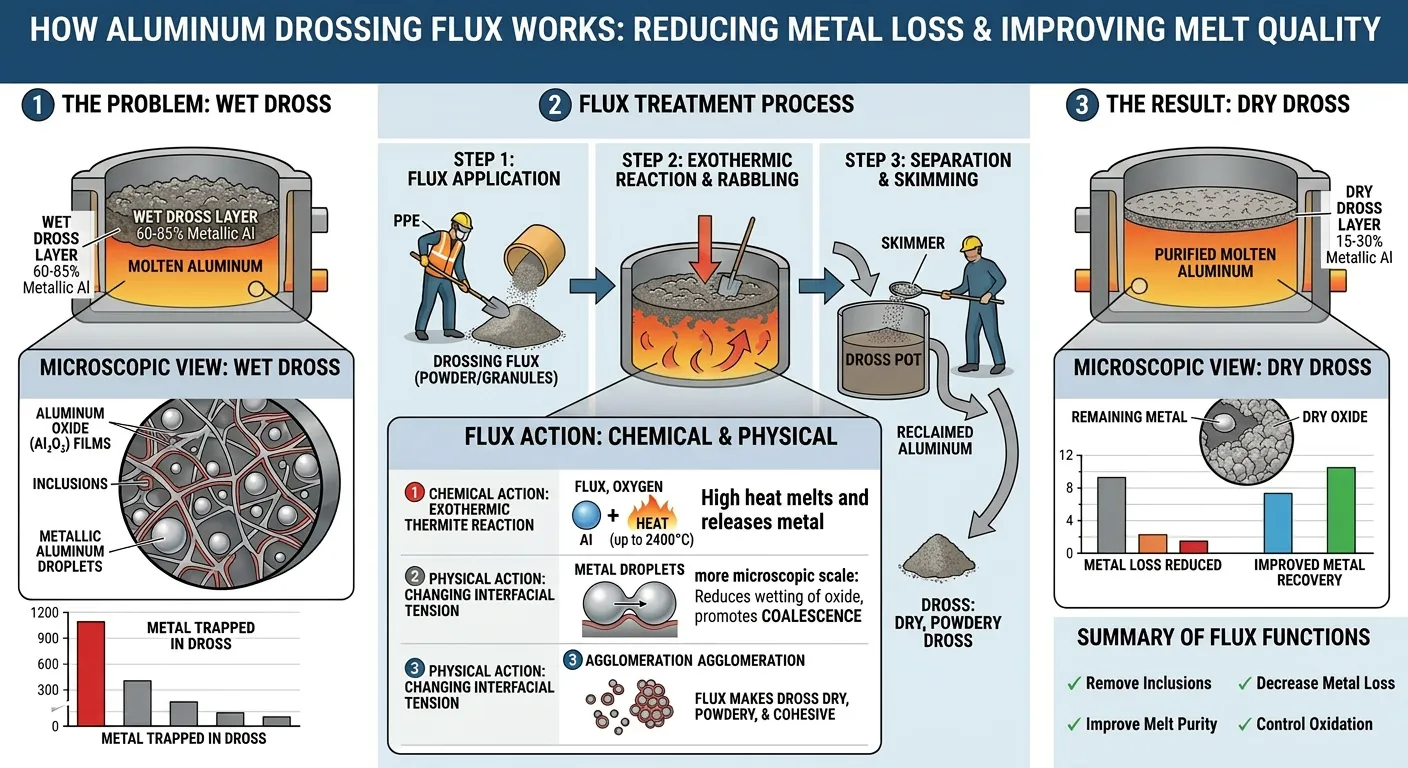
Chlorine-based degassing salts (commonly hexachloroethane tablets or granules) react with aluminium to generate chlorine gas bubbles in-situ:
C₂Cl₆ → C₂Cl₄ + Cl₂ (decomposition)
The generated chlorine bubbles then act similarly to inert gas bubbles in carrying hydrogen out of the melt. Chlorine is more aggressive than argon or nitrogen at removing hydrogen because it also chemically reacts with alkali metals (sodium, potassium, lithium) that act as surface tension modifiers.
Why Flux Degassing Is Falling Out of Favor
The main problem with chlorine-based flux degassing is environmental and safety-related. Chlorine gas and the byproducts (particularly phosgene and hydrogen chloride under certain conditions) are toxic. Regulatory frameworks in Europe, North America, and increasingly in Asia are restricting chlorine emissions from foundries.
Additionally, flux degassing is less consistent than rotary methods. The gas release pattern is not well-controlled, leading to variable bubble sizes and incomplete degassing.
When Flux Degassing Remains Appropriate
- Small foundries without budget for rotary equipment.
- Remote locations or intermittent production.
- As a supplementary treatment after primary rotary degassing for extreme quality requirements.
- When alkali metal removal is needed alongside hydrogen removal.
Salt Flux Compositions
| Flux Type | Primary Active Agent | Additional Function |
|---|---|---|
| Chlorine-releasing | Hexachloroethane | Hydrogen + alkali removal |
| Fluoride-based | Sodium fluorosilicate | Grain refinement assist |
| Mixed chloride/fluoride | Multiple | Comprehensive treatment |
| Covering flux | NaCl/KCl mix | Oxidation prevention only |
Vacuum Degassing and Other Advanced Techniques
Vacuum degassing operates on a different principle than gas bubbling methods. By reducing the pressure above the melt to a fraction of atmospheric pressure, the partial pressure of hydrogen in the atmosphere drops to near zero, and hydrogen diffuses from the metal to the surface.
Vacuum Degassing Performance
Under a vacuum of 1 mbar (0.1% of atmospheric pressure), Sievert’s Law predicts that hydrogen solubility in aluminium drops to approximately 7% of its value at atmospheric pressure. In practice, vacuum degassing can achieve hydrogen levels below 0.1 mL/100g Al — excellent for aerospace-grade castings.
However, vacuum degassing has significant limitations:
- Equipment cost is substantially higher.
- Batch processing only (no continuous treatment).
- Risk of melt surface oxidation if vacuum sealing is imperfect.
- Not practical for large melt volumes in high-production foundries.
Ultrasonic Degassing (Emerging Technology)
Acoustic cavitation induced by ultrasonic transducers can nucleate hydrogen bubbles throughout the melt volume. Research results have shown hydrogen reductions comparable to rotary degassing, but the technology remains primarily in developmental or niche applications because of the difficulty in scaling ultrasonic power to large melt volumes without equipment degradation.
Combined Degassing Approaches
Premium quality applications — aerospace structural parts, defense components, medical device castings — often combine methods:
- Rotary gas degassing as primary treatment.
- Flux addition for alkali metal removal.
- Filtration (ceramic foam filters) to remove non-metallic inclusions generated during degassing.
- Optional vacuum treatment for the most critical applications.
Degassing Gas Selection: Nitrogen vs Argon vs Chlorine-Based Mixtures
The choice of purge gas profoundly affects both degassing efficiency and operational cost. We have evaluated this decision in multiple foundry optimization projects, and the answer is never one-size-fits-all.
Pure Nitrogen (N₂)
Nitrogen is the lowest-cost inert purge gas option. It is effective for hydrogen removal from most aluminium alloys. The primary limitation is that nitrogen is not truly inert with aluminium — at elevated temperatures and with certain alloy compositions, nitrogen can react with aluminium to form aluminium nitride (AlN) inclusions. This is particularly a concern with magnesium-containing alloys (5xxx and some 7xxx series).
Best for: Pure aluminium, 1xxx and 2xxx series, 6xxx series, cost-sensitive operations where inclusion risk is low.
Pure Argon (Ar)
Argon is completely inert with aluminium under all casting conditions. It produces no reaction products, generates no inclusions, and is suitable for all alloy types including magnesium-rich compositions. The trade-off is cost — argon is typically 3–5× more expensive than nitrogen per unit volume.
Best for: Magnesium-containing alloys (5xxx, 7xxx), aerospace alloys, applications where any inclusion risk is unacceptable, high-value castings where gas cost is secondary.
Argon-Chlorine Mixtures
Small percentages of chlorine gas (typically 1–10%) added to argon dramatically improve alkali metal removal efficiency. The chlorine reacts with sodium and calcium to form soluble chloride compounds that float to the surface as dross. This combined treatment achieves both hydrogen removal and alkali metal reduction in a single step.
Regulatory note: Chlorine addition in degassing gas requires proper fume extraction and environmental compliance. Many jurisdictions require permits for chlorine use, and some are moving toward complete prohibition.
Gas Selection Decision Matrix
| Alloy Type | Recommended Gas | Reason |
|---|---|---|
| Pure Al (1xxx) | N₂ | Cost-effective, no reaction concern |
| Al-Cu (2xxx) | N₂ or Ar | Minimal Mg content |
| Al-Mg (5xxx) | Ar | AlN formation risk with N₂ |
| Al-Si-Mg (6xxx) | N₂ or Ar | Context-dependent |
| Al-Zn-Mg (7xxx) | Ar | High Mg content |
| Al-Si (casting alloys) | N₂ | Cost-effective for most compositions |
| High-purity applications | Ar | Maximum cleanliness |
Key Equipment Components: Rotary Degassing Units, Lances, and Inline Systems
Equipment quality directly determines degassing outcome. We have seen operations invest in excellent alloys and process controls only to compromise results with poorly maintained or undersized degassing equipment.
Also read: How Does Aluminum Degassing Equipment Work
Graphite Shaft and Impeller Materials
The shaft and impeller must withstand continuous immersion in molten aluminium at 680–780°C while rotating under mechanical load and conveying pressurized gas. High-purity, fine-grain graphite with impregnation treatments is the standard material. Key properties:
- Thermal shock resistance: Critical for insertion into hot melt.
- Oxidation resistance: Graphite oxidizes in air; impregnation extends service life.
- Mechanical strength: Must resist breakage from melt turbulence and thermal stress.
- Gas permeability: Shaft must convey gas efficiently without leakage.
Impeller designs vary among manufacturers. Blade geometry determines bubble generation quality. Advanced impeller geometries with precision-machined ports create more consistent bubble size distributions than simple drilled-hole designs.
Drive and Control Systems
Modern rotary degassing units incorporate:
- Variable-speed drives with PLC or digital control panels.
- RPM monitoring and adjustment during treatment.
- Gas flow rate controllers (mass flow controllers for precision).
- Treatment time programmers.
- Shaft lift mechanisms for insertion and extraction.
Inline Degassing Box Design
An inline degassing system typically consists of a rectangular or cylindrical chamber with:
- Metal inlet and outlet ports designed for smooth flow without turbulence.
- One or more rotary impeller stations (dual-rotor designs are common for high throughput).
- Heated refractory walls to maintain metal temperature.
- Dross collection areas.
- Sampling and measurement ports.
The metal residence time inside the inline box — calculated as volume divided by flow rate — determines available treatment time. Proper design matches residence time to the required degassing rate for the target hydrogen level.
Lance Degassing (Simple Gas Bubbling)
The simplest degassing approach uses a submerged lance (typically graphite or silicon carbide tube) through which inert gas is bubbled into the melt. This avoids rotating equipment but produces larger, less uniform bubbles compared to rotary systems. Lance degassing is a backup method, suitable for emergency use or very small operations, but it cannot match rotary efficiency.
Measuring Hydrogen Content: RPT, LECO, and Real-Time Sensors
You cannot control what you cannot measure. Hydrogen measurement is an essential part of any degassing process control system. Several methods exist, each with different precision, speed, and cost profiles.
Reduced Pressure Test (RPT)
The RPT is the most widely used foundry floor measurement. A small sample of melt (typically 100–200 grams) is poured into a mold placed in a chamber where pressure is reduced to 60–80 mbar. Under reduced pressure, dissolved hydrogen evolves and forms visible pores in the solidifying sample. The porosity index (PI) — calculated as the density ratio between the RPT sample and a reference sample solidified at atmospheric pressure — indicates relative hydrogen content.
Interpretation:
- PI < 0.1: Excellent (very low porosity).
- PI 0.1–0.15: Acceptable for most structural applications.
- PI 0.15–0.3: Marginal, requires attention.
- PI > 0.3: Unacceptable, degassing required.
Limitations: RPT gives a relative index, not an absolute hydrogen value in mL/100g. Operator technique affects results significantly.
LECO Gas Fusion Analysis
LECO analysis uses combustion/fusion of a solid aluminium sample and measures evolved hydrogen by thermal conductivity detection. This method provides an accurate absolute hydrogen concentration in mL/100g but requires laboratory equipment and sample preparation time (typically 30–60 minutes per sample). It is valuable for calibration and verification but too slow for real-time process control.
Telegas / Alscan Continuous Measurement
Electrochemical and pressure-equilibrium sensors can measure hydrogen content in real time while the metal is being treated. The Alscan system (and similar products) uses a probe immersed in the melt that reaches equilibrium with dissolved hydrogen. These instruments provide continuous hydrogen readings during degassing, allowing operators to stop treatment precisely when the target level is achieved rather than treating for a fixed time.
Comparison of Measurement Methods
| Method | Measurement Type | Speed | Accuracy | Cost |
|---|---|---|---|---|
| RPT (visual) | Relative (PI index) | 5–10 min | ±30% | Low |
| RPT (density) | Semi-quantitative | 15–20 min | ±15% | Low-Medium |
| LECO fusion | Absolute (mL/100g) | 30–60 min | ±5% | High |
| Telegas/Alscan | Absolute (real-time) | Continuous | ±10% | Medium-High |
| Vacuum Capsule | Relative | 10–15 min | ±20% | Low |
Quality Standards and Acceptable Hydrogen Levels by Application
Different casting applications have different tolerance for hydrogen-induced porosity. Understanding these thresholds allows foundries to optimize degassing effort proportionally — avoiding over-treatment of low-critical parts while ensuring adequate treatment for safety-critical applications.
Hydrogen Level Targets by Application
| Application | Target H₂ Level (mL/100g Al) | Typical Standard |
|---|---|---|
| Aerospace structural castings | < 0.10 | AMS, ASTM B594 |
| Automotive safety components | < 0.15 | IATF 16949, OEM spec |
| Pressure-tight hydraulic housings | < 0.12 | Internal pressure test |
| General structural castings | < 0.20 | BS EN 1706 |
| Non-structural decorative castings | < 0.30 | Visual standard |
| Continuous casting (extrusion billet) | < 0.15 | AA / EN standards |
Porosity Rating Systems
ASTM standard reference radiographs (ASTM E155) provide a grading system for porosity visible in radiographic inspection. Specification limits typically state a maximum grade level (e.g., Grade 2 or better from ASTM E155) for each part class.
European standard EN 12681 covers radiographic examination of castings with specific acceptance criteria by quality class.
How Heat Treatment Interacts with Hydrogen Content
An important and often overlooked interaction: aluminium castings heat-treated by T6 solution treatment at 520–540°C will blister on the surface if residual hydrogen content is too high. The elevated temperature increases hydrogen diffusion rates and causes sub-surface porosity to grow, forming visible blisters. This is why hydrogen control matters not just for mechanical properties but for downstream processing capability.
Common Degassing Failures, Root Causes, and Corrective Actions
After years of supporting foundry operations, we have documented recurring failure modes that undermine degassing effectiveness. Most are preventable with systematic process control.
Failure Mode Analysis Table
| Failure Mode | Symptom | Root Cause | Corrective Action |
|---|---|---|---|
| Incomplete degassing | High RPT, porosity in castings | Insufficient treatment time or gas flow | Increase treatment time; verify gas flow rate |
| Re-gassing after degassing | Good RPT, poor casting quality | Turbulent transfer, humid launder | Inspect transfer system; reduce transfer turbulence |
| Impeller breakage | Treatment interruption, metal contamination | Thermal shock, worn graphite | Preheat impeller before insertion; replace on schedule |
| Surface oxide entrapment | Inclusions in castings | RPM too high, surface agitation | Reduce RPM; check for surface vortex |
| Nitrogen nitride inclusions | Hard spots, machining difficulties | N₂ used with Mg-alloys | Switch to argon for Mg-bearing alloys |
| Inconsistent treatment | Variable quality batch to batch | Operator variability | Implement automated controls, PLC-based timing |
| Gas flow blockage | No degassing activity | Clogged impeller gas port | Clean or replace impeller; filter gas supply |
| Excessive dross generation | High metal loss, surface scum | Over-treatment, wrong gas | Optimize gas flow; review flux addition |
The Re-Gassing Problem
One of the most frustrating failure modes we encounter is proper degassing performance confirmed by measurement — followed by porosity defects in the final castings. The cause is almost always re-gassing during metal transfer. When properly degassed metal flows through an open launder, poured into a ladle from height, or transferred by pump with improper design, hydrogen absorption restarts immediately. The metal’s reduced hydrogen content creates a steep concentration gradient with the humid atmosphere, accelerating re-pickup.
Solutions include:
- Closed transfer systems with inert gas cover.
- Launder covers and minimal drop height.
- Casting as quickly as practical after degassing.
- Positioning the degassing station as close to the casting point as possible.
Environmental and Safety Considerations in Degassing Operations
Fume Extraction Requirements
All degassing operations generate fumes — hydrogen gas exiting the melt carries oxide particles and, if chlorine-based agents are used, acid gases. OSHA and EU workplace exposure limits require:
- Effective canopy extraction directly above degassing stations.
- Gas monitoring for chlorine and HCl where chemical agents are used.
- Worker PPE including respiratory protection during flux addition.
Transitioning Away from Chlorinated Agents
Environmental pressure is pushing foundries toward chlorine-free degassing. The good news is that modern rotary degassing equipment with optimized argon or nitrogen flow can achieve excellent hydrogen removal and reasonable alkali metal control without chlorine. Some proprietary gas mixtures using very small amounts of freon alternatives offer alkali metal removal with reduced toxicity compared to chlorine.
Graphite Shaft Disposal
Spent graphite shafts and impellers are generally classified as non-hazardous solid waste, but any contamination from flux residues should be assessed before disposal. Most foundries recycle graphite components to specialty graphite processors.
Carbon Footprint of Degassing Gas Production
Argon is produced as a byproduct of air separation in steel and chemical industries — its production carbon footprint is low. Nitrogen is even lower. The energy cost of the degassing process itself (motor power, gas compression) is minor relative to the melting energy. Proper degassing that eliminates casting rejections has a net positive environmental impact by reducing remelt energy.
Degassing in Different Aluminium Alloy Systems
Not all aluminium alloys respond identically to degassing treatment. Alloy composition affects hydrogen solubility, the risk of reaction with degassing gases, and the presence of other dissolved species that need removal alongside hydrogen.
1xx.x Pure Aluminium Alloys
Pure aluminium has moderate hydrogen solubility and responds well to nitrogen degassing. Alkali metal contamination risk is lower, and nitrogen-induced nitride formation is not a concern at practical magnesium levels.
3xx.x Al-Si Casting Alloys
The most common die casting and gravity casting alloys (A380, A356, A319) are silicon-based. Silicon does not significantly affect hydrogen solubility. Magnesium additions in A356 (0.25–0.45% Mg) are high enough that argon is preferable over nitrogen in precision applications to avoid any risk of nitride formation.
5xx.x Al-Mg Alloys
High magnesium content (4–5%) dramatically increases hydrogen absorption tendency and reaction with atmospheric moisture (magnesium is hygroscopic and reactive). Argon is mandatory for these alloys. Treatment times may need to be extended because the melt surface tends to form a less protective oxide skin compared to silicon-containing alloys.
7xx.x Al-Zn-Mg Alloys
Premium aerospace alloys with highest mechanical performance requirements. These require the most stringent hydrogen control (< 0.10 mL/100g) and benefit from combined rotary degassing plus vacuum treatment in some applications. Argon is the correct purge gas.
Recycled Aluminium Considerations
Secondary aluminium from recycled scrap typically arrives with higher hydrogen content and more contamination than primary metal. Degassing treatment for secondary aluminium should be extended compared to primary alloy processing, and additional flux treatment for alkali metal removal is often appropriate. Measurement before and after treatment is especially important when processing recycled material, as hydrogen levels can vary significantly from batch to batch.
FAQs About the Aluminium Degassing Process
1: What is the ideal hydrogen content in aluminium before casting?
The acceptable hydrogen level depends entirely on the application. For general structural castings, most foundries target below 0.20 mL/100g Al. Safety-critical automotive components require below 0.15 mL/100g, while aerospace castings demand below 0.10 mL/100g. Pressure-tight parts for hydraulic systems typically require below 0.12 mL/100g. Always refer to your customer’s specific material specification before establishing process targets.
2: How long should aluminium degassing take?
Treatment time depends on initial hydrogen content, melt volume, equipment type, and gas flow rate. Batch rotary degassing of a 500 kg ladle with a properly sized unit typically requires 10–20 minutes. Inline systems treat metal continuously with typical residence times of 3–8 minutes. Extending treatment beyond the point where hydrogen measurement shows no further reduction is wasteful and can increase oxide entrapment.
3: Can aluminium be over-degassed?
Yes, in a practical sense. Extremely long treatment times increase the risk of oxide film entrapment in the melt (from prolonged surface agitation), increase metal temperature loss, and waste gas and energy. Additionally, very high gas flow rates or excessive RPM on the impeller create surface vortexing that re-introduces atmospheric gases. Optimal degassing achieves the target hydrogen level with minimum treatment time.
4: Why does hydrogen porosity reappear after degassing?
Re-gassing is the most common cause. Even properly degassed metal will rapidly reabsorb hydrogen if it is:
- Transferred through open, turbulent launders
- Poured from significant height into open ladles
- Held in holding furnaces with high humidity conditions
- Treated and then held for extended periods before casting
The solution is to minimize the time and exposure between degassing and casting, and to use closed transfer systems with inert gas blankets where possible.
5: What is the difference between nitrogen and argon in aluminium degassing?
Both gases work by introducing low-hydrogen-partial-pressure bubbles into the melt. Nitrogen is less expensive but can react with magnesium to form aluminium nitride inclusions in Mg-bearing alloys. Argon is fully inert with all aluminium alloys at any composition. For alloys containing more than approximately 0.5% magnesium, argon is the recommended choice. For silicon-based casting alloys without significant magnesium, nitrogen is often a cost-effective option.
6: How do I know when my graphite impeller needs replacing?
Signs of impeller wear or damage include:
- Visual inspection showing erosion of impeller blades
- Reduced degassing efficiency at the same RPM and gas flow (confirmed by measurement)
- Physical wobble or vibration during rotation
- Visible gas escaping from the shaft rather than the impeller ports
Most foundries establish a scheduled replacement interval based on weight loss tracking or treatment cycle count. Worn impellers produce larger, less uniform bubbles that reduce degassing effectiveness.
7: Is the Reduced Pressure Test (RPT) accurate enough for quality control?
The RPT is suitable for process monitoring and trending but has limitations as an absolute measurement tool. Skilled operators achieve repeatable relative results. For certification to aerospace or high-precision standards, LECO analysis or continuous electrochemical measurement provides the accuracy required. Many operations use RPT for routine monitoring and LECO for periodic calibration and quality audits.
8: What causes white dross during degassing?
White or light-colored dross forming during degassing usually indicates aluminum oxide formation at the melt surface. This can result from:
- Surface agitation drawing in atmospheric oxygen
- RPM too high, creating surface vortex
- Insufficient fluxing to consolidate oxide films
Dark or oily dross may contain more flux residues or organic contamination from scrap. Dross formation is normal in degassing but excessive dross indicates a process optimization opportunity.
9: Can rotary degassing remove non-metallic inclusions as well?
Gas bubbles rising through the melt do attach to and lift some non-metallic inclusions to the surface, particularly oxides and flux inclusions. However, rotary degassing is not a reliable filtration method. For applications requiring low inclusion content, ceramic foam filtration following degassing is the standard approach. The combination of degassing followed by CFF (Ceramic Foam Filtration) is best practice for aerospace and safety-critical castings.
10: How does melt temperature affect degassing efficiency?
Higher temperatures increase hydrogen diffusion rates, which slightly improves degassing kinetics. However, higher temperatures also increase hydrogen solubility, meaning more hydrogen can dissolve in the first place. Additionally, higher temperatures accelerate melt surface oxidation. In practice, degassing at normal casting temperature (typically 720–760°C for most aluminium casting alloys) is appropriate. Significant deviation above or below this range without adjusting treatment parameters can affect results.
Summary and Key Takeaways
The aluminium degassing process is a technically sophisticated but well-understood discipline when approached systematically. The core principles that drive successful outcomes are:
- Control hydrogen entry points before they become a degassing problem
- Match equipment to production volume and alloy type — rotary impeller systems outperform lance or flux methods in nearly every metric
- Select purge gas based on alloy chemistry — argon for magnesium-containing alloys, nitrogen acceptable for many silicon-based casting alloys
- Measure hydrogen content reliably — RPT for process monitoring, LECO or continuous sensors for precision applications
- Prevent re-gassing by minimizing time and exposure between degassing completion and metal casting
- Maintain equipment rigorously — worn impellers, blocked gas ports, and contaminated lances destroy degassing efficiency
At AdTech, we supply degassing rotors, shafts, and inline degassing systems designed to meet the full range of foundry requirements — from small job shops to high-volume automotive casting lines. The understanding we have developed through working directly with foundry engineers and quality teams across multiple industries informs everything we produce.
Whether you are specifying degassing equipment for a new casting line, troubleshooting persistent porosity in existing production, or evaluating gas options to reduce operating costs, the principles in this article provide the technical foundation for making informed decisions.