

In the United States, particularly within the Gulf Coast’s massive refining complexes, the reliability of catalyst bed support is non-negotiable. AdTech positions itself at the forefront of alumina ceramic ball manufacturers serving the USA, providing inert media that exceeds standard industry expectations. Our 99% high-alumina balls are engineered to withstand the extreme thermal shocks and aggressive chemical environments found in hydrocrackers, desulfurization units, and ethylene plants.
If your project requires the use of Alumina Ceramic Ball, you can contact us for a free quote.
While domestic US options are available, AdTech offers a competitive edge by combining ASTM-compliant quality with optimized manufacturing costs. Our inert alumina balls ensure minimal pressure drop and maximum catalyst protection, making them the preferred choice for US-based EPC (Engineering, Procurement, and Construction) firms and refinery operators looking for high-performance refractory media.
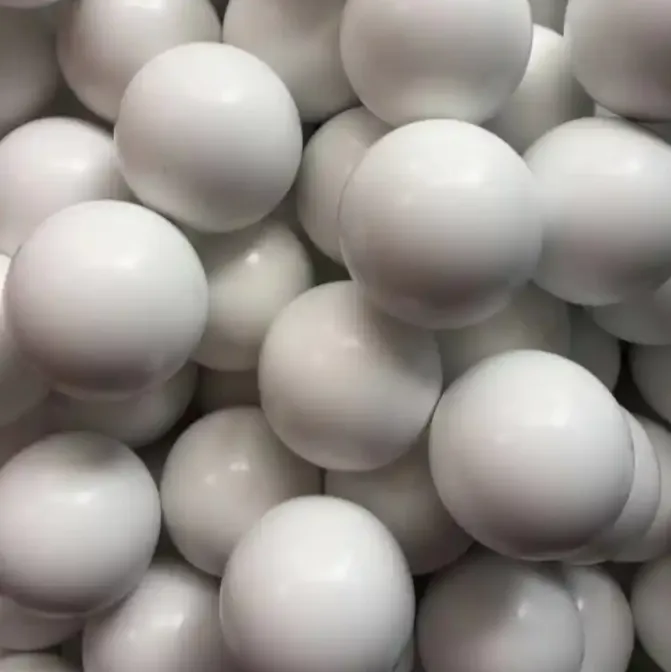
Why are ASTM catalyst support alumina balls such a critical purchase in the USA?
In many US plants, inert ceramic balls sit at the bottom of the reactor in a role that looks simple but carries high consequence. They support catalyst weight, protect support grids, improve flow distribution, and help stop catalyst migration into lower sections of the vessel. If these balls fail, crack badly, or carry the wrong size distribution, the result can be pressure drop problems, poor flow distribution, damaged internals, or expensive rework during a turnaround.
What do top-ranking market pages usually say, and what do they often miss?
Most high-visibility product pages in this sector focus on these points:
- High crush strength.
- Inert chemical behavior.
- Available ball sizes.
- Alumina percentage.
- Catalyst support use.
Those points are valid, but incomplete. In real procurement, we also need answers to these questions:
- Which ASTM methods were used in testing?
- Is there a single ASTM product standard, or only ASTM test methods?
- What lot traceability can the supplier provide?
- Are the balls made in the USA, stocked in the USA, or imported and warehoused domestically?
- What loading pattern is the reactor designed around?
- Does the plant need 17 percent alumina support balls, or a higher alumina grade?
Why does this matter so much?
Because reactor support media is often installed only during planned shutdown windows. A mistake in selection or delivery does not stay small. It becomes a schedule problem, a cost problem, and sometimes a process reliability problem.
Quick summary of what buyers actually need
| What many pages emphasize | What buyers and engineers also need |
|---|---|
| Alumina content | ASTM-linked test method clarity |
| “High strength” wording | Crush strength values by ball size |
| Generic catalyst support claim | Bed design and layer sizing logic |
| Product photo | Lot traceability and packaging control |
| Online price | Domestic stock and delivery timing |
| Standard sizes | Real tolerance and breakage data |
What are alumina ceramic balls, and how do they function under a catalyst bed?
Alumina ceramic balls, often called inert ceramic balls or catalyst support balls, are dense ceramic spheres made mainly from alumina and silica with controlled additives and firing conditions. Their main purpose is structural and hydraulic, not catalytic. They do not act like the active catalyst in the reactor. Instead, they create a stable support layer beneath it.
What do these balls do inside the reactor?
We use them to handle several tasks at once:
- Support the weight of the active catalyst bed.
- Protect support screens, grids, or nozzles.
- Help distribute liquid and gas flow through the lower section.
- Stop catalyst pellets or extrudates from falling into the bottom void space.
- Add thermal and chemical stability in severe process conditions.
Are they always placed only under the catalyst?
Mostly yes, though plant-specific designs vary. In many reactors, the largest balls go at the bottom, with progressively smaller balls placed upward until the upper support layer meets the catalyst bed. In some units, ceramic balls also appear in topping or hold-down roles, though that is a different design conversation and should not be assumed.
Simple definition for featured snippet style use
ASTM catalyst support alumina balls are inert ceramic spheres placed beneath catalyst beds to support reactor load, protect internals, and improve fluid distribution. US buyers usually verify crush strength, bulk density, porosity, size tolerance, and composition using ASTM test methods plus plant-specific requirements.
Functional breakdown
| Function | Why it matters in service | Typical failure risk if wrong |
|---|---|---|
| Mechanical support | Carries catalyst bed load | Broken media, bed settlement |
| Internals protection | Shields grids and nozzles | Hardware damage |
| Flow distribution | Supports uniform gas or liquid movement | Maldistribution, channeling |
| Catalyst retention | Prevents catalyst drop-through | Fines loss, contamination below bed |
| Thermal stability | Handles hot process conditions | Cracking or spalling |
Which ASTM-linked properties should engineers verify before approving a manufacturer?
One of the most misunderstood issues in this market is ASTM language. Many buyers assume there is one single ASTM specification that defines all alumina ceramic catalyst support balls. In practice, the market usually works differently. Plants often reference ASTM test methods together with manufacturer product data and internal acceptance limits. That distinction is important.
Is there one universal ASTM product standard for catalyst support balls?
Usually no. What we often see in US purchase documents is a combination of:
- Manufacturer specification sheet.
- Plant or licensor specification.
- ASTM test methods used to verify physical properties.
- Lot-based certificate of analysis.
This is a useful point because it helps us ask better questions. Instead of asking only “Is this ASTM?” we should ask “Which ASTM methods were used, and what are the acceptance values?”
Which ASTM-linked tests show up most often?
The exact set varies by project, but the market commonly refers to ASTM methods related to crush strength, density, porosity, and ceramic physical properties. ASTM D4179 is widely cited in catalyst and catalyst carrier discussions when single pellet crush strength matters. Ceramic density and porosity methods from ASTM refractory testing are also frequently referenced, depending on the supplier and the product form.
Practical ASTM review table
| Property | Why buyers check it | Common ASTM-linked method type buyers may see | What to confirm |
|---|---|---|---|
| Single ball crush strength | Shows load-bearing ability | ASTM D4179 often appears in catalyst carrier discussions | Ask whether data is per ball size and lot |
| Bulk density | Influences bed weight and reactor loading | Ceramic density methods, often ASTM-linked | Confirm loose and packed data if relevant |
| Apparent porosity | Affects mechanical stability and liquid hold-up behavior | Refractory ceramic property methods | Ask test conditions |
| Water absorption | Helps indicate fired density quality | Ceramic property methods | Request actual result, not “low” only |
| Chemical composition | Shows alumina and silica balance | Lab analysis, producer controlled | Confirm Al2O3 and SiO2 ranges |
| Size tolerance | Protects bed design and flow path | In-house dimensional QA, sometimes linked with standard measurement practice | Ask tolerance band by size |
| Thermal shock or temperature capability | Important in severe duty | Supplier specific plus standard ceramic practice | Ask whether application history supports claim |
What should we ask the manufacturer directly?
We recommend asking these exact questions:
- Which ASTM methods were used in your test report?
- Are results lot-specific or historical typical values?
- Is crush strength reported by individual ball size?
- What is the test sample size?
- What tolerance is applied to diameter?
- What breakage rate is allowed before shipment?
- Can you provide certificate of analysis with lot number?
A strong manufacturer or stockist should answer those points clearly.
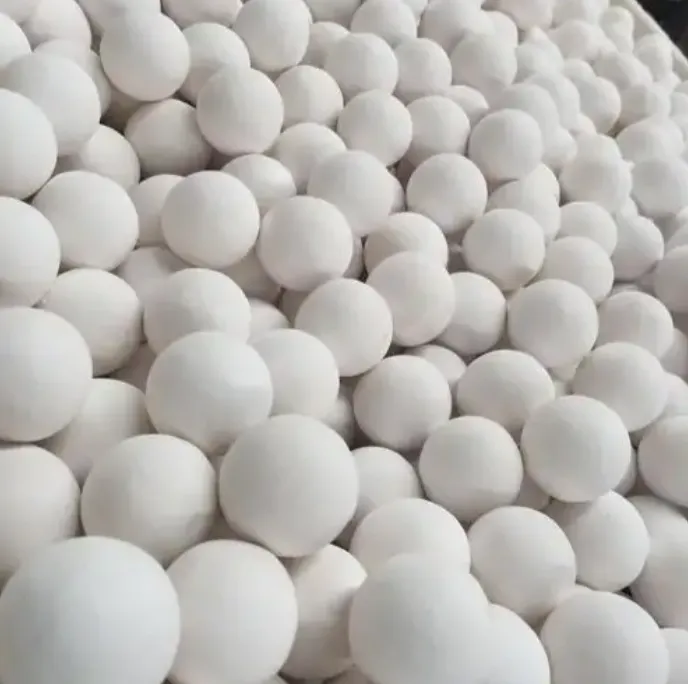
Which alumina grades, ball sizes, and support layers are common in US plants?
US buyers usually select alumina ceramic balls by three main variables:
- Alumina content.
- Ball diameter.
- Layer arrangement inside the vessel.
Which alumina grades are common?
The market often groups these products into lower alumina inert balls and higher alumina support media.
| Grade family | Typical Al2O3 level | Common use case | Main reason buyers choose it |
|---|---|---|---|
| Standard inert support balls | Around 17 to 23 percent | General catalyst support in many refinery and chemical duties | Cost-effective and widely used |
| Mid to high alumina balls | Around 45 to 68 percent | More demanding chemical or thermal service | Better chemical and thermal resistance |
| High alumina support media | Around 90 to 99 percent | Severe temperature, corrosive service, premium applications | Higher strength and purity |
Is higher alumina always better?
Not always. This is one of the biggest buying myths. Many refinery underbed support applications run very well on standard low alumina inert ceramic balls. Higher alumina grades cost more and should be selected when the duty justifies them, such as higher temperature, more aggressive chemistry, or stricter purity targets.
What ball sizes are common in the USA?
US plants often work in inch-based language, though metric equivalents are common in data sheets.
| Nominal size | Approx. metric | Typical role in bed |
|---|---|---|
| 1/8 inch | 3 mm | Upper fine support layer in selected designs |
| 1/4 inch | 6 mm | Upper support layer beneath catalyst |
| 3/8 inch | 10 mm | Transition layer |
| 1/2 inch | 13 mm | Transition or upper structural layer |
| 3/4 inch | 19 mm | Mid support layer |
| 1 inch | 25 mm | Lower support layer |
| 1.5 inch | 38 mm | Bottom support layer |
| 2 inch | 50 mm | Deep lower support in large vessels |
How are support layers usually arranged?
The general principle is large at the bottom, smaller toward the top. Exact design depends on catalyst size, support grid opening, flow direction, vessel diameter, and licensor requirements.
| Typical layer order from bottom to top | Why it is used |
|---|---|
| 2 inch, 1 inch, 1/2 inch, 1/4 inch | Broad load transfer and catalyst retention |
| 1.5 inch, 3/4 inch, 3/8 inch | Common in medium vessels |
| 1 inch, 1/2 inch, 1/4 inch | Compact arrangement in smaller reactors |
| Custom graded mix | Used when licensor or OEM specifies a unique profile |
We should never assume a standard layer sequence without checking the reactor design package.
Also read: Alumina Ceramic Ball Price.
How do USA manufacturers, stockists, and import channels differ when sourcing support media?
The phrase “Alumina Ceramic Ball Manufacturers USA” can mean several very different things in the market. Some sellers own domestic production. Others stock imported media in US warehouses. Others act as project distributors and source only after order confirmation.
Why does this distinction matter?
Because it changes:
- Lead time
- Lot traceability.
- Technical accountability.
- Price structure.
- Replacement speed if there is a shortage or damage issue.
Types of suppliers active in the USA
| Seller type | What they usually provide | Main strength | Main risk to review |
|---|---|---|---|
| Domestic manufacturer | US-made ceramic balls, direct QA control | Better plant visibility and often stronger traceability | Lead time if kiln schedule is full |
| US stockist | Domestic warehouse inventory | Fast turnaround shipment | Limited size or grade range |
| Importer with US stock | Imported product already in US warehouse | Broader brand access and quick shipment | Need to confirm lot consistency |
| Project distributor | Sources after PO | Flexible commercial sourcing | Longer or uncertain lead time |
| Reactor internals or catalyst service contractor | Bundled supply and loading support | Good field coordination | Media choice may follow package convenience |
How can we tell whether a seller is a true manufacturer?
Ask these questions:
- Where is the production plant located?
- Are you firing and grading the balls in-house?
- Can you provide plant-level QA documents?
- Can you offer lot traceability back to the kiln run?
- What domestic stock is available right now?
If the answers stay vague, the business may be distribution rather than manufacturing. That is not necessarily bad, but we should know the difference.
Which US regions matter most?
Demand is strongest in refinery and chemical corridors such as:
- Texas Gulf Coast.
- Louisiana.
- Oklahoma.
- Midwest refining and petrochemical zones.
- California process industry clusters.
- Gulf and East Coast chemical terminals.
That means stock position in Houston, Baton Rouge corridor, or nearby hubs can affect real turnaround performance far more than a nominal unit price difference.
Which industries in the USA use alumina ceramic catalyst support balls most often?
Support media is a mature product across several industries. The biggest demand comes from operations that rely on fixed-bed reactors, adsorber vessels, or high-temperature packed sections.
Major application sectors
| Industry | Typical equipment | Why alumina ceramic balls are used |
|---|---|---|
| Oil refining | Hydrotreaters, hydrocrackers, reformers, guard beds | Support catalyst and protect internals |
| Petrochemicals | Fixed-bed reactors, process vessels | Stable under chemical and thermal duty |
| Natural gas processing | Adsorber or reactor support sections | Bed support and flow distribution |
| Fertilizer | Ammonia and related process units | High temperature and mechanical support role |
| Hydrogen and syngas | Reactor support and protective underbeds | Good strength and chemical inertness |
| Sulfur recovery | Process vessel support media | Heat resistance and durability |
| Specialty chemicals | Fixed-bed catalytic systems | Controlled flow support |
| Environmental process units | Adsorbent and catalyst support | Stable inert media under varied conditions |
Are these balls only for catalyst support?
No. In some systems, similar balls are also used beneath adsorbents, molecular sieves, or other packed media. Still, catalyst support remains the most common search intent behind this product title.
How do crush strength, porosity, acid resistance, and thermal shock influence service life?
This is where technical selection gets serious. A support ball that looks fine in a brochure may still be wrong for the duty if one of these properties is missed.
Why is crush strength so important?
Crush strength tells us how well the media resists mechanical failure under bed load. Large balls in the lower layer carry the highest structural burden. If they are too weak, they can fracture, create fines, settle unevenly, and disrupt the support structure.
Why does porosity matter?
Higher porosity may reduce density, but too much open porosity can reduce mechanical integrity and alter liquid hold-up behavior. Dense, well-fired balls generally perform better in demanding support roles.
What about acid and alkali resistance?
Chemical resistance matters in units with corrosive vapors, acidic condensates, or challenging process chemistry. Support media is called inert for a reason, but inert is not the same thing as universal immunity. Chemistry still matters.
Why should we ask about thermal shock?
Reactors and process vessels do not always heat and cool gently. Rapid startups, shutdowns, steam-outs, and process upsets can stress the media. Higher purity and better firing quality often help.
Property comparison matrix
| Property | Why it matters | Low risk sign | Warning sign |
|---|---|---|---|
| Crush strength | Mechanical survival under load | Size-specific high values with lot data | Only generic “high strength” language |
| Apparent porosity | Indicates fired structure quality | Controlled, repeatable range | Wide variation |
| Water absorption | Often reflects density quality | Low and consistent | High or unstated |
| Alumina content | Purity and chemical resistance | Clear composition range | Vague grade label only |
| Silica and impurities | Chemical and thermal stability | Controlled impurity limits | No chemical breakdown provided |
| Thermal stability | Survives cycles and heat | Application history plus test data | Broad marketing claim only |
What is often missed in procurement?
Buyers sometimes compare only alumina percentage. That is incomplete. A 23 percent alumina ball from one producer may outperform a superficially similar product from another if firing quality, crush strength, and size consistency are better.
How do loading pattern, support depth, and bed hydraulics affect reactor performance?
Even excellent support media can perform poorly if the layer design or loading practice is wrong. This topic is often overlooked on product pages, yet engineers care about it immediately.
Why do bed hydraulics matter?
The support section should allow process flow while holding the catalyst bed stable. If the transition from large balls to small balls is poorly designed, we may see:
- Maldistribution
- Excess pressure drop
- Catalyst migration
- Support screen stress
- Bed settling
What should loading crews pay attention to?
- Correct layer sequence.
- Uniform spreading.
- Clean reactor internals before loading.
- Avoiding mixed sizes unless approved.
- Preventing damage from dropping media from excessive height.
- Confirming support depth against drawing.
Common loading errors and their consequences
| Loading error | Likely result |
|---|---|
| Wrong size order | Poor support transition |
| Too little depth | Internals exposure and load concentration |
| Excess fines or broken balls | Higher pressure drop |
| Mixed lots without review | Unpredictable bed behavior |
| Rough loading practices | Premature breakage |
| Using generic layout instead of design drawing | Poor flow performance |
Is there one universal support depth?
No. Support depth depends on reactor size, flow path, catalyst type, support plate design, and licensor rules. That is why we should never buy media by habit alone.
What documentation, QA records, and traceability should procurement teams request?
A strong document package separates a controlled industrial supply job from a risky commodity purchase.
Minimum documents we recommend
| Document | Why it matters |
|---|---|
| Technical data sheet | Defines product and typical values |
| Certificate of analysis | Confirms lot-specific data |
| Chemical composition report | Validates alumina and impurity ranges |
| Size distribution report | Confirms grading accuracy |
| Crush strength data | Shows mechanical capability |
| Packing list | Controls shipment quantity |
| Lot or batch identification | Enables traceability |
| Country of origin statement | Important in sourcing and qualification |
| Quality certificate or conformity statement | Confirms match to PO |
| Safety information | Useful during handling and storage |
What should receiving teams inspect on arrival?
We should check:
- Pallet condition
- Bag or drum integrity.
- Lot labels
- Size marking.
- Signs of excessive breakage.
- Quantity against packing list.
- Moisture or contamination exposure.
Why does lot traceability matter?
If there is a field complaint, traceability lets us isolate the issue quickly. Without it, one small quality problem can become a plant-wide dispute.
How do alumina ceramic balls compare with porcelain, quartz, silicon carbide, and metal support media?
Alumina ceramic balls dominate catalyst support duty, yet buyers sometimes compare alternative materials when cost, chemistry, or temperature shifts.
| Material | Main strength | Main limitation | Typical fit |
|---|---|---|---|
| Standard alumina ceramic balls | Strong balance of cost, inertness, and support strength | Not the top option in every extreme chemistry case | General catalyst support duty |
| High alumina ceramic balls | Better purity, heat resistance, and strength | Higher cost | Severe service, premium units |
| Porcelain media | Lower cost in selected uses | Lower performance in harsher duty | Mild service only |
| Quartz media | Useful in certain chemical environments | Lower mechanical versatility in many catalyst support roles | Niche applications |
| Silicon carbide media | Excellent heat and abrasion resistance | Higher cost and more specialized use | Severe thermal or abrasive duty |
| Metal support media | High load tolerance | Corrosion and chemistry concerns, not inert in the same way | Special engineered cases |
Why does alumina stay dominant?
Because it combines mechanical reliability, chemical stability, broad operating history, and cost practicality. In most fixed-bed catalyst support roles, it remains the default choice.
What pricing, stock, and logistics factors shape the real landed cost in the USA?
Headline unit price rarely tells the full story. Real cost is shaped by several variables.
Main commercial factors
| Factor | How it affects cost | What buyers should ask |
|---|---|---|
| Alumina grade | Higher purity usually costs more | Is premium grade truly required? |
| Ball size mix | Complex graded orders affect pricing | Is layer mix optimized? |
| Domestic stock position | Local stock may cost slightly more | Does it reduce shutdown risk? |
| Packaging type | Stronger packaging can raise cost slightly | Does it cut breakage loss? |
| Quantity | Full truckload or large volume lowers unit cost | Can orders be consolidated? |
| Testing and documentation | Special reports can add cost | Which records are mandatory? |
| Delivery term | Ex works and delivered site differ greatly | Are freight and unloading included? |
| Urgency | Shutdown demand often raises cost | Can we reserve stock early? |
Why can the lowest quote become the costliest decision?
Because a late or unsuitable support ball shipment can delay catalyst loading crews, reactor close-up, hydrotest, startup, and revenue return. In plant economics, that delay usually costs more than the media itself.
What mistakes cause reactor support media failure or purchasing delays most often?
We see the same errors repeatedly.
Common procurement mistakes
- Assuming “ASTM” means one universal product standard.
- Comparing only alumina percentage.
- Ignoring crush strength by ball size.
- Buying without confirming layer design.
- Accepting vague stock claims.
- Missing lot-specific test data.
- Ordering too late in the turnaround schedule.
- Forgetting to check breakage and packaging method.
- Mixing suppliers without engineering review.
- Overspecifying high alumina when lower alumina would work just as well.
Common field mistakes
- Rough loading that cracks media.
- Wrong size sequence in the support bed.
- Incomplete cleaning of reactor bottom before loading.
- Using generic depth instead of design depth.
- Ignoring broken-ball percentage on receipt.
These are avoidable with basic discipline.
How should we choose the right alumina ceramic ball manufacturer in the USA step by step?
A structured approach is far better than buying by habit or by the last supplier used.
Step 1: Define the reactor duty
We should document:
- Reactor type
- Operating temperature.
- Process chemistry.
- Catalyst type and size.
- Support plate opening.
- Required bed depth.
- Loading schedule.
Step 2: Define the media specification
This usually includes:
- Alumina content
- Ball sizes
- Layer arrangement.
- Minimum crush strength.
- Porosity or water absorption limits.
- Documentation requirements.
- ASTM test method references if the plant uses them.
Step 3: Separate manufacturer claims from stock reality
| Question | Why it matters |
|---|---|
| Is the product made in the USA or stocked in the USA? | Affects traceability and lead time |
| What quantity is available now? | Protects shutdown schedule |
| Can you provide lot-specific COA? | Confirms real quality control |
| Which ASTM methods support your data? | Prevents meaningless “ASTM compliant” wording |
| What packaging method is used? | Reduces breakage risk |
Step 4: Compare offers on one normalized sheet
| Comparison point | Supplier A | Supplier B | Supplier C |
|---|---|---|---|
| Alumina grade | |||
| Size mix | |||
| Crush strength by size | |||
| Porosity | |||
| ASTM-linked methods stated | |||
| Lot-specific COA | |||
| Stock location | |||
| Delivery time | |||
| Packaging type | |||
| Delivered cost |
This simple matrix prevents apples-to-oranges buying.
Step 5: Align purchasing with loading planning
Do not buy support balls in isolation. Coordinate media arrival with:
- Reactor entry schedule.
- Internals inspection.
- Catalyst loading crew timing.
- Lift plan and staging area.
- Spare quantity allowance.
That coordination often makes the difference between smooth execution and a shutdown delay.
Why does supplier content quality matter when choosing catalyst support media?
A serious manufacturer or stockist should be able to explain more than “high alumina, high strength.” Good technical content signals real competence. Weak content usually stops at generic claims.
Signs of credible technical content
- Clear distinction between product grade and test method.
- Real discussion of crush strength, porosity, and size control.
- Practical notes on loading and layer design.
- Honest explanation of stock versus made-to-order supply.
- Lot traceability language.
- Documentation clarity.
At AdTech, we believe that content should help an engineer make a better decision, not simply fill a page. That approach tends to match what modern search systems reward, and more importantly, it helps buyers reduce operational risk.
FAQs about alumina ceramic ball manufacturers in the USA and ASTM catalyst support
Catalyst Support Media FAQ: US Standards
ASTM Methods, Reactor Loading, and Media Specifications
1. What are alumina ceramic balls used for in catalyst service?
They act as inert support media. Positioned at the bottom (and sometimes top) of the reactor, they support the heavy catalyst bed, protect internal screens, ensure even flow distribution of reactants, and prevent the catalyst from migrating into the downstream piping.
2. Are alumina ceramic balls the same thing as catalyst?
3. Is there one ASTM standard for all support balls?
There is no single universal “product” standard. Instead, engineers rely on ASTM test methods (like D4179 or C373) combined with individual plant specifications and manufacturer-guaranteed properties to qualify the media for service.
4. Which ASTM method is linked with crush strength?
ASTM D4179 is the most common reference for single-pellet crush strength. It defines how to measure the force required to crush the ball. High crush strength is vital in tall US reactors where the weight of the catalyst bed can exert massive pressure on the support layer.
5. What alumina percentage is most common?
6. Does higher alumina always mean better performance?
7. What ball sizes are commonly used in US reactors?
US refineries typically use graded loading. Common sizes range from 1/8″, 1/4″, 1/2″, 3/4″, 1″, up to 2″. The sizes are layered—largest at the bottom near the screen and smallest directly under the catalyst—to ensure a smooth flow transition.
8. How to verify a real US manufacturer?
Verify their Quality Management System (ISO 9001) and ask for lot-specific QA documentation. A legitimate manufacturer should provide Traceability Reports that link the finished product directly back to the raw material batch and firing run.
9. What documents should come with the shipment?
- Technical Data Sheet (TDS): Nominal specs.
- Certificate of Analysis (COA): Actual test results for the lot.
- Chemical Composition Report: Alumina and Silica levels.
- Crush Strength Data: Average and minimum values.
10. What is the biggest buying mistake?
What should buyers remember before placing the final order?
Alumina ceramic balls used in ASTM-linked catalyst support duty are a technical reactor component, not a low-risk commodity. We should verify grade, size mix, crush strength, porosity, test method references, lot traceability, packaging quality, and stock location before issuing a purchase order. We should also align the purchase with the reactor loading plan, not treat it like a routine warehouse buy. In the USA, the strongest source is usually the manufacturer or stockholding supplier that can prove quality with data, prove availability with real inventory, and prove accountability with clear documentation.