

Alumina ceramic ball filter media are high-purity aluminum oxide spheres engineered to provide durable, inert, and thermally stable support for filtration, catalyst beds, gas distribution, and moisture removal. They deliver long service life with minimal abrasion, low contamination risk, and predictable pressure-drop behavior, making them a preferred choice for petrochemical reactors, water treatment beds, industrial dryers, and metallurgical filtration. When chosen with the correct alumina grade and packing strategy, these spheres reduce maintenance frequency, improve process uptime, and lower total operating cost.
1. What are Alumina Ceramic Ball Filter Media?
Alumina ceramic ball filter media are engineered spheres made predominantly from Al₂O₃. Their intended role is to act as a stable bed layer that supports filter elements or catalyst pellets, smooths gas or liquid flow, and resists mechanical wear under thermal cycling. These spheres come in multiple purity levels and density classes that determine mechanical strength and chemical resistance.
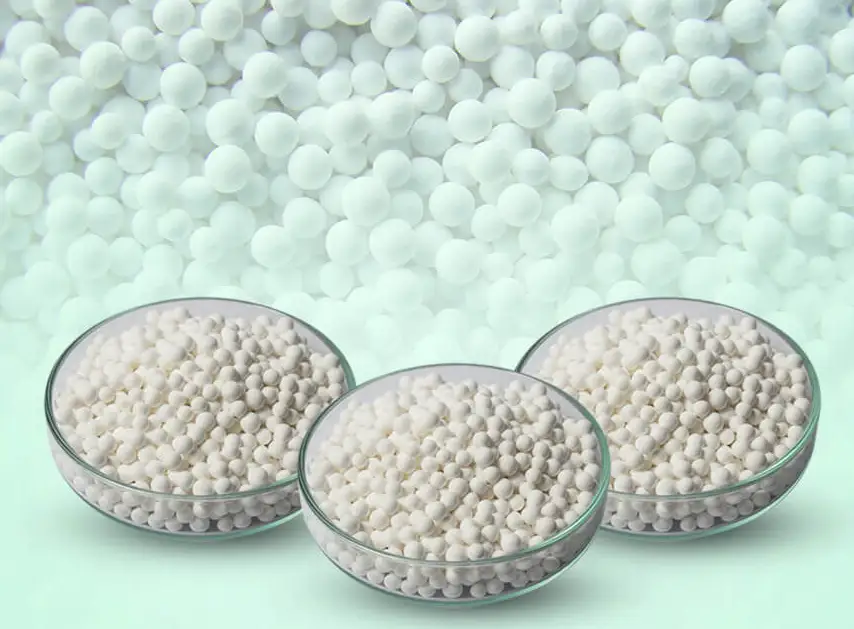
2. Material chemistry and common alumina grades
Alumina used in ball media typically appears in commercial grades expressed by percent Al₂O₃ content. The common grades are:
-
High-purity (near 99% Al₂O₃) for highly corrosive, high-temperature service. These have very low impurity content and low porosity.
-
Technical purity (92% to 95% Al₂O₃) offering an attractive balance of performance and cost for many support and grinding roles.
-
Activated or porous alumina forms exist for adsorption tasks; those provide surfaces that capture moisture or specific contaminants.
Chemical impurities commonly listed on data sheets include SiO₂, Fe₂O₃, CaO, MgO, Na₂O. Lower impurity content improves chemical inertness and reduces risk of product contamination.
3. How manufacturing affects performance
The route used to make spheres influences density, pore structure, and strength. Typical steps include powder preparation, pressing or forming, binder burn-out, and sintering at high temperature. Variables that matter:
-
Sintering temperature and hold time control grain growth and porosity. Higher temperature typically yields denser, stronger balls.
-
Forming technique (isostatic pressing, extrusion, or wet casting) determines dimensional tolerance and surface finish.
-
Post-process machining or glaze can reduce surface roughness, lowering pressure drop for gas flow beds.
Choosing a supplier that publishes production details and test data reduces risk of receiving underperforming stock.
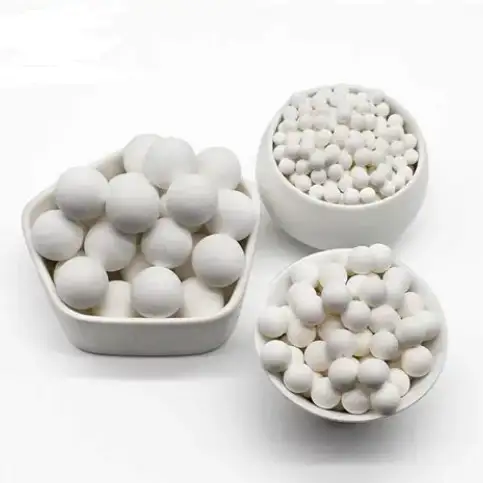
4. Physical and mechanical properties (table)
Below is a concise technical comparison table that product pages and spec sheets should present for buyer clarity.
| Property | Typical range or value | Why it matters |
|---|---|---|
| Al₂O₃ content | 92% / 95% / 99% | Higher content increases chemical and thermal stability. |
| Bulk density | 3.5 to 3.9 g/cm³ (depends on grade) | Denser media resist attrition and packing collapse |
| Water absorption | ≤0.1% to 1% | Low absorption signals dense microstructure and less contaminant uptake. |
| Hardness | Mohs 8 to 9 | High hardness reduces wear and contamination of processed streams |
| Thermal stability | up to 1600°C for high grade | Use for high temperature reactors or thermal regeneration cycles. |
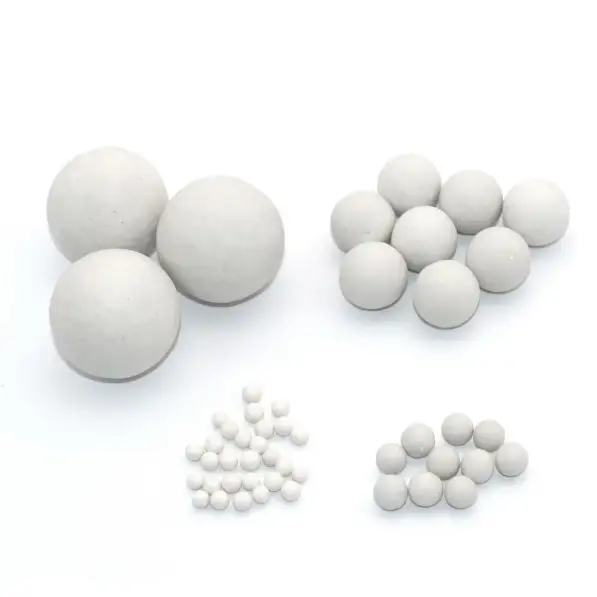
| Typical ball sizes | 3 mm to 40 mm (common catalog items) | Size selection governs void fraction and pressure drop. |
| Typical porosity | Near zero (inert balls) to controlled porosity (activated) | Determines adsorption capability if that function is required. |
For manufacturing certificates, request a laboratory test report showing bulk density, water absorption, and phase composition.
5. Performance benefits that matter to users
-
Longevity and low abrasion: Dense alumina resists mechanical breakdown, which lowers fines generation and filter blockage.
-
Thermal resilience: Stability during rapid temperature swings preserves bed geometry and maintains flow characteristics.
-
Chemical inertness: Low reactivity reduces risk of contaminating a catalytic process or product stream.
-
Predictable pressure drop: Smooth, spherical geometry and controlled size distribution let engineers calculate headloss accurately during design.
These advantages convert into fewer interventions, better product quality, and lower life cycle expenditures.
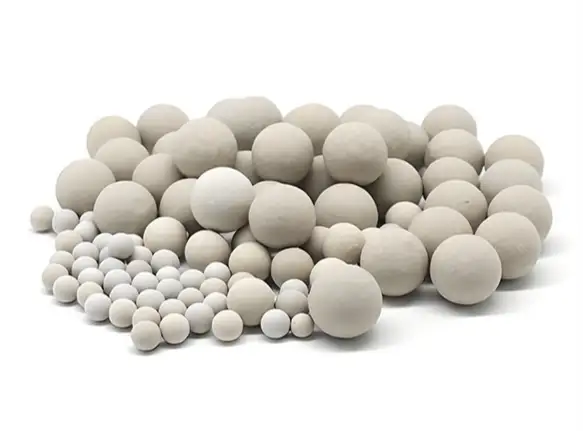
6. Typical industrial uses and packed bed arrangements
Alumina spheres populate many installations where stable, inert bed support is needed. The following matrix summarizes common matches.
| Sector | Functional role | Typical ball grade / size | Notes |
|---|---|---|---|
| Petrochemical and refining | Catalyst support, redistributor | 95% to 99%, 6–25 mm | High temperature, low impurity grade required. |
| Water treatment | Support under filter layers, media separator | 92% to 95%, 5–20 mm | Use inert balls below filter sand to prevent washout. |
| Gas dryers and adsorbers | Bed support, flow smoothing | Activated alumina or inert balls, 3–12 mm | When adsorption required, choose activated variant. |
| Metallurgical filtration | Filtering molten metal flow support | High purity, dense balls, size per design | Thermal shock resistance critical for casting environments. |
| Chemical reactors | Packing between catalyst zones, distributing flow | 95%+, tolerance tight, 6–20 mm | Low abrasion protects catalysts from contamination. |
Engineers commonly place a coarse support layer of large diameter balls below finer catalyst pellets to prevent migration or channeling.
7. How to choose grade, diameter, and tolerance
Three primary selection axes exist: chemical purity, particle size, and mechanical tolerance.
-
Purity: For product streams sensitive to trace metals, choose 99% alumina or request certified low Fe content.
-
Size: Larger spheres increase void fraction, reducing pressure drop but increasing potential for pellet movement under vibration. Use packed bed calculations to balance headloss versus support.
-
Tolerance and sphericity: High sphericity yields lower pressure loss and uniform flow distribution. Tight tolerances reduce segregation during loading.
When possible, request a technical data sheet that lists bulk density, crushing strength, and water absorption.
8. Installation, bed packing, and hydraulic considerations
Good practice when placing alumina spheres:
-
Base support: Provide a flat, perforated support pan or distributor that keeps balls from passing into downstream piping.
-
Layering: Start with larger diameter balls as a base, then set smaller sizes if needed for flow transition.
-
Compaction: Avoid excessive tamping that could fracture brittle ceramics; gentle vibration can encourage settling without breakage.
-
Pressure drop: Calculate using packed bed models that incorporate sphere diameter and void fraction. Track differential pressure during commissioning; a sudden rise often indicates fines generation or clogging.
Documented commissioning records help track long-term performance and identify when replacement is economical.
9. Inspection, testing, and quality control
Buyers should insist on receiving or witnessing the following tests:
| Test | Purpose | Typical acceptance |
|---|---|---|
| Bulk density | Confirms density grade | Match supplier spec within tolerance. |
| Water absorption | Indicates porosity | Low absorption desired for inert balls. |
| Crushing strength | Predicts attrition resistance | Minimum value per application demand. |
| Chemical composition | Validates purity and impurity levels | Report Al₂O₃, SiO₂, Fe₂O₃ etc. |
| Thermal shock test | Confirms survivability under cycles | Pass criteria depend on operating range. |
Request a certificate of analysis for each shipment. Random sampling on receipt reduces risk of installing substandard media.
10. Comparison with alternative media
Alumina balls compete with materials including ceramic saddles, glass beads, stainless steel Raschig rings, and activated carbon spheres.
-
Versus metal support media: Alumina resists corrosion and high temperature better, but metal gives higher mechanical toughness under impact.
-
Versus glass beads: Alumina typically offers higher hardness and thermal endurance.
-
Versus activated carbon: Carbon adsorbs organics, while inert alumina supports structure or provides non-specific adsorption when activated.
Selecting a material depends on temperature, chemical exposure, required lifetime, and cost constraints.
11. Handling, storage, and safety
Ceramic balls are brittle. Recommended handling steps:
-
Store in a dry, covered area to prevent contamination.
-
Transport with cushioning to avoid chipping.
-
During loading, use controlled drops and avoid concentrated impacts on vessels.
-
Wear appropriate PPE when handling dust generated by breakage.
-
For calcined or activated media, follow safety data sheet for dust inhalation and disposal practices.
Environmental notes: Alumina is inert and nonhazardous under normal conditions; disposal is governed by local solid waste regulations.
12. Procurement, pricing drivers, and lifecycle cost
Cost drivers include alumina grade, ball diameter, tolerance, and production volume. High-purity 99% balls cost more than 92% grades due to raw material and sintering demands. Buying in bulk reduces per-unit cost. When evaluating suppliers, move beyond unit price and calculate:
-
Expected lifetime before significant fines or strength loss.
-
Downtime cost for bed replacement.
-
Freight and handling risks.
A higher upfront cost for premium balls often pays back through fewer maintenance interventions.
13. Product content structure example
-
Product overview with immediate statement of value (must include conclusion up front).
-
Quick spec table for engineers.
-
Performance features with short technical proofs or test results.
-
Use cases with recommended grades and sizes.
-
Installation notes and pressure drop guidance.
-
QA documentation and downloadable PDF certificate.
-
Buyer FAQs.
-
Contact and sample request form.
This structure helps both human readers and search algorithms find the most relevant content quickly.
14. FAQs
-
What is alumina ceramic ball filter media used for?
They function as support beds, redistributors, and inert packing in reactors and filters, helping stabilize flow while resisting wear. -
Which alumina grade should I choose for high temperature service?
Select near-99% Al₂O₃ grade because it offers the best thermal stability and lowest impurity levels. -
How do ball size and void fraction affect pressure drop?
Larger balls increase void fraction and typically lower pressure loss, while smaller balls give finer flow distribution but higher headloss. Use packed bed calculations for exact values. -
Can these balls be used in water filters?
Yes. Inert alumina balls provide solid bed support beneath sands or membranes, and activated variants can assist moisture or contaminant adsorption. -
How long will a typical alumina ball bed last?
Service life depends on mechanical load, thermal cycling, and chemical exposure. Dense, high-purity balls in benign conditions often last many years with minor attrition. -
What tests should I request from suppliers?
Ask for bulk density, water absorption, crushing strength, and full chemical composition. Certificates help validate quality. -
Do alumina balls release contaminants into product streams?
High-purity grades minimize this risk. Lower purity balls might contain trace metals; request composition data to confirm suitability. -
What handling precautions are necessary?
Avoid impact drops, store dry, and wear dust protection when loading to prevent inhalation of fine ceramic dust. Follow supplier safety data. -
How do ceramic balls compare with metal support media?
Ceramic balls resist corrosion and high temperature better; metal media excel under heavy mechanical impact. Choose by operating conditions. -
Can I get custom sizes and tolerances?
Many manufacturers produce custom diameters and tighter tolerances. Lead time and minimum order quantities vary by vendor.
References and where core facts came from
Key public technical references consulted while drafting this article include vendor datasheets and technical pages that report typical alumina ball composition, density, and usage notes. Representative sources: Across International product specifications, Christy Catalytics technical notes on T-99 alumina, manufacturer pages describing 92/95/99 grades, and specialist sites on activated alumina uses.